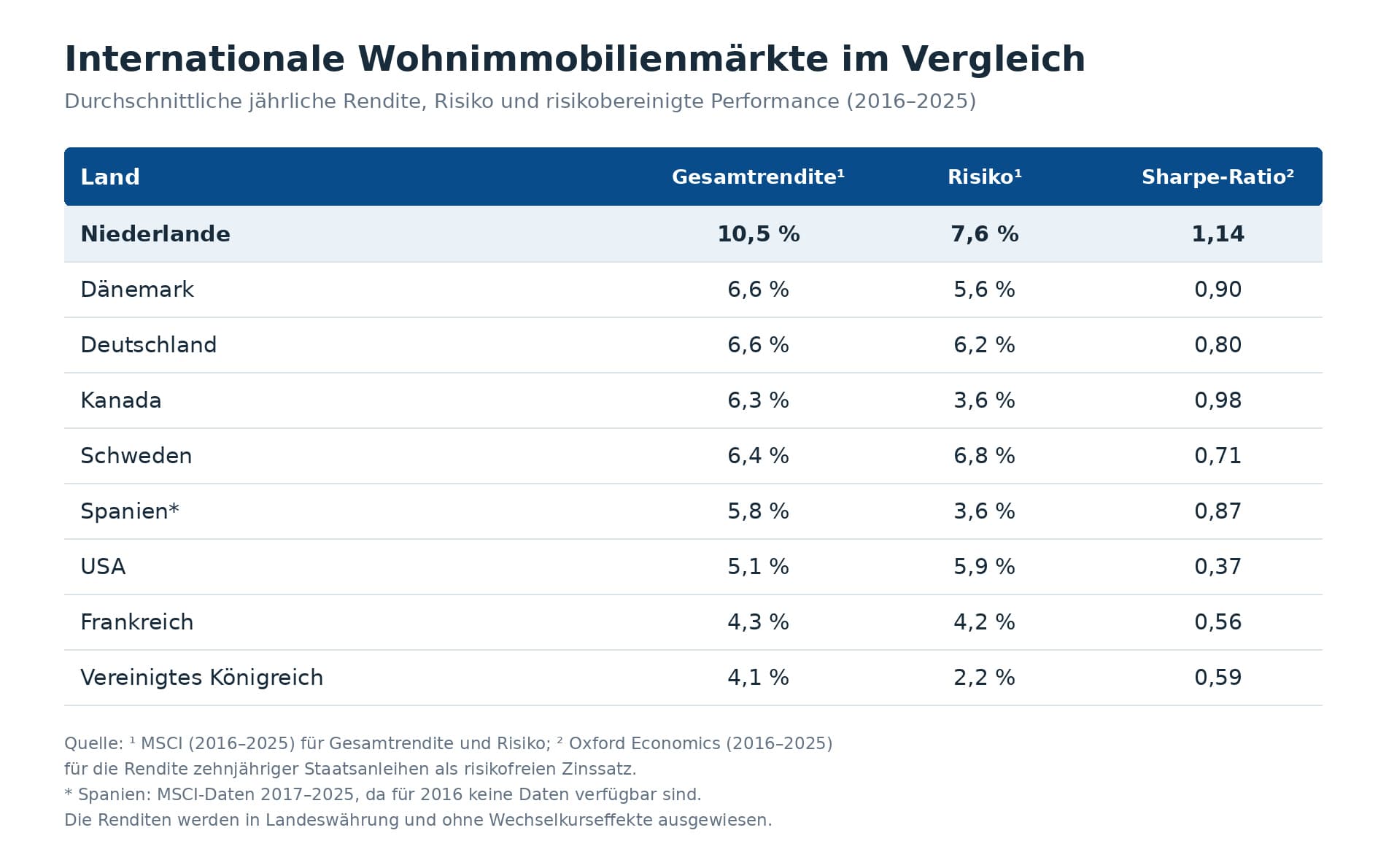
Over the past ten years, the Dutch residential property market has generated above-average returns by international standards. Between 2016 and 2025, Dutch core residential properties generated an average annual total return of 10.5 per cent at property level. This put them well ahead of comparable residential property investments in Denmark and Germany (6.6 per cent each), Sweden (6.4 per cent) and Canada (6.3 per cent). It also outperformed the markets in the US, France, Spain and the UK. These are the findings of the latest position paper, ‘The Case for Investing in Dutch Residential Real Estate’, which was initiated by Holland Metropole and the Dutch Association of Institutional Property Investors (IVBN) and compiled by Finance Ideas. The analysis is based, amongst other sources, on data from MSCI, INREV, Oxford Economics and GRESB.
Robbert van Dijk, Fund Director at a.s.r. real assets, explains: “The strong performance of Dutch residential property is down to the combination of stable, CPI-linked current income and significant capital appreciation. Over the period under review, the average annual yield stood at 3.3 per cent, whilst property values rose by an average of 7.1 per cent per year. This means that Dutch residential property recorded the highest average capital growth of all the countries examined. By way of comparison: in Germany, the average capital appreciation was 3.8 per cent per year; in Denmark, 3.6 per cent; and in Sweden, 3.4 per cent. These results reinforce our long-standing conviction that Dutch core residential property is an attractive asset class for institutional investors from a European perspective. High demand for housing, stable rental income linked to the CPI and an established investment market form a solid foundation for long-term investments.”
Even when the risk taken into account, the Dutch residential property market performed particularly well. With a Sharpe ratio of 1.14, it achieved the highest risk-adjusted return by international comparison. Furthermore, the study highlights the benefits of diversification for investors whose property portfolios are heavily weighted towards France, the UK, the US or Canada.
Within the Dutch property market, too, residential property outperformed other property types. Average annual total returns stood at 8.7 per cent for logistics and industrial property, 5.7 per cent for office property and 2.4 per cent for retail property.
Van Dijk adds: “Our flagship residential property fund, the ASR Dutch Core Residential Fund, has achieved an average annual total return of 10.3 per cent over the past ten years. We remain focused on sustainable, high-quality residential properties with a clear emphasis on affordable housing in the Netherlands’ strongest metropolitan areas and cities, both economically and demographically.”
The residential property market is characterised by a significant shortage of supply. “In a market with a shortage of housing, access to high-quality new-build flats is becoming increasingly important. Our in-house project development expertise, with a pipeline of 13,000 residential units, combined with targeted acquisitions on the market, enables us to continuously strengthen and renew the fund’s portfolio,” explains van Dijk. “This is a key distinguishing feature of our fund and an important competitive advantage for our investors.”
An established investment market offers opportunities for international capital
In addition to historical performance, there are further reasons to invest in the Dutch market. “For international investors, the size and institutional maturity of the Dutch residential property market are also significant. The value of residential property held by institutional investors stood at around 73 billion euros in 2025. “The transaction volume reached just under 10 billion euros in the same year, representing around 13 per cent of the institutional market volume,” explains van Dijk.
“International institutional investors will find a well-established and easily accessible residential property market in the Netherlands. The well-developed investment infrastructure, high market transparency and experienced market participants provide a reliable foundation for long-term investments,” said van Dijk.
In the 2026 Global Real Estate Transparency Index compiled by JLL and LaSalle, the Netherlands ranks fifth worldwide. Van Dijk adds: “The long tradition of institutional residential property investment in the Netherlands makes it easier for international investors to gain access to portfolios that have been built up over the past decades by Dutch institutional investors. This applies to the ‘ASR Dutch Core Residential Fund’, whose initial portfolio was built up over decades by a.s.r., the Netherlands’ second-largest insurance company. In 2013, a.s.r. used this existing residential property portfolio to launch the ASR Dutch Core Residential Fund. A large number of Dutch institutional investors invested in the fund, and over the years it has grown to its current size of around 2.4 billion euros and over 5,600 residential units.”
A structural housing shortage is underpinning long-term demand
A key factor affecting the long-term outlook for Dutch residential property is the persistent imbalance between housing supply and demand. According to the study, there is currently a shortfall of around 384,000 homes in the Netherlands. This corresponds to approximately 4.6 per cent of the total housing stock and is therefore significantly higher than the estimated European average of 3.5 per cent.
Van Dijk explains: “At the same time, demand for housing is likely to continue to rise – including in the affordable housing segment. Between 2025 and 2040, the number of households is expected to increase by more than 800,000, which corresponds to around 10 per cent. In addition to the rising number of households, the declining average household size is also contributing to this trend, particularly in urban areas.”
Construction activity remains insufficient to meet this growing demand. The Dutch government aims to complete or otherwise provide at least 100,000 additional homes each year. Between 2016 and 2025, however, the housing stock grew by an average of only around 80,400 units per year. The persistent shortage of supply is driving high demand for rental properties, low vacancy rates and very low levels of rent arrears. According to MSCI, the average vacancy rate in the Dutch residential property market over the past ten years was just 1.7 per cent.
New-build housing requires annual investment running into the billions
Significant additional capital is required to finance the planned expansion of the housing supply. According to estimates by the Dutch central bank, De Nederlandsche Bank (DNB), around 40 billion euros are required annually to meet the government’s target of 100,000 new homes per year. Of this, approximately 6.4 billion euros is allocated to the construction of privately financed rental homes outside the social housing sector, including affordable housing.
In 2025, Dutch institutional investors invested around 3.6 billion euros in this sector, thereby covering only just over half of the annual capital requirement. This funding gap highlights the importance of mobilising further private capital – particularly from international institutional investors.
At the same time, the Dutch government has taken initial steps to improve the framework conditions for residential property investment. The measures announced in September 2026 include a planned reduction in the land transfer tax for non-owner-occupied residential properties from 8 per cent to 7 per cent from 2027. Further proposals relate to adjustments to rent control, greater clarity regarding corporation tax exemptions for foreign pension funds, and targeted incentives for the construction of new rental flats in the mid-price segment. Several of these proposals still require further political decisions. Overall, however, they demonstrate that the importance of institutional capital in addressing the acute housing shortage is increasingly being recognised.
Van Dijk sums up: “The Dutch residential property market combines strong fundamentals, driven by a structural housing shortage, with an established institutional investment market and a long track record of attractive, stable long-term returns. The study highlights the opportunities the Dutch residential property market offers international investors, whilst also shedding light on the improving investment conditions. As a leading specialist in Dutch residential property, a.s.r. real assets aims to be the preferred partner for institutional investors. To this end, we offer both fund solutions and bespoke mandates. In addition, we have our own project development company with an extensive residential property pipeline, which enables us to convert capital commitments into profitable investments.”
About the study
The position paper ‘The Case for Investing in Dutch Residential Real Estate’ was published in October 2026. It is a joint initiative by Holland Metropole and IVBN and was prepared by Finance Ideas. The study examines historical performance, the structure of the institutional investment market and the long-term economic and demographic fundamentals of the Dutch residential property market. It draws, amongst other sources, on data from MSCI, INREV, Oxford Economics and GRESB.
You can download the full study HERE.