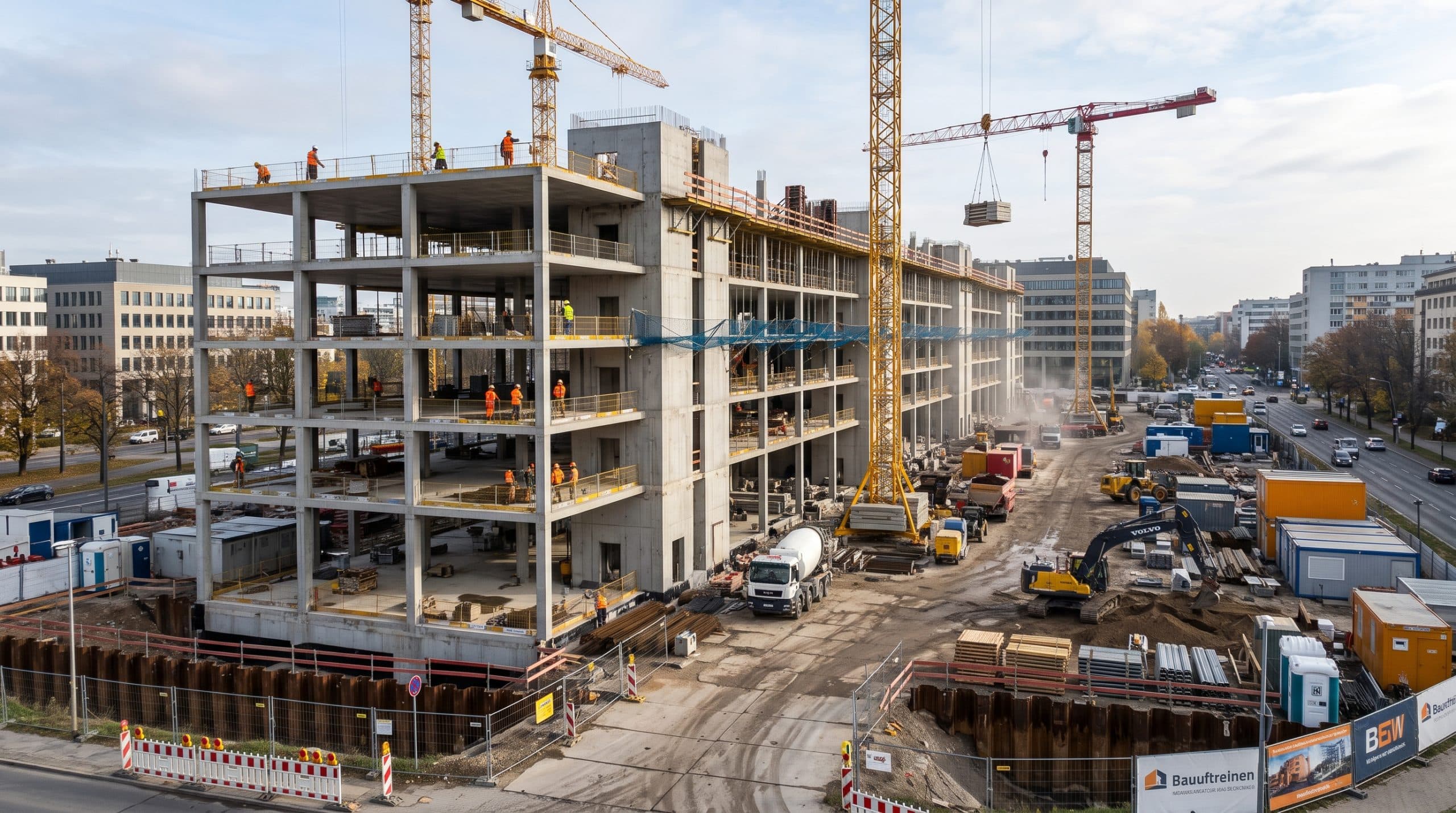
The results of the RICS Global Construction Monitor (GCM) for the third quarter of 2026 show that the overall Construction Sentiment Index (CSI) has fallen to +4 globally, down from +13 in the second quarter. This indicates a significantly weaker trend overall. In contrast to the previous quarter, when three of the four global regions reported an improvement, all four regions recorded weaker CSI figures this time. The outlook for credit conditions also became more restrictive once again. The net balance for the coming 12 months fell back into negative territory, having returned to a neutral level in the second quarter. Forward-looking expectations regarding construction output were scaled back across all three sectors. On a positive note, however, cost forecasts for the coming year have been revised downwards across all components. Nevertheless, they remain high by historical standards, and inflation continues to be frequently cited as a problem.
All four regions are experiencing a slowdown, with the Americas and Europe seeing the biggest changes
The Americas continue to have the highest CSI score of the four regions; however, the index fell significantly to +17 (from +29 in the second quarter), which is attributable to a marked loss of momentum in the US. Europe recorded a decline of a similar magnitude: the CSI fell to +5 (from +17), thereby reversing most of the improvement seen in the previous quarter. The Middle East and Africa (MEA) region proved to be the most resilient, weakening only slightly to +16 (from +19). Nevertheless, this points to more moderate growth than was seen throughout the previous year. The Asia-Pacific region (APAC) weakened further to -9 (from -2), remaining the weakest of the four regions. However, this reflects a deterioration in mainland China rather than a broad-based regional decline.
Sri Lanka and India top the country rankings, whilst France and China are losing ground
Sri Lanka recorded the strongest figure of all countries this quarter, with a net balance for current total construction volume of +52 per cent, following +10 per cent in the second quarter, representing a significant acceleration in construction activity. India followed closely behind at +51 per cent, continuing the consistently strong momentum seen across all three sectors in recent quarters. Nigeria was just behind at +46 per cent, whilst the Netherlands recorded a particularly solid figure in the third quarter. Elsewhere, growth in construction volume remains positive across a wide range of markets. Singapore recorded a net balance of +33 per cent, Germany +27 per cent, Italy +25 per cent and Ireland +24 per cent, with the figures for the latter two countries each being stronger than in the second quarter. The United Arab Emirates (UAE) improved to +18 per cent, and Saudi Arabia recorded +16 per cent, which continues to point to resilience in parts of the Middle East. New Zealand returned to growth with a net balance of +13 per cent, having recorded a decline in the previous quarter.
At the lower end of the scale were Australia (+1 per cent) and the United Kingdom (-2 per cent), where growth was largely stagnant, whilst Hong Kong recorded a net balance of -14 per cent.
The US recorded significantly less positive results. The net balance for total construction output there fell to +10 per cent from +33 per cent. Qatar deteriorated to -32 per cent, and Mauritius fell to -37 per cent, having recorded a clearly positive figure in the second quarter. China had been the weakest market for most of the past two years. However, France is now at a similarly weak level, with net balances of -57 per cent and -63 per cent respectively.
Looking at the individual sectors, infrastructure continues to perform better than the other market segments, although the global net balance for current infrastructure construction volume weakened to +15 per cent (from +23 per cent). Private construction activity in non-residential building fell slightly back into negative territory at -4 per cent (from 0 per cent), whilst private residential building continued to weaken to -13 per cent (from -6 per cent). Viewed more broadly, the net balance for new business enquiries fell from +13 per cent to -10 per cent, suggesting a weaker order pipeline in the coming quarters.
Forward-looking indicators have been withdrawn
In contrast to the upward revisions seen in the second quarter, respondents have consistently scaled back their expectations regarding construction volumes over the next 12 months. At a global level, the net balance for expected infrastructure construction volumes over the next 12 months fell to +30 per cent (from +45 per cent), although the sector continues to have by far the most positive outlook. Expectations for private non-residential construction were revised down to a net balance of +11 per cent (from +23 per cent), whilst expectations for private residential construction weakened to +8 per cent (from +15 per cent). Expectations regarding profit margins over the next twelve months, which had turned positive in the second quarter for the first time in over a year, fell back to a largely stagnant net balance of +1 per cent (down from +12 per cent).
At regional level, the MEA continues to show the strongest forward-looking figures. The net balance of expectations for infrastructure construction volume over the next 12 months remained unchanged at +46 per cent, whilst expectations for private non-residential construction stood at +32 per cent. Expectations in the Americas weakened, but remain clearly positive outside the private residential construction sector. In private residential construction, the outlook has now levelled off. In Europe, expectations for private non-residential construction were significantly revised downwards to a net balance of +5 per cent (from +30 per cent), and expectations regarding profit margins over the next twelve months turned negative. In APAC, expectations for both private sectors fell slightly below zero, whilst expectations for infrastructure remain positive with a net balance of +23 per cent.
Cost forecasts revised slightly downwards, but inflation remains a significant problem
Global cost forecasts for the coming 12 months were revised downwards across all components in the third quarter. The forecast increase in material costs for the coming year fell to 5.5 per cent (from 6.1 per cent in the second quarter). Expectations regarding labour costs for skilled and unskilled workers also fell slightly to 4.7 per cent and 3.4 per cent respectively. It is important to note that this merely represents a slightly less severe inflation outlook for materials and does not constitute a solution to the problem. In fact, material costs remain among the most frequently cited obstacles to construction activity. The net balance for current profit margins also deteriorated further to -27 per cent (from -19 per cent), suggesting that pressure on profitability is intensifying. Looking ahead, recent developments in oil and energy prices represent a clear upside risk to these forecasts and could once again affect inflation expectations in the coming quarters.
When it comes to obstacles to construction activity, material costs remain the most frequently cited factor. They were mentioned by 73 per cent of respondents (up from 69 per cent in the second quarter). The proportion of respondents citing financial constraints also rose to 72 per cent (up from 65 per cent). The most striking individual change concerned planning and regulation, which were cited by 48 per cent of respondents, compared with 39 per cent previously. Insufficient demand also gained in significance and was cited by 52 per cent (up from 47 per cent), whilst competition rose to 57 per cent (up from 53 per cent). Labour shortages remained unchanged at 47 per cent, whilst the shortage of skilled workers, at 54 per cent, remained at a similar level to previous quarters.
The outlook for lending conditions is set to become even tighter
Indicators of credit conditions deteriorated in the third quarter across all three time horizons. At a global level, the net balance of respondents reporting a deterioration in credit conditions over the past three months fell to -21 per cent (from -15 per cent in the second quarter). Looking ahead, the net balance for the next three months fell to -12 per cent (from -6 per cent), whilst the net balance for the next twelve months declined to -7 per cent, having returned to a neutral level in the second quarter. The deterioration was evident in every region and is consistent with the renewed rise in government bond yields across a number of major economies during the quarter, which has affected both the cost and the availability of project finance.
Europe: Regional outlook worsens as sentiment in France takes a sharp turn for the worse
The results of the Global Construction Monitor (GCM) for Europe in the third quarter of 2026 show a significantly weaker regional trend. The Construction Sentiment Index (CSI) fell to +5 (from +17 in the second quarter of 2026). This reverses most of the improvement reported three months ago, although the overall index remains slightly in positive territory. A marked deterioration in France is largely responsible for this trend, whilst the other markets surveyed generally recorded smaller declines. The financing environment also continued to deteriorate: indicators for credit conditions declined across all time horizons, and expectations regarding profit margins over the next 12 months turned negative once again.
The
CSI has weakened sharply in France, whilst most of the other countries surveyed recorded a moderate decline
At country level, France recorded by far the greatest change: the CSI fell to -56 (from -8 in the second quarter), the weakest reading recorded by any European market in the current cycle. The deterioration was widespread, with net balances of -50 per cent in private residential construction, -71 per cent in private non-residential construction and -67 per cent in the infrastructure sector. This points to a market in which construction activity has declined across all sectors. Elsewhere, the changes were more moderate. The Netherlands continues to post the strongest figure at +28 (down from +35), underpinned by very strong infrastructure activity with a net balance of +67 per cent. Germany weakened to +21 (down from +36), whilst Italy fell slightly to +5 (down from +10) and the UK remained largely stagnant at zero. Ireland was the only market surveyed to show an improvement: its CSI rose to +19 (from +12).
At sectoral level, current construction output in private residential construction strengthened, with the net balance rising to +11 per cent (from +5 per cent), whilst activity in private non-residential construction weakened to +4 per cent (from +11 per cent). Infrastructure construction output fell to +10 per cent (from +22 per cent), although both the energy and information and communications technology (ICT) sectors improved within this segment. More worrying is the sharp decline in new business enquiries, whose net balance fell to -8 per cent (from +29 per cent), accompanied by a deterioration in the current profit margin indicator to -26 per cent (from -7 per cent).
Financial constraints are becoming the most frequently cited obstacle
Financial constraints are now the most frequently cited problem amongst the factors hampering construction activity. They were mentioned by 70 per cent of respondents, compared with 60 per cent in the second quarter. This is in line with the indicators for credit conditions, which deteriorated further over the course of the quarter. Planning and regulation also became significantly more important, rising to 64 per cent (from 53 per cent). In contrast, the proportion of respondents citing labour shortages fell to 44 per cent (from 58 per cent), thereby reversing much of the sharp rise previously reported.
Forecasts for private non-residential construction are being revised downwards and profit prospects are turning negative
Expectations regarding construction activity over the next 12 months for private residential construction remained unchanged at a net balance of +23 per cent, whilst expectations for private non-residential construction were revised down significantly to +5 per cent (from +30 per cent). Expectations for infrastructure weakened to +22 per cent (from +33 per cent), but the sector still had the most positive outlook. Employment expectations fell to +11 per cent (from +20 per cent). Of particular significance is that expectations regarding profit margins over the next 12 months turned negative at -17 per cent, having stood at +13 per cent in the second quarter. This represents a complete reversal of one of the most encouraging developments in the previous survey.
Conclusion: Sentiment in the construction sector is weakening across all regions, but remains positive
Susanne Eickermann-Riepe FRICS, Senior Vice President (SVP) of RICS Worldwide: “The Global Construction Index has fallen compared with the previous quarter, but remains positive. All four regions are showing signs of a slowdown, with the Americas and Europe recording the most significant changes. In Europe, the downturn is attributable not so much to a loss of momentum in the Americas as to the pronounced weakness in France. The 12-month outlook has been significantly revised downwards compared with the previous quarter. In Europe, the sharp slump in private non-residential construction is a key factor. Infrastructure remains the sector with by far the most positive outlook. The 12-month cost forecasts have been revised slightly downwards, although inflation remains a significant problem. Material costs and financial constraints remain the most frequently cited obstacles. The outlook for profit margins has also deteriorated in light of developments in oil and energy prices. Despite the slowdown in momentum, the construction industry remains a sector that is viewed positively, particularly in Germany.”
Here is the link to the press conference:
https://us02web.zoom.us/rec/share/y-GiWYKjPwu9GOr8J3PGSeqk_Sfi_IkLCathXh2UK9I7QJx6PRchJUTMc25Fa2x-.osX0jQJ8zOgvSULd
Access code: v4J@8#b.