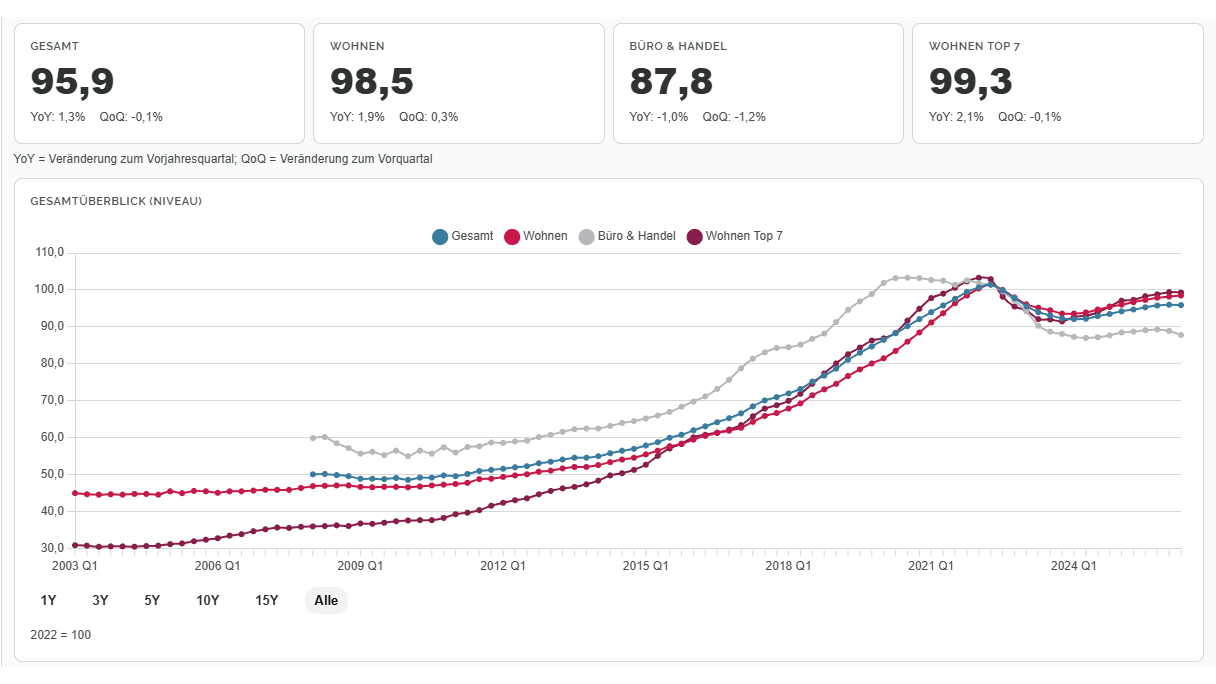
Property prices in Germany remained stable overall in the third quarter of this year: according to the property price index published by the Association of German Pfandbrief Banks (vdp), they rose slightly by 0.2 per cent compared with the same quarter last year. By contrast, property prices fell by 0.2 per cent overall compared with the previous quarter. This trend was characterised by a noticeable divergence between residential and office property prices.
Whilst residential property prices still showed year-on-year growth of 1.0 per cent, they remained largely unchanged quarter-on-quarter (-0.1 per cent). Prices for retail properties remained stable both over the past twelve months (0.0 per cent) and over the past three months (+0.1 per cent). Office property prices, by contrast, fell by 3.9 per cent year-on-year and by 1.0 per cent quarter-on-quarter in the third quarter of this year.
The data underpinning the vdp Index has been collected by vdpResearch since 2010 and covers price trends across the entire German market for residential, office and retail properties financed by banks. It is based on the analysis of actual property transaction data from more than 700 credit institutions – a feature that sets the vdp Index apart from many other price indices. Following a new collaboration between vdpResearch and the Deutsche Bundesbank, the index methodology for some sub-indices was adjusted at the start of this year. The year 2022 was defined as the new base year (index value = 100). The historical data has been adjusted to reflect the new methodology.
“Residential property prices are being buoyed by the continuing excess demand for housing.”
Jens Tolckmitt, Chief Executive of the vdp
“The current conditions in the property markets, including the significant rise in financing costs since the start of the year, are making property investment more difficult overall and, in particular, are causing office prices to fall,” explained Jens Tolckmitt, Chief Executive of the vdp. Residential property prices, on the other hand, are being supported by the continuing excess demand for housing.
Residential property: Prices for owner-occupied homes are the driving force
The rise in residential property prices was driven by owner-occupied homes, the price of which increased by 1.4 per cent overall compared with the third quarter of 2025. Detached houses rose by 1.3 per cent and flats by 2.3 per cent. Prices for multi-family dwellings rose by 0.5 per cent in the reporting period compared with the same quarter of the previous year. Compared with the second quarter of this year, there was virtually no change in prices across the residential property segments under review.
The situation in the rental market continued to worsen during the quarter under review: due to the significant shortage of housing, rents for new tenancy agreements for rental flats continued to rise sharply – by 3.5 per cent compared with the third quarter of 2025. As the rise in rents was thus significantly higher than the rise in prices for multi-family dwellings, yields – as measured by the vdp index for property yields – increased noticeably (+2.9 per cent) during the period under review.
“Germany needs more housing, reliable financing conditions and investment security – not ideological experiments at the expense of those looking for a home.”
Jens Tolckmitt, Chief Executive of the vdp
According to Tolckmitt, the situation on the German housing market, particularly in the major cities, is becoming increasingly acute. Against this backdrop, the vdp welcomes the federal government’s initiatives – the ‘Bau-Turbo’ and ‘Gebäudetyp E’ – aimed at enabling faster and more cost-effective construction. By contrast, he said, the ongoing debate about the nationalisation of private companies’ rental housing portfolios is extremely damaging. With regard to the coalition talks currently taking place at state level in Berlin between Die Linke, the Greens and the SPD, he warned: “The plans of the potential Berlin coalition partners jeopardise confidence in Germany as an investment destination and in the reliability of loan collateral. The discussion alone is leading to reluctance to invest and to finance property. Germany needs more housing, reliable financing conditions and investment security – not ideological experiments at the expense of those seeking accommodation,” Tolckmitt emphasised.
Residential Top 7[1]: Price rises strongest in Hamburg
Compared with the rest of Germany, residential property prices in the top seven cities showed a slightly stronger year-on-year increase: Berlin, Düsseldorf, Frankfurt am Main, Hamburg, Cologne, Munich and Stuttgart recorded an average price rise of 1.4 per cent compared with the same quarter of the previous year. Residential property prices rose most sharply in Hamburg (2.4 per cent), followed by Frankfurt am Main (1.6 per cent) and Cologne (1.4 per cent). Only Stuttgart saw a decline (-0.5 per cent). Compared with the second quarter of this year, all seven cities recorded negative rates of change – ranging from -0.4 per cent (Düsseldorf) to -0.9 per cent (Stuttgart).
The shortage of housing, which falls far short of meeting demand, led to a further rise in rents in the top seven cities in the third quarter of 2026: by an average of 3.0 per cent year-on-year. The range varied from 1.4 per cent (Stuttgart) to +4.1 per cent (Hamburg). Yields, as measured by the vdp Property Yield Index, rose by an average of 1.5 per cent in the top seven cities.
Office and retail property: Office yields rise by 6.7 per cent
Price trends in the commercial property market were mixed in the third quarter of 2026: whilst retail property prices remained stable both year-on-year and quarter-on-quarter, office property prices fell significantly in both cases: by 3.9 per cent year-on-year and by 1.0 per cent quarter-on-quarter.
By contrast, new office rental rates showed a further noticeable increase of 2.5 per cent compared with the same period last year. Retail properties also recorded an increase, with rents rising by 1.7 per cent. Based on price and rent trends, yields – as measured by the vdp property yield index – rose by 6.7 per cent for offices and by 1.8 per cent for retail properties.
“The trend in office property prices reflects the current challenging environment.”
Jens Tolckmitt, Chief Executive of the vdp
The significant rise in financing costs is currently weighing on both the residential and commercial property markets, explained Tolckmitt. In the commercial property market – and particularly in the office segment at present – external factors are also having a negative impact: “The trend in office property prices reflects the current challenging environment. In addition to geopolitical conflicts and the current economic downturn, structural changes – such as the rise in working from home – continue to hamper the office market.” As a result, demand for space remains subdued, whilst vacancy rates continue to rise. “Furthermore, the general interest rate environment is also leading to higher yield requirements on the part of investors.” The combination of all these factors makes the market environment challenging.
Interactive charts and the raw data for the individual vdp property price indices are available at https://www.vdpresearch.de/preisindizes/.
About the vdp Property Price Index
The Association of German Pfandbrief Banks (vdp) publishes quarterly rent and price indices, based on actual transactions, to track developments in the residential and commercial property markets. Since 2026, the vdp indices have been calculated partly using an adapted methodology developed by the Deutsche Bundesbank in collaboration with the vdp subsidiary vdpResearch. Both organisations are simultaneously publishing new, comprehensive indices on commercial property prices in Germany. These new indices are based on the market fluctuation database, which already exists for regulatory purposes, and draw on vdpResearch’s comprehensive transaction database – into which actual sales transactions (actual purchase prices and rents) from more than 700 banks are fed quarter by quarter – as well as on the Central Property Market Database of the Sparkasse n-Finanzgruppe.
For the Bundesbank’s new commercial property price indices, price trends for multi-family dwellings, office and retail properties are calculated for various regional definitions and aggregated into a Germany-wide index. For multi-family dwellings, a separate price index is also compiled for the top seven cities. The index is backdated to the first quarter of 2013.
All index data for the individual vdp property price indices (2003–2026) are available in interactive charts and as raw data at https://www.vdpresearch.de/preisindizes/. A detailed analysis of the regional Top 7 housing markets, including all sub-segments (owner-occupied properties and multi-family dwellings), is also available there.
[1] The rates of change mentioned here in the ‘Top 7’ section are still based on the earlier vdp index methodology. They differ temporarily from the figures reported by the Deutsche Bundesbank’s Top 7 index. Uniform Top 7 figures will be reported by the time of the first index publication in 2027 at the latest.