

Last week, the German Council of Economic Experts published its Autumn Report 2026/27. In it, the Council paints a picture of moderate growth, persistent inflationary pressures and increasing fiscal risks.
📊 Economic outlook: Germany, Europe and the world
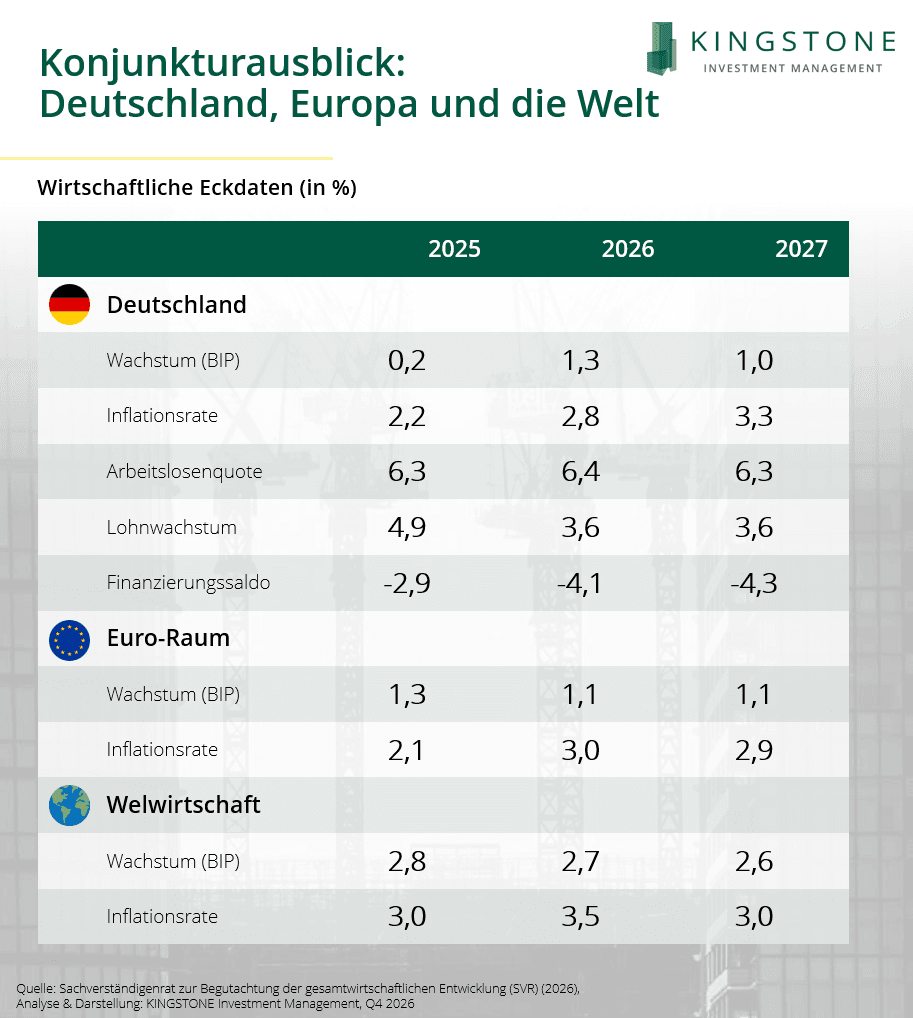
The Economic Council expects GDP growth of 1.3 per cent in 2026 and 1.0 per cent in 2027 for Germany. At the same time, inflation is likely to rise from 2.8 per cent to 3.3 per cent.
For the eurozone, growth of 1.1% is forecast in each year, with inflation at around 3%. The global economy is expected to grow by 2.7% in 2026 and 2.6% in 2027.
Germany is growing again – albeit amid rising prices and weak structural momentum.
🇩🇪 Germany’s upturn: government stimulus rather than structural strength?
The recovery is being underpinned in particular by stronger exports and credit-financed government spending. Investment in infrastructure and defence is expected to provide additional growth impetus. But this financing comes at a price. The German Council of Economic Experts warns that Germany’s debt-to-GDP ratio could rise to around 98 per cent by 2040 if the expanded borrowing limits for defence spending are utilised on a permanent basis. At the same time, interest burdens and the need for fiscal consolidation are increasing.
⚖️ The Council of Economic Experts calls for fiscal policy decisions to be made now
Key recommendations for action include:
▪️ Limit debt financing: Gradually phase out debt-financed defence spending.
▪️ Make spending more efficient: Reduce subsidies and reform social security systems.
▪️ Secure investment: Ensure long-term sustainability of infrastructure investment.
▪️ Boost productivity: Promote digitalisation, competition and labour mobility.
The challenge: to promote short-term growth without jeopardising the ability to take fiscal policy action in the long term.
🎙️ Macro Matters: What lies ahead in 2027?
How do Paul Richter and Helaba assess the economic and inflation outlook? How do their forecasts differ from those of the German Council of Economic Experts? And how realistic is the political implementation of the reform recommendations?
We’ll be discussing this on 27 November in our next ‘Macro Matters’ webinar.
👉 You can find the registration link here.
#KingstoneSpotlight #MacroMatters #Economy #Inflation #EconomicGrowth #PublicDebt #RealAssets