
- Real estate index rises by 1.8% in nominal terms
- Housing market up again significantly: rents rise sharply
- Office rents rise in central locations, while retail remains under pressure
- B-cities show the strongest growth nationwide
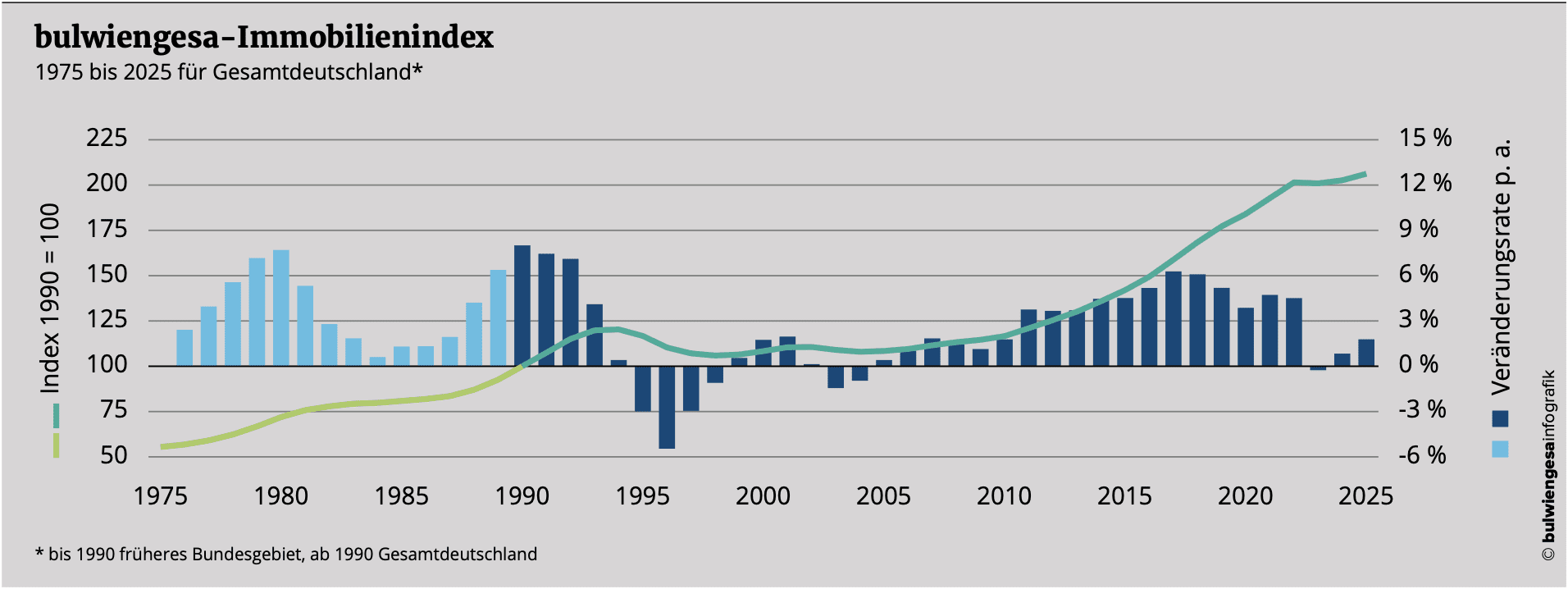
For the 50th time in a row, bulwiengesa presents the real estate index, which analyses the development of real estate prices and rents in Germany since 1975. After difficult previous years, the index recorded a recovery for 2025 with a nominal increase of 1.8%. Nevertheless, the industry remains cautiously cautious: high construction costs, low completion figures and hesitant investment decisions define a still fragile market environment.
The results for 2025 at a glance:
- Overall index: +1.8% (previous year: +0.8%)
- Housing sub-index: +2.3% (previous year: +1.0%)
- Sub-index for trade: +0.4% (previous year: +0.2%)
Housing market: Rents are driving development
After the growth phase of the housing market was interrupted in 2023, the sub-index was able to exceed the inflation rate again in 2025 with an increase of 2.3%. The main drivers are rents: rents for new buildings rose by 3.7% and existing rents by 2.6%. Prices for terraced houses (+2.7%) and new-build condominiums (+2.0%) also rose in lockstep, while building land prices largely stagnated (+1.1%). André Adami, Head of Housing, estimates: “We have reached the low point of the start of construction. However, we do not expect a slight increase in completion figures again until 2027.”
Office and logistics: Focus on quality and new drivers
Within the commercial segment, a differentiated picture emerges. While traditional office structures are under pressure, modern spaces benefit from the quality orientation of tenants. The logistics sector is also stabilising at a high level.
Oliver Rohr, Vice President Commercial and Office Properties: “Although take-up in the office sector is declining slightly, we are recording an increase of 1.9% in office rents, driven by a clear ‘flight to quality’ in central locations. While the volume of new construction is continuously declining, conversions into commercial apartments and hotels are increasing. In the logistics sector, we see a robust development with an increase of 1.1% in commercial properties, fueled by new drivers such as the defense industry and data centers.”
Retail: Structural change in city centres
The retail sector remains the problem child in the trade index, although the fluctuations are less drastic than in previous years. Prime rents in prime locations fell by an average of 1.5%, while rents for secondary and district locations remained comparatively stable at minus 0.8%.
Dr. Joseph Frechen, Head of Retail: “The gap in brick-and-mortar retail is widening. While food-oriented specialty stores remain highly popular with investors, quality and active vacancy management are decisive for the ability to invest in large-scale inner-city shopping centers. For 2026, the pressure on brick-and-mortar retail in city locations will continue with consumers’ subdued desire to buy.”
Excursus: Trend reversal in performance
A particular focus of this year’s report is on real performance. Despite the lack of a broad market recovery, the values in almost all segments are turning slightly positive again. While office properties are again seeing positive signs due to rising prime rents, the losses in value in the retail sector are continuing, but are weakening noticeably. Residential properties are benefiting from rising rents across the board and are returning to positive performance.
Outlook for 2026
For the current year, bulwiengesa forecasts a continuation of the stabilisation of the real estate markets with an inflation rate of around 2%. Since only about 185,000 completions continue to create too little living space, a further increase in rents in the conurbations is to be expected.
About the bulwiengesa real estate index
The bulwiengesa real estate index analyses the development of the real estate market in Germany on the basis of 49 West German cities since 1975 and 125 German cities since 1990. The results of the bulwiengesa real estate index are based on bulwiengesa’s extensive data collection of location and market analyses. This database is supplemented annually by targeted empirical surveys, on-site surveys and newspaper analyses and published in the RIWIS database. The bulwiengesa real estate index is calculated and updated annually on the basis of this data. The nine sub-markets are weighted equally in the calculation of the index. In addition to the overall index, a sub-index is given for both the residential and commercial real estate markets.
Contact: Jan Finke, jan.finke@bulwiengesa.de, phone 0201-87 46 96-63