
Sometimes industry trends reveal themselves in small individual cases. For example, the first institutional investors are pushing for particularly strong responsibility governance in real estate master fund mandates. The legal responsibility of the asset manager should no longer be limited to merely advising the portfolio management of the master or service KVG. What is not unusual in liquid funds is now being taken as a promise from asset managers in some cases as well in real estate funds: he is to take over portfolio management from the master or service KVG with full responsibility.
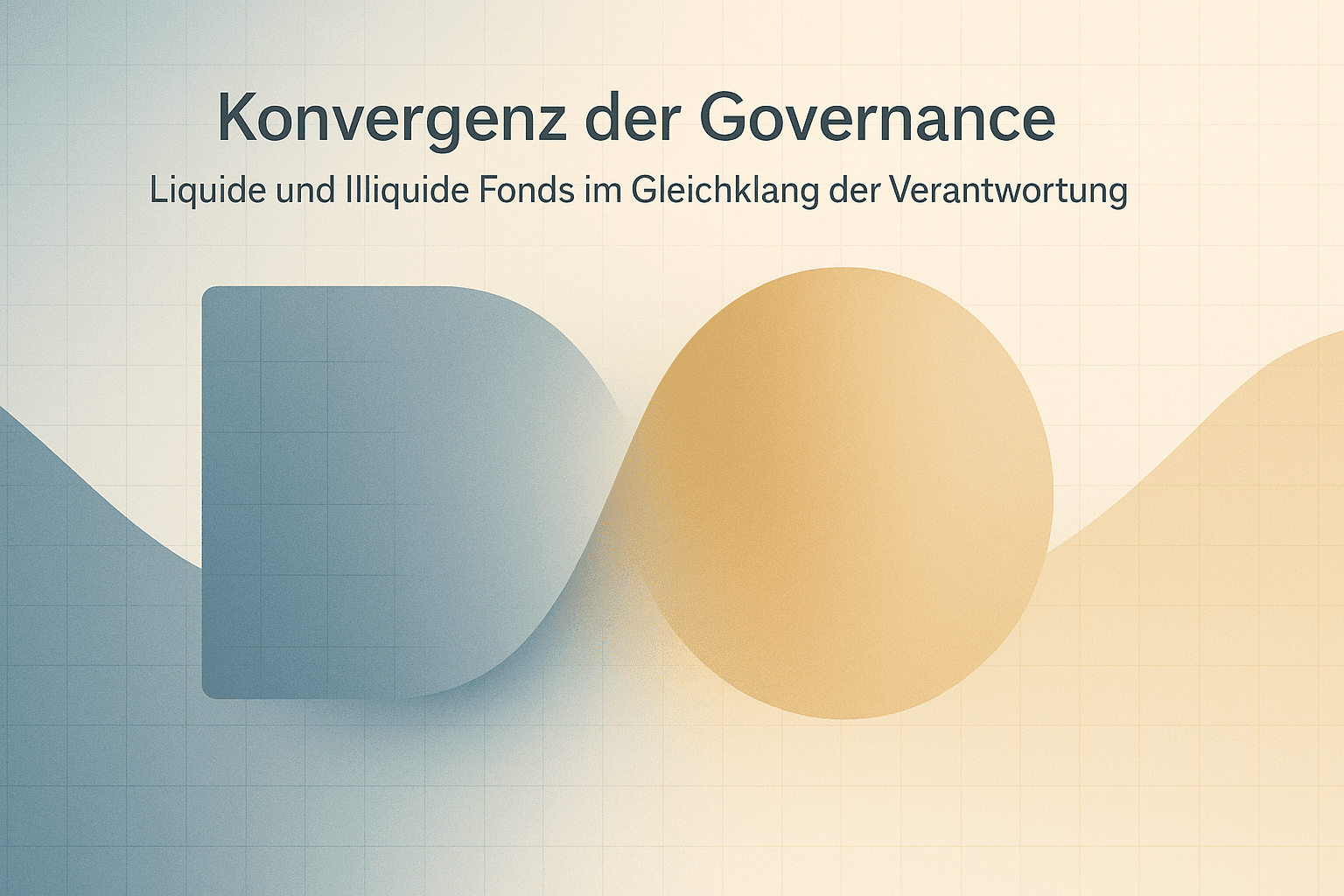
Until now, it has been almost uncommon in the real estate world and also in other sub-areas of real assets for the asset manager to take over the complete portfolio management by delegation. – and thus bears more far-reaching responsibility. But it is precisely this example that impressively describes the overarching trend of an increasing number of Convergence of governance between liquid and illiquid funds.
Two worlds that have traditionally been considered largely independently of each other began to converge structurally some time ago. What has long seemed clearly separated – here the liquid world with its data-driven logic and daily valuation, there the illiquid world with its individual valuation cycles and project-related risks – is moving even closer together. Investors, supervisors and market mechanisms mean that governance principles of both sides are increasingly intertwined.
The catalysts for this development are market providers in particular, who see themselves as drivers of innovation. The first thing they did was to technologically link the regulatory and operational processes – and thus make the application of governance principles from the liquid world available for real assets as well.
One consequence of this is that the first master AIFMs are launching real estate funds for individual investors with the special feature: the asset manager, who as the service provider of the master fund is to take care of the real estate management of the properties directly linked to the master fund, is not only commissioned to advise the portfolio management – which remains with KVG – by means of a service contract. Instead, the asset manager is completely transferred to portfolio management by way of a “real” outsourcing by means of an outsourcing contract. Technically, the asset manager is then also called the “delegated portfolio manager”.
The demand of first investors in real asset-based master fund mandates for a complete outsourcing of portfolio management Although this is comparatively new, it is basically a not surprising consequence of the development that governance principles from the liquid world are making themselves available in the real assets world: What has long been common practice in the liquid fund industry is now also in demand by institutional investors in real asset structures. Where asset managers have in-depth market and property expertise, the transfer of portfolio management can lead to greater accountability and clearer decision-making structures – provided that KVG’s governance and risk management remain effectively anchored.
For KVG, on the other hand, this is precisely the central question: How does its risk management function remain intact when it delegates operational investment decisions, including real estate management? In practice, this requires adapted contracts in the real assets world, precise interface regulations and a revised supervisory concept – a balancing act between control and transfer of responsibility.
For master and service AIFMs in particular, this development means a challenging but equally promising task: to create structures that allow for different mandate models without diluting their own supervisory function. Governance thus becomes a A balancing instrument between freedom and control – and a common language that connects the liquid and illiquid worlds.
Perhaps this is precisely the most important finding: liquid and illiquid funds do not converge by chance, but because they are based on the same basic idea – to manage capital reliably, transparently and in a fiduciary manner. Technology as an enabler has only accelerated and amplified this process.
📌 Result
- Convergence does not mean a blurring of differences, but an intact trend of governance convergence between liquid and illiquid funds.
- The outsourcing of portfolio management is routine in the liquid world, so far the exception in the real assets segment – but one that makes you think.
- Perhaps it is a foretaste of what illiquid fund structures could look like in the future: more flexible, more transparent and with an even clearer accountability compass. In any case, this development provides new impetus for further professionalisation of institutional real asset investment.