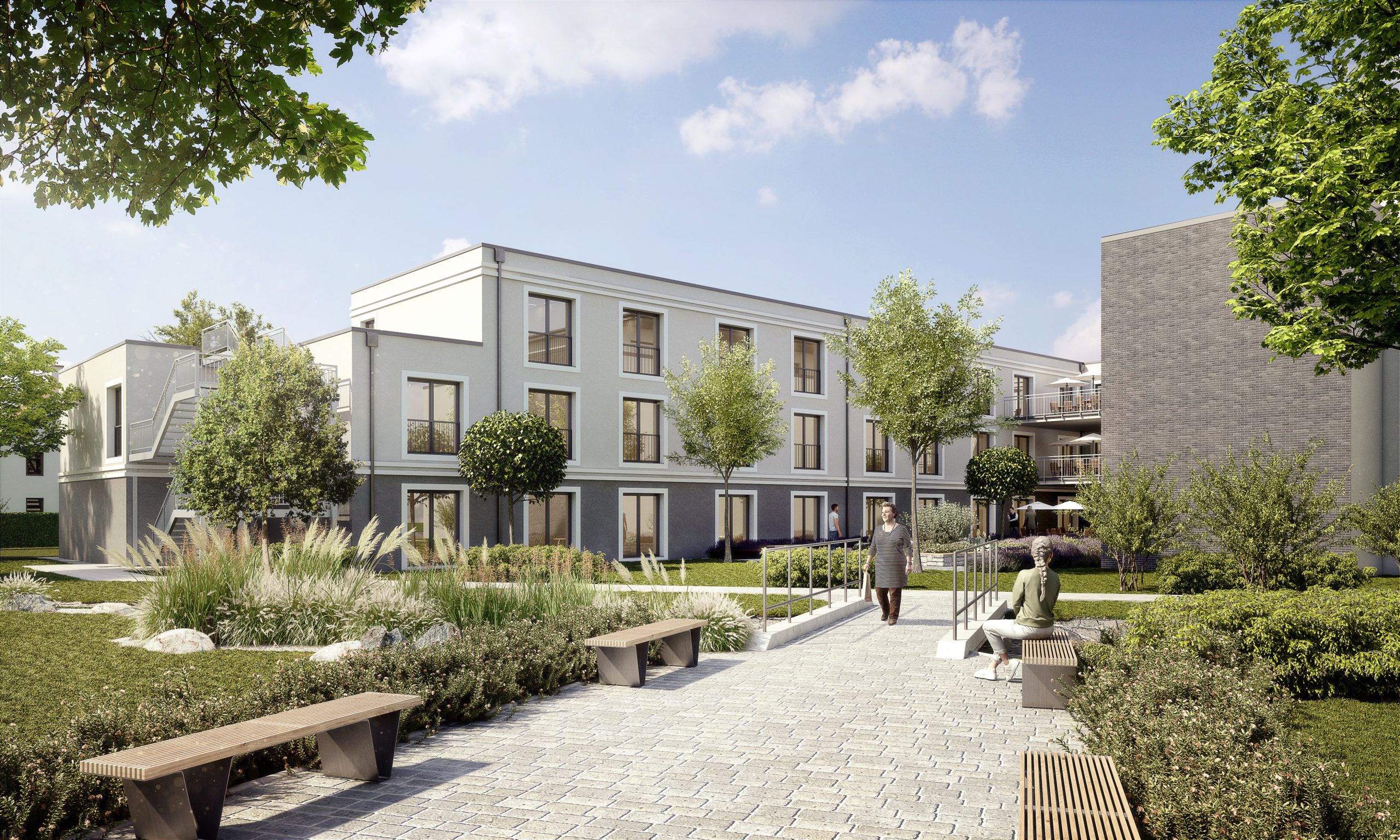

Cureus, a portfolio holder specializing in inpatient care properties that is building new for its own portfolio and actively manages it, has completed the DOREAFAMILIE Aschendorf at Hüntestraße 5 in 26871 Aschendorf, a district of Papenburg (Lower Saxony) ahead of schedule and handed it over to the operating partner DOREAFAMILIE. Cureus itself acted as general contractor for this project.
“We are very pleased to have expanded the range of urgently needed care capacities for the residents of Papenburg and the surrounding area in just about one year of construction according to the latest standards and in attractive architecture,” says Kevin Lleshi, project manager of Cureus. “The already established care location has thus once again undergone a significant upgrade. Even more people in need of care are now finding a place to feel good. We wish the future residents and the team of the DOREA family Aschendorf all the best. A big thank you goes to everyone involved in the construction,” Lleshi continues.
Dr. Walter von Horstig, Managing Director of the DOREA family, is pleased with the successful completion of the work: “I am thrilled. The extension also has modern equipment that offers all the possibilities of contemporary, well-founded nursing care. In this way, we have successfully expanded the familiar and fun-loving community that we have so far built up together with our residents and our local team in a cozy setting. The outdoor facilities, the community and therapy rooms as well as comfortable seating areas now also invite the new residents to socialize, but also offer retreats if necessary.”
Living and working in the DOREA family Aschendorf
Those interested in a nursing place can still find out more from our facility manager in Aschendorf, Annie Kremers, by phone 04962 90696902 or by e-mail to el.aschendorf@doreafamilie.de.
The extension will create additional modern and crisis-proof jobs. Applicants for one of the positions in the fields of nursing, housekeeping, administration or building services can find out more at [link] and continue to apply for the additional new positions.
Sustainable care facility with a focus on the well-being of the residents
The approximately 5,850 square metre site previously only housed the existing modern nursing home with 71 spacious single rooms for inpatient care and four residential units. There are a total of five family residential groups on three floors. Each of the living areas has twelve cosy single rooms and a large apartment; this is intended as a double room for married couples. A large, bright and cosy eat-in kitchen serves as a social centre and meeting zone in every residential group. Directly adjacent to the hotel-like foyer on the ground floor is the restaurant for residents with a sun terrace and its own fresh kitchen. A range of hairdressers and pedicurists as well as doctors and therapists is also regularly available in the house.
The extension now complements the L-shaped main building to the south. It has two full storeys and a staggered storey and comprises around 2,440 square metres of gross floor area. The extension follows the typical Cureus system approach. A straight-lined façade that blends in with the existing surrounding buildings in terms of colour and floor-to-ceiling windows throughout are striking elements. The extension was built in accordance with the KfW 40NH standard and is supplied with heat and electricity by its own combined heat and power plant. The building is also striving for certification according to the extremely sustainable DGNB Silver Standard, and spacious care bathrooms as well as additional staff and administration rooms complement the existing offer at the site. In the new part of the building, too, only generously designed single rooms with private bathrooms were created. Each of the 48 rooms has a telephone, television and Internet connection as well as a nurse call. It is possible to furnish the rooms yourself and can facilitate the transition to a new phase of life. For a familiar, social togetherness, the newly added rooms will be divided into three further, independently organized residential groups with an associated kitchen–living room and lounge area as well as a balcony or terrace.
Lots of greenery and good connections
The house of the DOREA family Aschendorf was built on the site of a former Franciscan monastery on a small river. The ensemble, directly on the monastery garden, is located on the outskirts of the former district town, which now belongs to Papenburg; the town centre is within walking distance. The green surrounding area as well as several shopping facilities, nearby social facilities and medical practices make the location attractive. The bus stops near the building and parking spaces for cars and bicycles are available on the premises, which makes it easier for employees and visitors to get there.
Building to high-quality, individual standards
The extension of the DOREA family Aschendorf was built in accordance with the Cureus standard of the system care property. This relies on uniform, high quality standards and is oriented, among other things, to the needs of the operators with a focus on residents and nursing staff. For example, the construction processes and all objects are optimized from the inside out: This applies, for example, to the size and arrangement of rooms to optimize areas and walkways. The on-site equipment is also well thought-out from a utility point of view: corridors always receive daylight, each room has floor-to-ceiling windows and the modern bathrooms and window arrangements always follow the same standardised system approach. In the architecture and façade design, however, great importance is attached to individuality and the highest quality in order to fit optimally into the respective project environment. Sustainable aspects also play an important role, for example, the KfW Efficiency House 40 standard is aimed for all properties. The bundled procurement, including floor coverings or elevator systems, also ensures cost synergies. Long-term maintenance contracts covering several properties also reduce the costs of the future operator. By constantly reviewing and optimizing this system approach, the creation of needs-based properties can be guaranteed.