Investment in the European residential real estate sector increased by 22 percent to 62.2 billion euros in 2025 and is expected to exceed the 70 billion euro mark in 2026. This is shown by current market data from JLL. The “EMEA Living Market Perspectives 2026” analysis looked at transactions of apartment buildings, student apartments, subsidized apartments, coliving properties, nursing homes and senior housing from five million euros.
“Investor confidence is clearly returning”
The growth is mainly driven by large platform transactions and the return of institutional investors. Investment in corporate acquisitions increased by 168 percent year-on-year in 2025, while purchases of existing properties increased by 20 percent. In contrast, the volume of forward investments fell by 22 percent.
explains Gemma Kendall, Head of EMEA Living Capital Markets at JLL. “We are seeing larger platforms changing hands, and institutional capital is becoming more active again. Fundamentals remain favourable, yields are declining and price certainty is bringing buyers back to the table.”
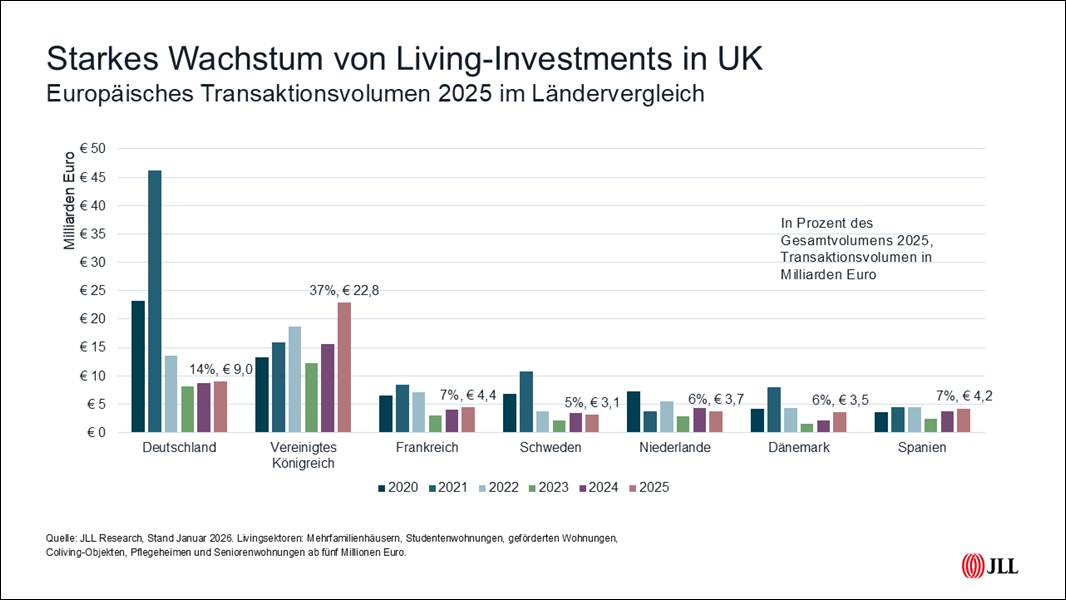
The largest European residential investment market in 2025 was once again the United Kingdom with a share of 37 percent and a volume of 22.8 billion euros, followed by Germany with 14 percent and nine billion euros respectively, and France and Spain with seven percent each. The highest relative year-on-year increases were achieved by Norway with 69 percent, Denmark with 64 percent and Ireland with 54 percent.
The volume of major transactions of more than EUR 500 million rose sharply by more than doubling to around EUR 14.2 billion (previous year: EUR 6.5 billion). The average deal size was EUR 50.9 million (previous year: EUR 40.3 million). Particularly striking in 2025 was the activity of US investors, who invested 17 billion euros in European residential real estate, more than ever before.
Dominance of apartment buildings is dwindling, care properties are coming into focus
Buyers continue to focus on apartment buildings. Their share of total sales was just over half in 2025. Compared to previous years, however, with market shares of between 60 percent and 80 percent, their dominance is declining. In contrast, investments in nursing homes are developing extremely dynamically, rising by 165 percent last year to a record level of 14.4 billion euros. In the case of student housing (Purpose-Built Student Accommodation; PBSA), the investment volume grew by 52 percent. Here, continental Europe surpassed the United Kingdom for the first time with 55 percent of the total volume.
Several large platform sales are currently in the pipeline – including Brookfield’s €1.8 billion International Campus and Blackstone’s €1.2 billion Fidere portfolio in Spain, as well as the £1.5 billion UK single-family home platform Leaf Living, which is up for sale and will further drive transaction growth in 2026. Increasing transaction volumes are also expected in Germany, Sweden and the Netherlands.
New construction continues to decline and leads to persistent rent pressure
Parallel to the rising demand, the supply situation is intensifying. Completions in Europe’s largest investment markets were 11% lower in 2024 and will fall by a further 5% in 2025 and 2026. In 2026, 1.2 million apartments will be completed, 400,000 fewer than at the peak in 2022 – the lowest level in more than a decade.
“We expect new construction to shrink further in 2026, leaving only about half as much new housing as 20 years ago,” says Emma Rosser, EMEA Living Research Director at JLL.
The lack of new supply is leading to ongoing rent pressure. Average rent growth in European cities was 5.2 percent at the end of 2025, above wage growth. In 60 percent of Europe’s key cities, rents now exceed 30 percent of income – a record high that exacerbates the affordability problem.
For 2026, JLL forecasts rent growth to stabilize below five percent as landlords have to respond to their tenants’ affordability issues. At the same time, capital values are expected to rise by a further six percent, supported by yield compression and continued above-average rental growth.