From blind spot to industry standard: over 5 million euros for logistics booth
The Dortmund-based tech company convinces leading venture capitalists with its new system standard for global supply chains
By establishing a completely new software category in the system landscape of production, logistics and trading companies, the logistics booth convinces a well-known consortium of investors and receives over 5 million euros in a Series A financing round. The Dortmund-based tech company has developed a software solution that allows companies to easily control load carriers such as pallets, containers or racks digitally – and thus solved a challenge that almost every company along the supply chain is struggling with. With the fresh capital, Logistikbude is massively accelerating the automation of load carrier processes and driving forward its internationalization. The lead investor is Capnamic, one of the leading venture capital investors in Europe. Moguntia Capital, a renowned supply chain investor with a private equity and US footprint, is also investing. The existing investors of the logistics booth – the Fraunhofer Technology Transfer Fund (FTTF), Rethink Ventures, the venture capital fund (VC) XPRESS Ventures, which is supported by the Fiege family, and Golzern – are also increasing their commitment and thus also reaffirming their confidence.
“Logistikbude has the potential to turn the system landscape of global supply chains upside down and become a category leader in the B2B Vertical Software-as-A-Service sector,” says Jörg Binnenbrücker, Managing Partner and Co-Founder of Capnamic. Dr. Nils Eiteneyer, Partner at Capnamic, adds: “The software solution forms a new category that addresses a significant and at the same time less digitized cost driver in the process chains of retail, industry and logistics. We are thrilled with the team’s deep domain expertise.” The Dortmund-based tech company is pursuing the mission of revolutionizing the global management of load carriers, such as Euro pallets, lattice boxes or racks.
10 billion charge carriers – a system-critical blind spot
They form the backbone of global supply chains: Around 10 billion load carriers are in circulation worldwide; there are an estimated 150 billion transitions between companies every year. At the same time, pallets, containers or racks are by no means cheap mass-produced goods – they represent tied up capital and cause considerable costs in the event of loss, damage or inefficient use. Each individual exchange generates postings, balance reconciliations, reconciliation processes and documentation, often still manually or fragmented across e-mails, Excel lists and siloed systems. In addition to the tied-up capital, these administrative expenses drive up the total costs. Although load carriers are system-critical and cost-relevant for industry, trade and logistics, they are still only treated as a secondary process in existing IT systems.
LCMS: From a side topic to a separate software category
“This is exactly where we come in,” says Dr. Philipp Hüning, co-founder and CEO of Logistikbude. “Our goal is to fully automate load carrier management and thus relieve companies of this issue.” To this end, the tech company is defining a completely new software category: The logistics booth is the first Load Carrier Management System (LCMS). “Just as a warehouse management system (WMS) supports companies in controlling their warehouse processes and a transport management system (TMS) organizes their transport processes, an LCMS takes over the management of all pallets, racks and lattice boxes,” explains Hüning.
To do this, the platform bundles information from existing IT systems such as WMS, TMS and enterprise resource planning (ERP) systems. At the same time, it closes existing data gaps by integrating additional information, for example via its own app, Internet of Things (IoT) sensors or AI-supported processing of receipts. This data forms the basis for the complete automation of all processes relating to load carriers. The core technology of the LCMS for this is artificial intelligence (AI): It makes it possible to automatically read, process and book any PDF and Excel document – a process that has so far been highly manual and error-prone. In addition, the AI checks external documents and compares them with its own postings. “In this way, we automate workflows that have cost many employees hundreds of working hours every year,” says Hüning.
Spin-off with a clear mission
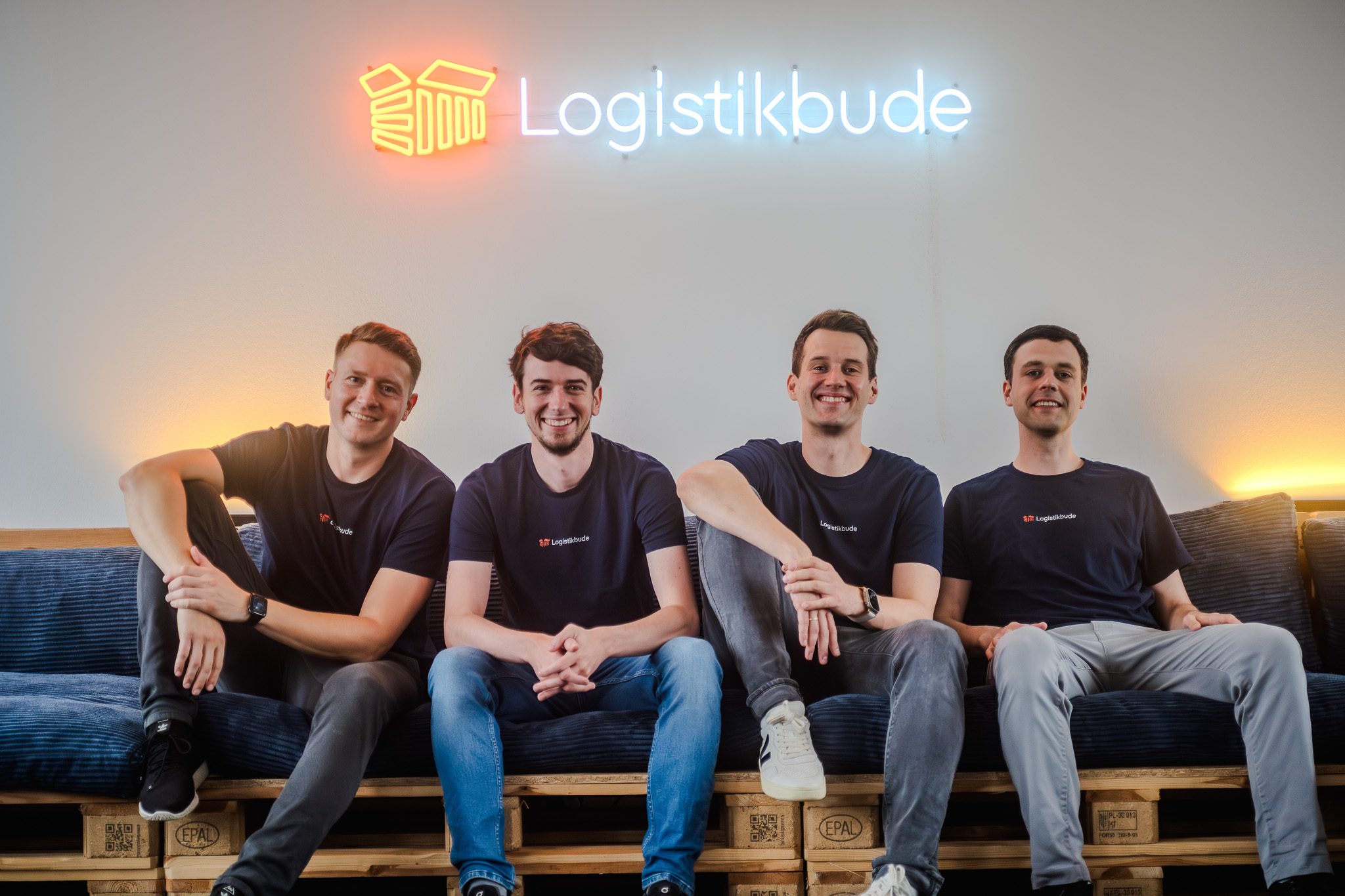
“When we worked together at the Fraunhofer Institute for Material Flow and Logistics (IML), we quickly realized how complex and inefficient the management of load carriers is still organized in many companies,” says Michael Koscharnyj, co-founder and COO of Logistikbude. At the same time, existing solutions were often unnecessarily complicated and left many new technological opportunities untapped.” This observation did not let go of the founding team: In 2021, Koscharnyj founded the logistics booth together with Dr. Philipp Hüning, Patrik Elfert and Jan Möller. Since its spin-off from Fraunhofer IML, the company has developed from a tech start-up to a provider that establishes load carrier management as an independent software category in the market.
Internationalization and standardization as the next phase of growth
The company was already able to convince in 2023 as part of seed financing and received over 2 million euros from various VCs and angel clubs. With this capital, the team further developed the solution, grew from 4 to 25 employees and now books more than 50 million load carriers per month for well-known customers such as the Nagel-Group and DACHSER. The Series A financing thus ties in with a phase of validated growth and now marks the next milestone in the growth story of the logistics booth. “With the fresh capital, we are scaling our LCMS internationally and consistently expanding our leadership position in this emerging software category. In this way, we are establishing the LCMS as an integral part of the B2B system landscape beyond the DACH region,” explains Koscharnyj.