The extent to which households in Germany benefit from reduced grid fees on their electricity bills depends largely on where they live. This is shown by an analysis by the smart metering company metrify. The annual grid fee reduction in more than 10,000 cities and municipalities for households with controllable consumption units such as heat pumps, electricity storage systems or wallboxes was examined and compared. It turns out that while the relief in Igelsbach in Hesse is the highest in Germany at almost 180 euros/year, the lowest reduction of 88.35 euros is lower.
When the power grid reaches its limits, grid operators are allowed to throttle controllable devices such as heat pumps, electricity storage systems or wallboxes at short notice. This works via the smart meter and is important to avoid overloading the grid and keeping it stable. In return, however, these households will then benefit from reduced grid fees, i.e. lower fees for the use of the electricity grids.
metrify’s analysis clearly shows that households in certain regions benefit significantly more from the nationwide relief, while other regions receive little from it. The amount of the grid fee reduction follows a simple system: grid operators calculate a flat-rate annual relief based on their regional grid fees and typical consumption values of controllable devices such as heat pumps or wallboxes. Since the costs for operating and expanding the electricity grids vary depending on the region, the underlying grid fees also vary. On this basis, a standardised relief is determined that households receive for their willingness to control flexibly. So the higher the grid fees in a region, the greater the possible reduction.
“The grid fee reduction is more than just a financial incentive. It encourages households to opt for a smart meter. These are indispensable for a flexible, resilient and future-proof energy system. Anyone who installs a smart meter today actively contributes to the stabilization of the grids and enables the intelligent integration of renewable energies into the overall system. Although the smart meter rollout in Germany is increasingly gaining momentum, it has not yet been implemented nationwide and many consumers are not yet fully aware of the advantages of reducing grid charges. With further expansion, this picture will increasingly change”says Dr. Wim Drożak, Managing Director of metrify, a subsidiary of the new energy company Enpal and the largest competitive metering point operator in the field of smart meters.
Stuttgart is ahead of the big cities, Cologne is trailing behind
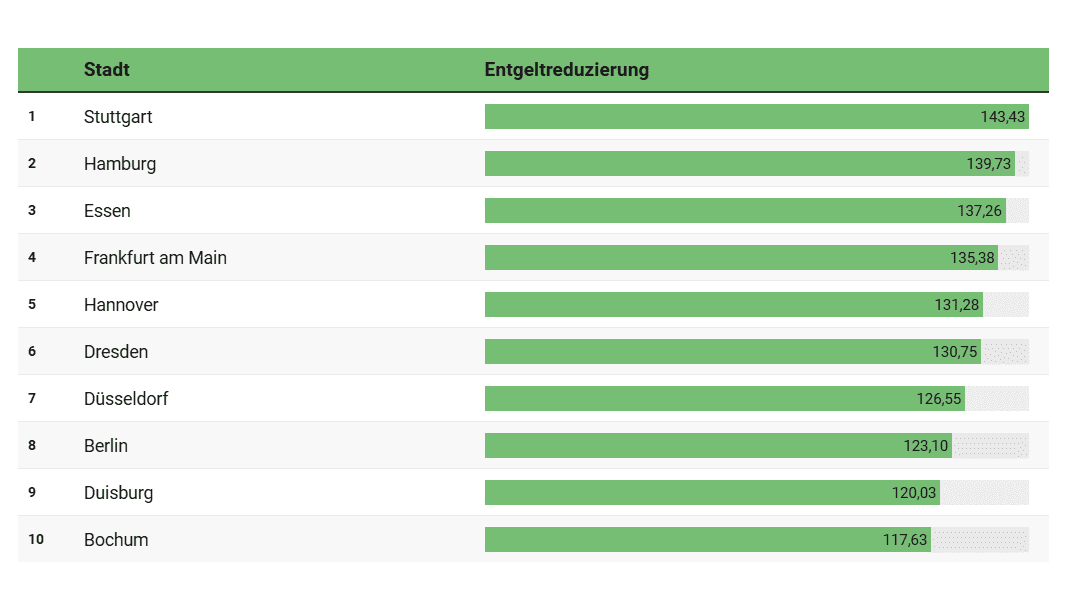
Among the 20 most populous cities in Germany, consumers save the most in Stuttgart with 143.43 euros per year. Hamburg follows in second and third place with a grid fee reduction of 139.73 euros per year and Essen with 137.26 euros/year. Households in Cologne, on the other hand, benefit the least: they pay an average of 95.58 euros less per year. With an annual reduction of 99.83 euros, Leipzig is also well below the average of 119.24 euros in the 20 largest cities. Berlin with 123.10 euros/year and Munich with 115.56 euros/year come much closer.
Difference for grid fees is almost 90 euros throughout Germany
A look at the more than 10,600 cities and municipalities analysed shows strong differences in annual savings. The list is headed by Igelsbach in Hesse. In the municipality in the Rhein-Neckar district, residents can look forward to a potential pay reduction of 179.58 euros/year. The next highest savings of 169.23 euros/year are in Bad Herrenalb in Baden-Württemberg.
At the other end of the ranking are more than 280 municipalities in Lower Saxony, where the annual pay reduction is 91.23 euros. This results in a difference of 88.35 euros between the highest and the lowest grid fee reduction. The nationwide average among all cities surveyed is 116.61 euros.
Lowest grid fee reduction in Bavaria
Extrapolated to the federal states, Hamburg (139.26 euros/year) tops the list with the highest grid fee reduction. This is followed by Rhineland-Palatinate (128.84 euros/year), Baden-Württemberg (123.86 euros/year) and Berlin (123.10 euros/year). On average, the Bavarians, on the other hand, save the least. Here, consumers can expect relief of 106.80 euros per year. In Mecklenburg-Western Pomerania (107.39 euros/year), in Bremen (108.44 euros/year) and in Lower Saxony (109.58 euros/year), there is also only slightly more for a possible reduction in performance.
You can see all the results of the comparison here: https://www.metrify.de/netzentgelte#info