According to analyses by DIP partner Aengevelt Immobilien, absolute purchase prices for residential and commercial properties rose slightly in 2025. However, these are largely inflationary effects, as rent levels have also increased. This is in line with the fact that the purchase price factors for real estate investments have fallen moderately in most cities, with the result that yields have tended to rise. This also corresponds to rising interest rates for fixed-interest securities and mortgage loans.
The Association of German Pfandbrief Banks (vdp) recently published that the nominal purchase prices for real estate, which are calculated on the basis of actual transactions, have been rising continuously since the beginning of 2024. Residential property prices increased by 4.2% in the fourth quarter of 2025 compared with the same quarter a year earlier. Office property prices rose by 3.9% and retail property prices by 2.3% in the same period. Aengevelt Immobilien, however, points out that these are nominal price increases, from which the inflationary effect must be excluded, because rent levels have also risen during this period.
For the investment markets, the purchase price factors or the yields are more important. To this end, the broker association DIP – Deutsche Immobilien-Partner, co-founded by Aengevelt, has determined both the market-standard entry factors and the top factors for the asset classes office, commercial buildings, logistics, hypermarkets and residential investments in the 16 German cities of Berlin, Bremen, Dresden, Düsseldorf, Essen, Frankfurt am Main, Freiburg, Hamburg, Hanover, Karlsruhe, Cologne, Leipzig, Magdeburg, Munich, Nuremberg and Stuttgart. Most of the factors were stable. In addition, both positive and negative changes in most cities and asset classes were minor and were in the order of half to full points. Exceptions were the B-city of Nuremberg and the C-city of Freiburg/Breisgau, where more clear positive trends were observed. In addition, the industry/commerce/logistics segment performed comparatively best among the asset classes.
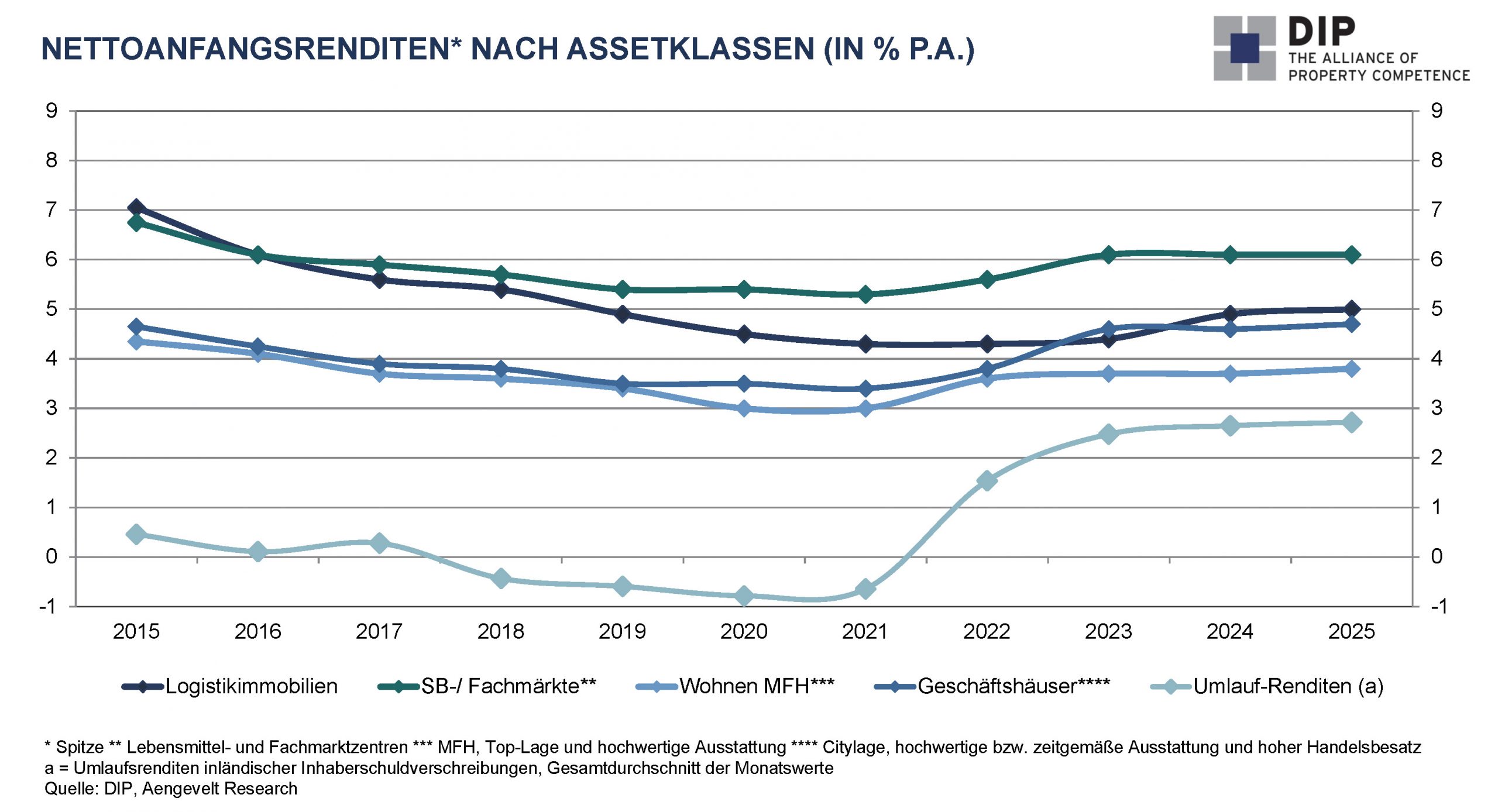
Despite differentiated developments in detail, it can be said that there is a slight downward trend across all locations and asset classes, which in turn means slightly rising yields. The rise in yields on real estate investments corresponds to the fact that yields on ten-year German government bonds also rose over the course of the year, from 2.14% to 2.83%. The interest rate level for mortgage loans with a ten-year fixed interest rate rose accordingly from 3.15% to 3.85%.
The highest yields across all locations are currently offered by the asset classes industry/commerce/logistics and self-service markets/specialist stores/centres, where yields of between 6.0% and 7.5% can be achieved in many locations, and even up to 10.0% in individual cases, followed by office buildings with market yields of 5.5% to 6.5%. For existing apartment buildings (medium equipment), yields are between 4.5% and 7.0%, and for new residential construction it is between 4.0% and 5.0%. With these ranges, however, it should be noted that there are regional outliers downwards and upwards. For 2026, Aengevelt essentially expects a sideways movement both in terms of macroeconomic interest rate levels and in terms of purchase price factors and yields on real estate.
Dr. Wulff Aengevelt, Managing Partner of DIP partner Aengevelt Immobilien: “Our analyses show that there has been extensive stability in terms of the development of purchase prices and yields. However, the regional markets, micro-locations and individual properties offer numerous opportunities and niches that investors with market knowledge can exploit. In principle, there is no longer any reason to postpone transactions – this applies to the buyer side as well as to the seller side, where historical book values may have to be adjusted to current market values.”