Energy resilience is changing the choice of commercial real estate and leading to rent premiums
Energy availability and security are becoming key factors in investment decisions in the commercial real estate sector – with far-reaching implications for project viability, property values and building performance. According to the JLL study “Where Energy meets Property“, this is not only changing the role of real estate in the energy value chain. Locations with a secure energy supply also promise higher rental income.
“Especially for companies in the industrial and logistics sector, power outages and energy interruptions are among the greatest operational risks. They are therefore increasingly incorporating this aspect into their site assessment and are willing to pay premiums for a reliable energy infrastructure,” says Helge Scheunemann, Head of Research at JLL Germany. “The traditional real estate mantra ‘location, location, location’ is increasingly giving way to location, resilience, reliability.’”
High-power real estate achieves significant premiums
These preferences are already translated into measurable market data. Research data from JLL shows that in Silicon Valley, for example, leases with high electricity output of 4,000 amps or more have achieved an average of 49 percent higher rents than all other leases over the past three years. Compared to buildings completed in the past three years, the premium is still lavish at 33 percent. In contrast, new buildings without corresponding performance commitments only achieve rent premiums of eleven percent on average. “In Germany, too, we are already seeing this development among energy-intensive users,” says Scheunemann.
Energy demand is growing faster than grid capacity
The importance of energy security will increase in the coming years. The demand for electricity is increasing rapidly – driven by AI, data centers, automation in production and the charging of electric vehicles. At the same time, this demand meets a network infrastructure designed for much slower and more predictable growth patterns. The electricity system is changing from a linear chain – from centralised generation to transmission grids to end-users – to a more decentralised network where energy is generated, stored and managed increasingly closer to where it is consumed.
This development is of particular relevance for Germany. With an industry quota of around 23 percent, Germany has a very high level of industrialization by international standards. Industry consumes around 217 TWh of electricity annually and is thus responsible for around 44 percent of total electricity consumption. Demand is particularly prevalent in energy-intensive industries such as chemicals, metal production and processing, as well as coking and mineral oil processing. At the same time, German industrial electricity prices are among the highest in Europe. This cost burden has triggered a broad debate on locations and is leading to reluctance to invest and relocation of production by energy-intensive companies.
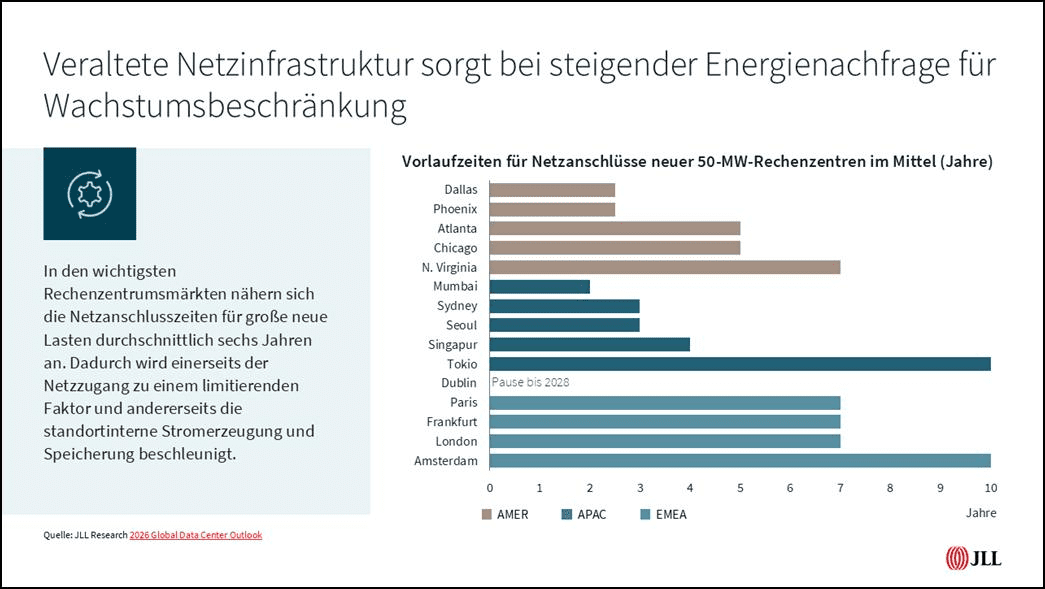
However, many locations are not prepared for these developments. As a result, grid connection times for large new loads in the most important European data center markets are now an average of five to seven years, making access to electricity a limiting factor long before construction begins. “In practice, the players often make do with a staggered provision of electricity volumes or with local solutions, which can shorten the connection time in individual cases,” says Martina Williams, Head of JLL Work Dynamics Northern Europe.
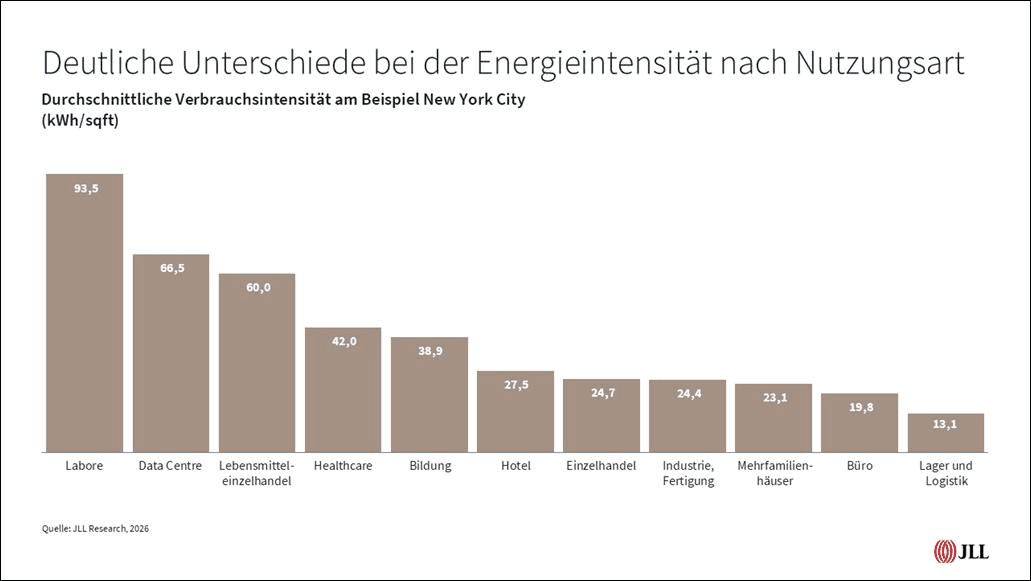
E-mobility and automation drive electricity demand
Not only data centers, but also industrial and logistics buildings require more and more electricity because automation and increasing electrification are fundamentally changing work processes. “Charging electric vehicles at workplaces, in shopping malls and warehouses in particular puts a heavy strain on the power grids – an uncontrolled charging infrastructure can even more than triple the peak electricity demand of a site. For hospitals, research laboratories and other critical facilities, an uninterrupted, fully reliable power supply has become essential,” Williams emphasizes.
Today, energy infrastructure and real estate value are inextricably linked. Buildings with intelligent energy management and their own power generation would have a clear competitive advantage in the current energy crisis. “Energy security has long since ceased to be a technical detail – it is at the top of the agenda of corporate management and is receiving new attention, especially in the event of geopolitical tensions and events.”
Battery storage and renewable energies as a solution
Battery storage systems play a key role in solving the challenges of energy supply. Costs have fallen by 75 percent since 2015, from 448 to 108 US dollars per kilowatt hour (2025). Germany now has more than 10 GW of installed storage capacity, with a strong upward trend. These systems can absorb power peaks faster and cheaper than expensive grid expansions and ensure that fluctuating renewable energies become a stable 24/7 supply. “In Germany, the combination of photovoltaics and battery storage systems pays off, especially for logistics and industrial buildings with large roof areas. Improved legal regulations for self-consumption and grid feed-in make investments more secure and pay off faster,” says Scheunemann.
Since 2020, more than 90 percent of the newly created electricity capacity worldwide has come from clean energies – two-thirds of it from solar cells alone. The main driver is economic efficiency: renewables are now the fastest and most cost-effective way to create new capacities.
Germany aims to cover at least 80 percent of its electricity consumption from renewable energies by 2030. Worldwide, record investments of 2.3 trillion US dollars flowed into the energy transition in 2025 – more than twice as much as in 2020. “Energy has long since ceased to be a downstream cost issue,” emphasizes Scheunemann. “Electricity availability, reliability and costs determine the choice of location, project feasibility and property value today. Buildings are increasingly actively interacting with the electricity system – this creates real competitive advantages.”