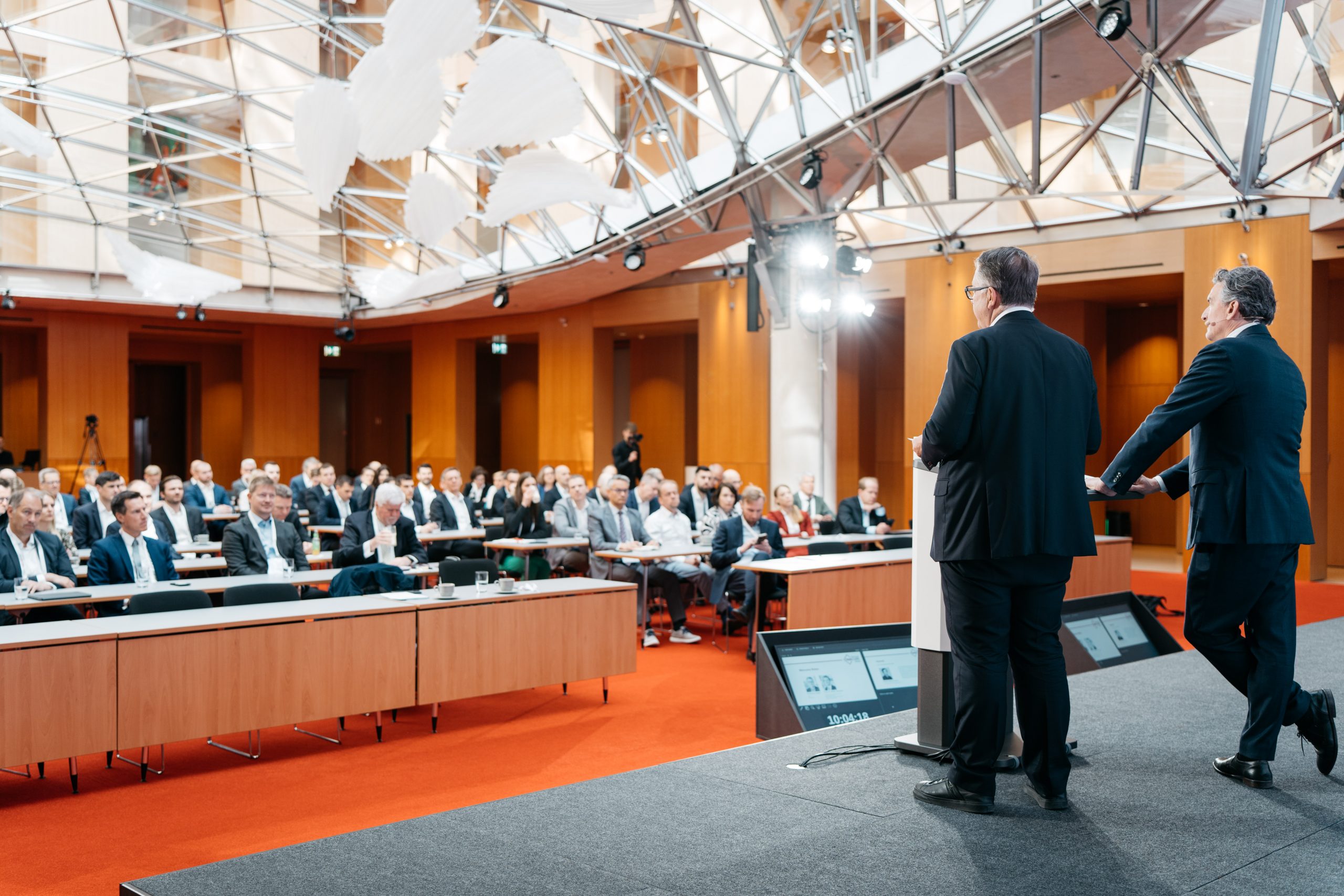
BF.direkt, IREBS and RUECKERCONSULT welcomed around 130 guests to the Real Asset Finance & Debt Summit in Berlin on 23 April 2026. “What began ten years ago in Frankfurt has grown and developed. The congress has moved from Frankfurt to Berlin, we have survived Corona and we have changed the name from Annual Congress Financing for the Real Estate Industry to Real Asset Finance & Debt Summit,” said Francesco Fedele, CEO of BF.direkt AG. Last year, the organizers already expanded the range of topics to include debt and infrastructure.
The programme was moderated by Professor Dr. Steffen Sebastian, Chair of Real Estate Finance at IREBS and, together with Francesco Fedele, Chairman of the Advisory Board of the Real Asset Finance & Debt Summit. His assessment of the current financing environment: “Anyone who wants to make forecasts for the financing market at the moment not only needs very good military and geopolitical knowledge. Above all, one must also be able to predict how the increasingly erratic US president will behave in the coming months. After the developments on the bond markets, the majority of market participants expect both long-term and short-term interest rates to rise. At the same time, the economy will probably weaken due to higher energy prices.”
In his keynote speech at the start, Prof. Dr. Moritz Schularick, President of the Kiel Institute for the World Economy (IfW), said: “Europe is in a sandwich position between the USA and China in the global economy. Europe must therefore stick together. But it is not without problems to establish this European unity.” In addition, there are structural challenges at home: too little public investment over many years, weak private investment and stagnating working hours.
In his keynote speech, Prof. Dr. Andreas Löschel, Chair of Environmental/Resource Economics and Sustainability at the Ruhr University Bochum and researcher at RWI – Leibniz Institute for Economic Research, shed light on how the European energy market is currently developing. He emphasizes: “Geopolitical tensions and shocks are becoming more frequent. Oil prices in Europe in particular are susceptible to geopolitical shocks. We need to make our energy supply more resilient.”
What Germany’s defense capability costs
In the following thematic block, the speakers addressed the question of the financing of defence infrastructure. In theory, the special fund for armaments expenditure should provide sufficient money for rearmament. Jörg Hingott, Deputy Head of the Department for Recruitment (Subdivisions III–IV) at the Federal Ministry of Defence, provided information on whether this is sufficient. He then discussed with Martin Czaja, Managing Director of GARBE Insite GmbH, Prof. Dr. Alexander von Erdély, Spokesman of the Board of Directors of the Federal Institute for Real Estate (BImA), moderated by Karsten Mieth, Managing Director, KINGSTONE Infrastructure Investments, what role the private real estate industry can play in the expansion of the armaments infrastructure.
Debt Funds and Banks – Antagonists or Cooperation Partners?
In real estate financing, banks and alternative financiers have been in an ambivalent relationship with each other for years: they compete and cooperate. In their keynote speech, Frank Müller and Christoph Coenen from the law firm McDermott Will & Schulte Rechtsanwälte Steuerberater LLP highlighted the differences between banking and fund regulation. The focus of banking regulation is on the stability of the financial system, while fund regulation focuses primarily on investor protection. In practice, this often leads to banks often taking on senior tranches, funds in the past mostly granting mezzanine loans, but today they tend to grant whole loans. In the following panel discussion, Claudia Hard, Global Co-Chair Finance Group at Greenberg Traurig Germany, LLP, Heiko Maaß, Head of Domestic CRE Finance at Berlin Hyp, and Eugenio Sangermano, Managing Director of BF.capital GmbH, worked out, among other things, the emerging back leverage in Anglo-Saxon real estate loan funds as a game changer in the relationship between banks and debt funds.
Restructurers: White knights or body snatchers?
With the end of the low interest rate phase, the number of non-performing real estate financings in need of restructuring increased sharply. What leeway do borrowers and lenders have? Carsten Demmler, Managing Director of HIH Invest, René Doeubler, Associate Partner at Drees & Sommer, Frank Schrader, Head of Real Estate Finance at Deutsche Hypo – NORD/LB Real Estate Finance, moderated by Annette Benner, lawyer and partner at GT Restructuring and Managing Partner at Nova Fides GmbH, discussed. According to René Doeubler, there is still a lack of awareness of the multiple crisis situation. “If you don’t want the white knight, you get the body snatcher,” he said, summing up the situation for borrowers in difficulty. Carsten Demmler used two specific projects of HIH Invest, the Salut Potsdam residential project and the Koryfeum office project near Munich, to illustrate how restructuring can work in practice.
Mammoth task of transforming the real estate portfolio
The building sector in Germany is responsible for around 30 to 40 percent of CO2 emissions. If Germany wants to be climate-neutral by 2045, the real estate industry faces a mammoth task. Banks are under regulatory pressure to take the energy efficiency of secured properties into account when granting loans. How are banks’ requirements for the energy efficiency of real estate changing? Are there now lower interest rates for green real estate on the market? What role does financial supervision play in this process? These questions were discussed by Marcus Buder, Head of Commercial Real Estate Financing at Berliner Sparkasse, Patrick Otto, Managing Director and Head of Real Estate Germany West & Key Accounts at HypoVereinsbank – Member of UniCredit, and Bernhard Visker, Managing Director of B&L Real Estate GmbH. The final panel was moderated by Fritz Roth, Managing Director of Praeclarus Invest GmbH.