Quarterly sales start at a constant level despite new challenges
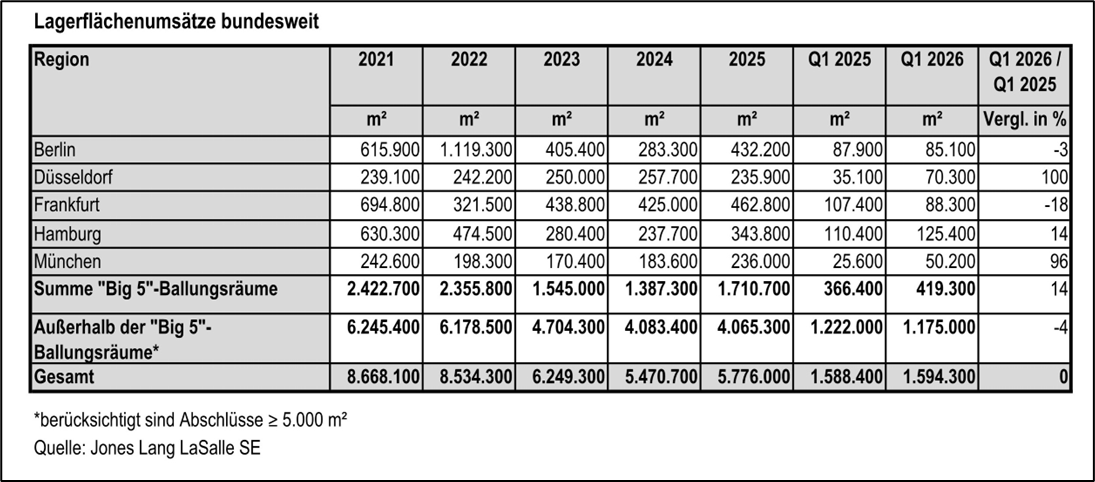
Despite geopolitical uncertainties and subdued economic growth, the German market for warehouse and logistics space has proven to be robust, taking up around 1.59 million m² (owner-occupiers and lettings) in the first quarter of 2026. Earnings were on a par with the previous year, but fell short of the long-term averages. The five-year average was undercut by ten percent and the ten-year average by eight percent. The number of contracts also declined slightly, falling by five percent to 160 contracts.
While rental revenue increased by eleven percent year-on-year, the share of owner-occupiers in total revenue fell by 34 percent. At around 244,000 m², they contributed only 15 percent to the result of the first quarter.
Sebastian Bögel, Head of Industrial & Logistics Agency JLL Germany: “In view of the additional challenges posed by drastically increased fuel prices, which are directly affecting the logistics industry, and the great uncertainty as to when the situation could ease again, stability in take-up can already be seen as a success. In addition, it is encouraging that the industry has already had to contend with many challenges in recent years, sometimes at the same time, and has repeatedly proven to be innovative and resilient. For the year as a whole, I therefore do not consider take-up of more than six million m² to be ruled out.”
Hamburg is the region with the highest turnover among the five metropolises
In the five major conurbations (Berlin, Düsseldorf, Frankfurt, Hamburg and Munich), the market turned over around 419,300 m² in the first three months. This is the best start to the year since 2022, with the previous year’s result being exceeded by 14 percent, but falling short of the five-year comparative value by eleven percent.
The region with the highest take-up was Hamburg with 125,400 m², an increase of 14 per cent compared to the previous year. The regions of Frankfurt with 88,300 m² (minus 18 per cent) and Berlin with 85,100 m² (minus three per cent) follow at a considerable distance. In contrast, the Düsseldorf and Munich regions recorded significant growth. At 70,300 m² and 50,200 m² respectively, around twice as many square metres were taken up here as in the first quarter of the previous year.
Companies from the transport, traffic and warehousing sector were the most active user group. Their take-up totalled 167,400 m², which corresponds to 40 per cent of total take-up and an increase of around 100,000 m² compared to the same quarter of the previous year. Retail companies recorded an increase of twelve percent to 61,700 m². By contrast, take-up by industrial companies slumped by half to 73,900 m².
Large-scale leases in the five main markets together achieve significantly more space
“At the same time, we observed a shift to larger leases in the first quarter. In the size class from 10,000 m², there were nine deals with a total of 222,800 m². In the first quarter of the previous year, there were eight deals spread over 159,500 m². The average deal size in this segment thus increased by almost 5,000 m²,” says Bögel , describing the market development. Two major deals in the first quarter are particularly noteworthy: an online retailer leased more than 50,000 m² in Hamburg-Allermöhe, while the Chinese logistics service provider JD Logistics secured around 40,000 m² in Ludwigsfelde near Berlin.
Meanwhile, noticeably less new space came onto the market: From January to March, around 85,000 m² of new warehouse space was completed in the five metropolitan regions, almost 60 percent less than in the first quarter of 2025. Compared to the five-year average, there is a minus of 55 percent. One third of the space was still available at the time of completion, 46 percent had been rented and the remaining space had been allocated to owner-occupiers. Around 620,000 m² are currently under construction, 58 percent of which have not yet been let. Most construction is currently taking place in the regions of Berlin (around 200,000 m²) and Düsseldorf (approx. 136,000 m²).
Munich is the first city to crack the top rent of eleven euros
Prime rents for warehouse space of 5,000 m² or more rose slightly in two of the five regions in the first quarter. In Munich, an increase of 30 cents to 11.00 euros/m² was observed and in Frankfurt by 20 cents to 8.50 euros/m². Prime rents were stable in Berlin at 10.50 euros/m², in Düsseldorf at 9.00 euros/m² and in Hamburg, where 8.50 euros/m² are achieved.
Outside the five main regions, logistics companies dominate the demand for space
At around 1.17 million m², take-up in the first quarter of 2026 outside the five conurbations was only four per cent less than in the same quarter of the previous year (Q1 2025: 1.22 million m²). However, the five-year average was missed by ten percent. Around 20 percent of total sales were accounted for by owner-occupiers.
As in the previous year, companies from the transport, traffic and warehousing sectors dominated the demand for space in the first quarter. With a share of 42 percent, this sector accounted for around half a million square meters. These include two of the largest leases: ID Logistics leased around 67,000 m² in Alsdorf and the Chinese logistics service provider Goodcang almost 65,000 m² in Rieste, Lower Saxony.
Retail companies accounted for around a fifth of total take-up, with 285,100 m² up nine per cent year-on-year. Demand from industrial companies, on the other hand, fell by a significant 56 per cent to 186,000 m², and never before in the past ten years have fewer spaces been taken up by this sector in the first quarter.
The Ruhr region leads outside the five main regions with around 129,500 m² and an increase of 30 percent year-on-year. Particularly striking is the strong commitment of Chinese companies, which account for 44 percent of sales. The Hanover/Braunschweig region follows at a small distance with 122,400 m² and the Cologne region in third place with 95,600 m².