
From textbook to reality: Stagflation in focus
In the 1970s, Chancellor Helmut Schmidt summed up a central economic policy dilemma. Behind this was the assumption of an opposing relationship: inflation rises, unemployment falls – theoretically founded by the Phillips curve. Falling unemployment was seen as an expression of economic dynamism. Inflation and stagnation therefore appeared as opposites.
But it was precisely this connection that broke down in the 1970s. The simultaneous combination of high inflation and weak growth – later referred to as stagflation – challenged economic doctrine. What was considered a theoretical contradiction became empirical reality.
Today, this scenario comes back into focus. As part of our webinar “Macro Matters – Investment Insights” (March 2026), we discussed this mixed situation: geopolitical tensions around the Iran conflict, rising oil price risks and fiscal policy debates are meeting new regulatory decisions. Traditional macroeconomic contexts are coming under increasing pressure.
In addition, once the “stagflation monster” has established itself, it develops a dangerous momentum of its own. Inflation is becoming entrenched in expectations and wage demands, while growth remains weak. An environment is emerging that can only be stabilized again at considerable economic cost. Against this background, the question arises as to whether this is merely a temporary risk or whether the first signs of a renewed stagflationary phase are already emerging. And what are the implications for real assets, especially real estate as a central component of institutional portfolios?
Stagflation as a risk – and inflation as a socio-political challenge
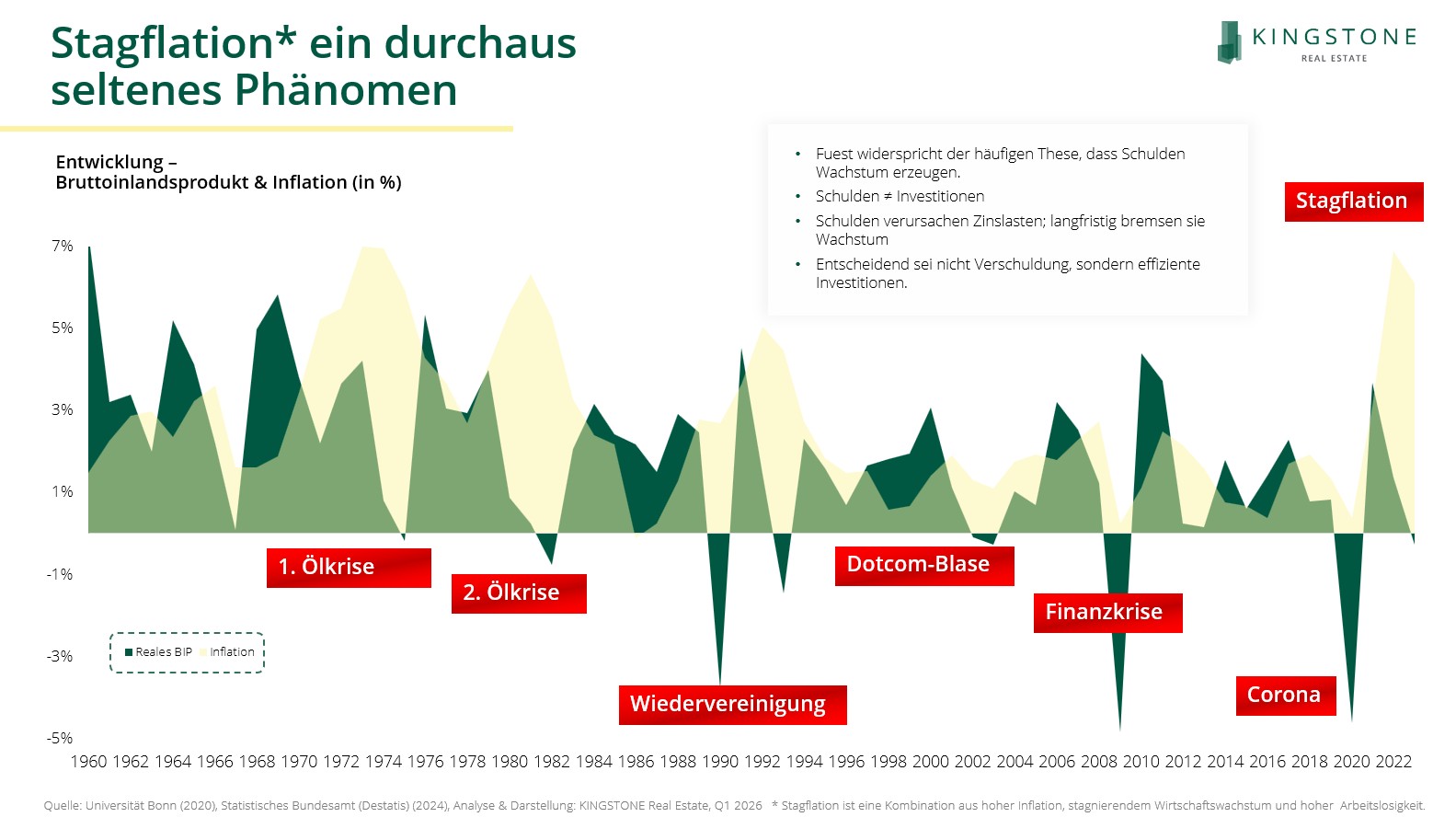
Stagflation is considered an economic state of emergency. The combination of high inflation, weak growth and rising unemployment is historically rare and is therefore often treated as a fringe rather than a baseline scenario. A look at the recent past puts this view into perspective. Energy price shocks in particular have made stagflationary tendencies more visible again. At the latest since the Russia-Ukraine war from 2022 onwards, it has become apparent how quickly geopolitical upheavals combine rising prices with declining economic momentum.
The current forecasts for Germany (Q1 2026) also do not yet fully address possible new tensions. Real GDP growth is 0.6% to 0.8%, inflation is 2.2% to 2.7%. This is not yet stagflation, but a vulnerable environment. In view of additional geopolitical risks, even this scenario seems increasingly fragile.
Inflation is not a monocausal phenomenon, but the result of an interplay of commodity prices, second-round effects and monetary policy impulses. Counterarguments such as demographic effects or technological deflationary pressure relativize these drivers, but do not replace them. Short-term shocks and political interventions currently dominate, while structural relief factors have a delayed effect.
In addition, there is an often underestimated aspect: the social character of inflation. Price increases affect households to varying degrees – especially through spending on housing and energy. These now account for around 34–35% of the German CPI (2000: less than 30%) and are thus the largest cost block. The result is a disproportionate burden on lower-income households. Inflation is thus becoming not only an economic, but increasingly a socio-political issue – between consumer habits, distribution issues and perceived justice.
Rising oil prices and their macroeconomic effects
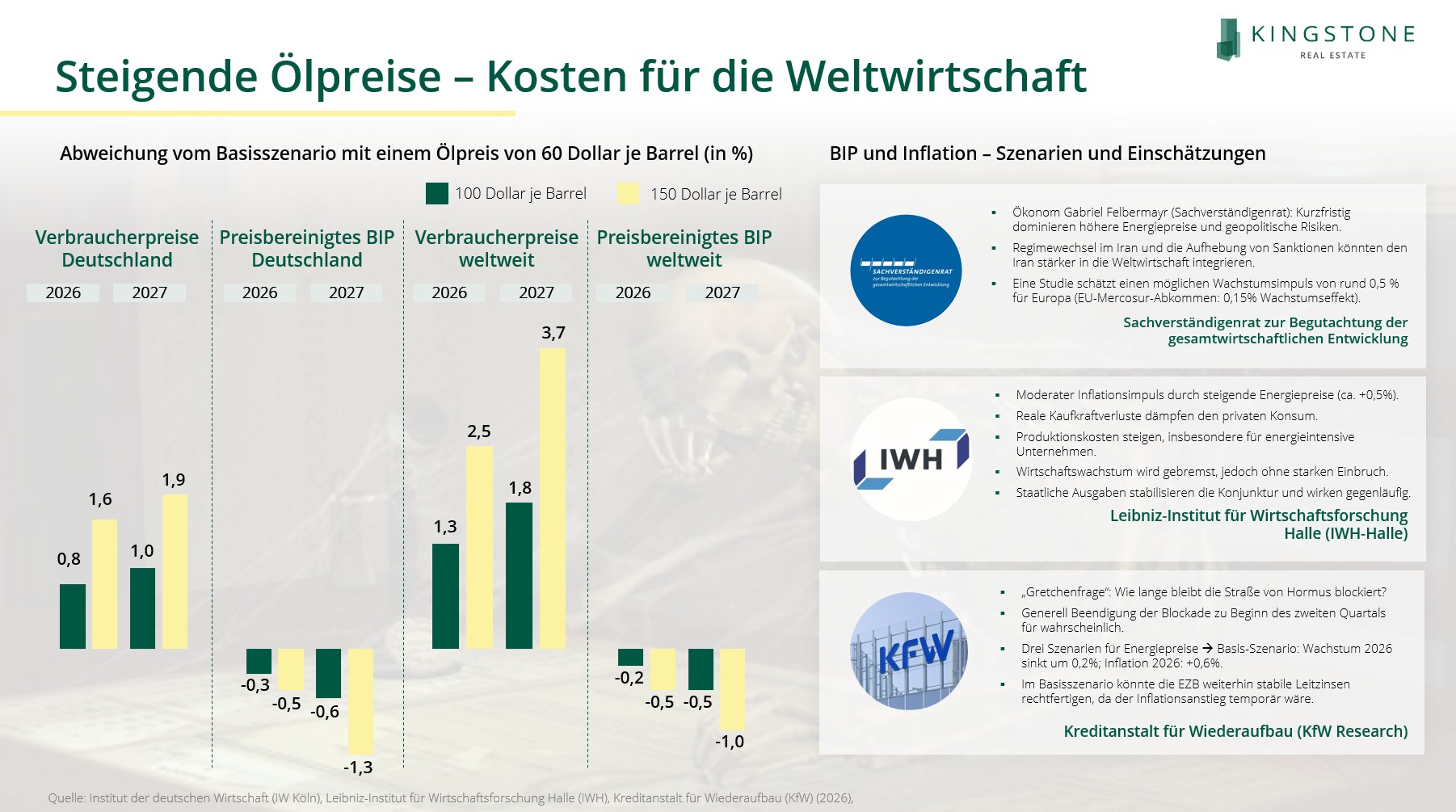
Energy prices and inflation are closely linked. Oil and gas are the “lubricant of the economy”, especially in industrial economies. Rising prices have a direct impact on costs, consumption and ultimately overall inflation.
Against this background, it is not surprising that Joseph E. Stiglitz, winner of the Nobel Prize in Economics, recently spoke of a “hand grenade for the global economy”. What is meant is the simultaneity of geopolitical conflicts, trade conflicts and political uncertainty. Particularly critical are possible disruptions to oil transports through the Strait of Hormuz. Such a supply shock would affect large parts of the global oil trade – with direct consequences for prices, inflation and economic stability. The price reaction in March 2026 – Brent from around USD 80 to around USD 90 at times – shows how sensitively the markets are reacting.
But the impact goes beyond the supply side. Oil price shocks are increasingly hitting demand through wealth effects. In the USA, consumption is strongly oriented towards equity assets – falling markets thus have an immediate dampening effect.
The consequence is clear: energy price shocks drive inflation up quickly, while growth slows down with a time lag. It is precisely this dynamic – rapid price pressure, delayed growth – that is typical of stagflationary tendencies.
The implications extend to monetary policy. Persistent inflationary pressures are increasingly calling into question expectations of falling interest rates. Rising interest rates or interest rates that remain high for a longer period of time deteriorate the framework conditions for investment – especially for capital-intensive asset classes.
Monetary policy in a stagflationary environment: Fed and ECB in comparison
In uncertain times, investors traditionally look for safe havens. The rising dollar prices indicate that the USA will continue to be perceived as such. However, a classic safe-haven mechanism is only showing itself to a limited extent: yields are not falling, but rising – driven by higher inflation expectations and the prospect of more restrictive monetary policy.
With the escalation in the Middle East, long-term interest rates have risen noticeably globally – including in Germany. In mid-March, ten-year German government bonds reached a 52-week high of over 3%. The safe haven effect is thus clearly overshadowed by increasing stagflation risks.
For the central banks, the conflict of goals is intensifying. The ECB sees rising inflation risks in the Middle East conflict with weaker growth at the same time – a classic stagflationary environment. Accordingly, Christine Lagarde emphasizes the willingness to act, while the markets are again pricing in interest rate hikes. At the same time, the ECB is aware that the necessary investments in infrastructure and defence would be burdened by excessively high real interest rates – an interest rate hike therefore remains a balancing act between fighting inflation and the ability to invest.
The Fed is acting more cautiously. Its dual mandate speaks against premature interest rate hikes. In addition, Fed Chair-elect Kevin Warsh is apparently relying on disinflationary effects through artificial intelligence – a possible argument for looser monetary policy.
Ultimately, two scenarios are emerging. First, central banks could fight inflation less consistently than communicated. Growth risks and political pressures are limiting the tightening path – inflation is here to stay, real interest rates are becoming negative. Second, rising government debt could lead to higher risk premiums. In the euro area, the ECB might then be forced to take unconventional measures such as QE again to stabilise the markets. In both cases, real interest rates remain structurally low.
When nominal interest rates rise, the real estate spread melts
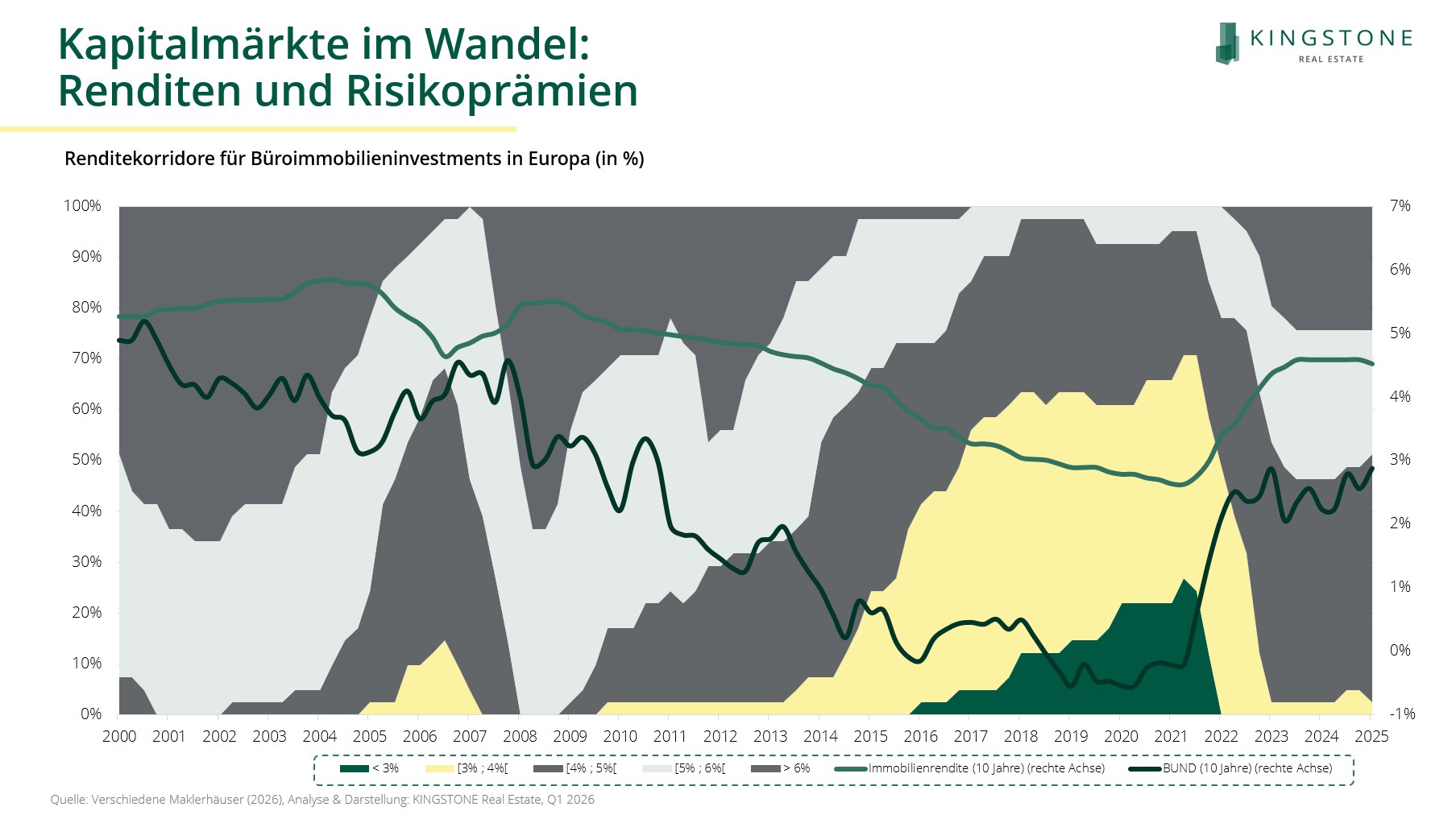
The central selling point of many years no longer applies. Real estate has long been positioned as a bond substitute with stable excess returns. It is true that yields – for example in the German office market from around 5.5% (2009) to around 2.6% (Q1 2022) – have fallen significantly. In the low interest rate environment, however, the spread to government bonds rose to as much as 350 basis points at times – a strong argument for investors.
With the interest rate turnaround, this picture has changed. The spread has since fallen to around 100 basis points and is currently around 150 to 200 basis points – much less convincing. At the same time, structural changes in individual types of use place an additional burden on classic argumentation.
In addition, there are rising financing costs, which put pressure on distribution yields and make debt capital appear less attractive. Nevertheless, this view does not go far enough: the decisive factor remains that the expected return on capital is higher than the cost of borrowing. Especially in an inflationary environment, this connection becomes more important. Debt is devalued in real terms, while inflation-protected cash flows can support total returns.
The actual classification is therefore as follows. Real estate is not a bond substitute, but real assets – with current income, value appreciation potential and diversification effects.
The Bottom Line
In the long term, pronounced stagflation conditions are not a baseline scenario, but a realistic risk. Geopolitical tensions, structural price pressures and weak growth are noticeably shifting the macroeconomic environment. Traditional contexts are losing their significance, and monetary policy leeway is becoming narrower.
For investors, this means that simple narratives no longer work. Neither the safe-haven mechanism nor the bond substitute currently offer reliable guidance. Rising nominal interest rates, volatile risk premiums and low real interest rates require a more differentiated view of risk and return.
It is precisely in this environment that real assets are gaining in importance. Not as a short-term inflation hedge, but as a stable component of robust portfolios. Real estate continues to offer current income, inflation and diversification. The decisive factor is therefore not whether stagflation occurs, but how resilient portfolios are. Real assets remain a central component of robust portfolios.