by Benjamin Rüther, Head of Fund Management Residential, and Dr. Lars Vandrei, Head of Research, Catella Investment Management GmbH
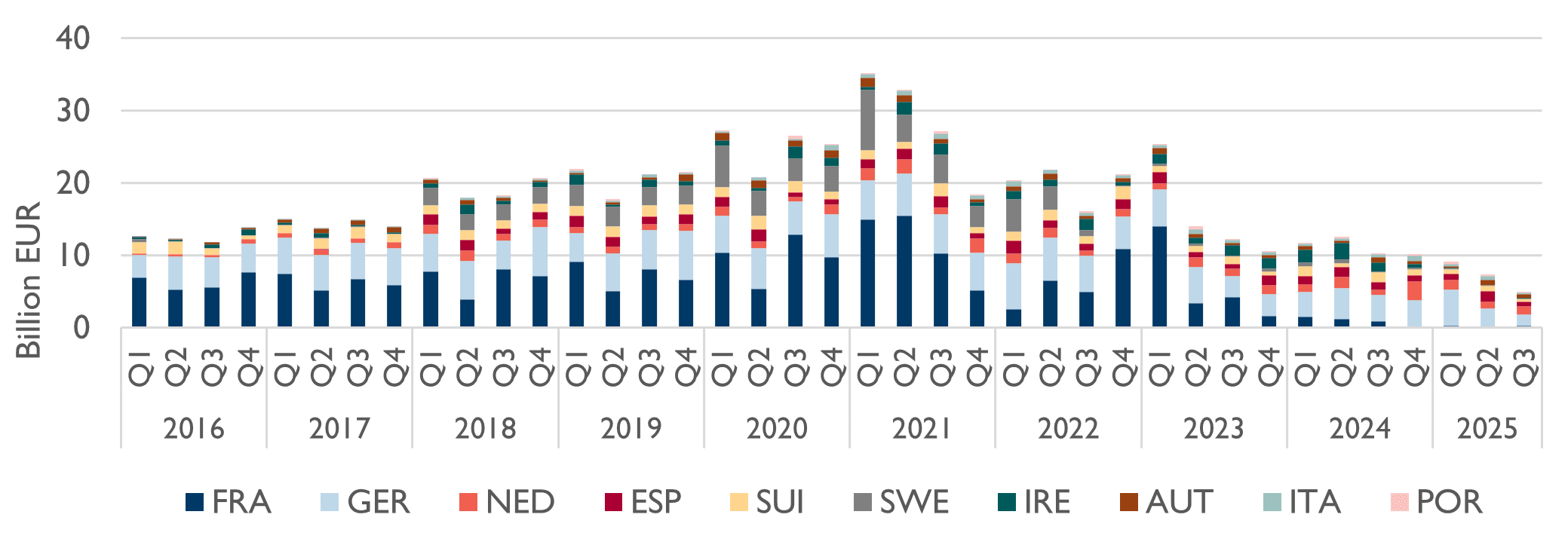
Affordable housing emerges as a cornerstone of Catella’s House View for 2026, reflecting both the structural urgency and the strategic opportunity shaping Europe’s residential markets. Across Europe, housing has become an increasingly tangible constraint in everyday life. Rising rents and house prices are part of this story, but they are not the only signals. Affordability pressures manifest differently across markets: young adults remaining longer in the parental home, households living in overcrowded conditions – particularly in the rental sector – and a growing share of tenants who struggle to cover their housing costs. Taken together, these developments paint a picture of housing markets that are no longer merely expensive, but socially consequential. All of this is unfolding against the backdrop of declining residential construction activity across Europe (see Exhibit I).
Source: RCA Western Europe | Western Europe | Apartment
What makes this pressure less immediately apparent is that it often builds up gradually. For many households, higher market rents or house prices do not immediately change their monthly budgets. As long as people remain in their current homes, affordability problems can remain abstract – something seen in headlines rather than directly affecting household finances. This changes when contracts are renewed or when owner-occupiers are confronted with higher refinancing costs. At that moment, the strain becomes concrete. Housing costs begin to compete directly with other essential expenditures, and what once seemed manageable turns into a binding constraint for everyday decisions.
Housing market pressures tend to become most visible at moments of transition. When a move becomes necessary – to change the job, household growth, or a separation occurs, relocation can suddenly become unaffordable – if rents and prices have increased sharply in the meantime, particularly relative to existing rents or previous financing conditions. In such situations, many households stay put, even when their current home no longer fits their needs. These lock-in effects leave traces in delayed household formation, in young adults remaining longer in the parental home, and in rise in overcrowded living arrangements.
The extent to which pressure is felt varies widely across Europe. Looking at the EU, the share of households experiencing housing cost overburden has declined since 2014, among tenants and owner-occupiers. In the Netherlands and France, a significantly larger share of tenant households is experiencing housing cost overburden than a decade ago, suggesting sustained pressure in rental markets despite overall improvements at the EU level. At the same time, national averages also conceal substantial intra-country disparities, as major metropolitan areas tend to experience crucial affordability challenges – due to higher demand, population growth and limited housing supply.
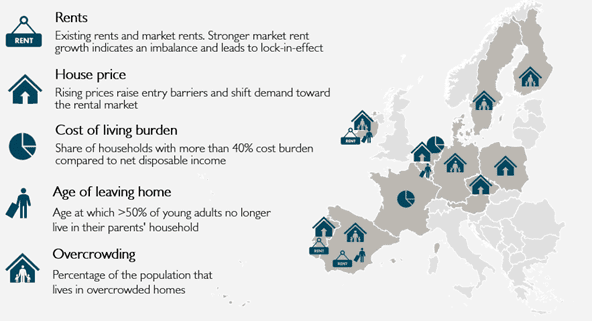
Similar contrasts appear when household formation is considered. On average, young adults across the EU are leaving home slightly younger than ten years ago. But in several countries, including Spain and Ireland, the transition to independent living has been delayed. These patterns indicate that favourable aggregate trends do not necessarily translate into improved affordability for all groups. Instead, constraints remain acute in specific markets and for particular demographic segments. Patterns of overcrowding reinforce this uneven picture. While overcrowding rates have fallen across the EU, they have risen in the rental sector, both EU-wide and on national level. This indicates that pressure is increasingly concentrated among renters, even when overall affordability statistics lighten up.
It shows that housing affordability does not follow a single trajectory. It emerges from the interplay of price developments, financing conditions, mobility constraints, regulations, and supply limitations, and it affects countries, tenure types and population groups in markedly different ways. This diversity of experiences forms the context in which both public policy responses and the role of private actors need to be evaluated (see Exhibit 2).
Against this backdrop, the EU has begun to translate its assessment into a set of concrete policy directions, articulated through the work of the Housing Advisory Board (see Exhibit 3). Rather than relying on a single lever, these recommendations span several layers of intervention. Some of them address the conditions under which housing can be delivered in the first place: accelerating planning processes, defragmenting permitting procedures, infrastructure that keeps pace with development, and better data on housing markets and building stocks. These are largely matters for public authorities, but they shape the environment in which any additional housing supply can emerge.
Other measures move closer to the physical housing stock itself. Here, the emphasis shifts to giving residential development greater priority and to making better use of what already exists before pushing further outward through urban expansion. This reflects an understanding that affordability pressures cannot be eased by new construction alone. The way existing buildings are used, maintained and upgraded plays an equally important role.
This logic is reflected in the EU’s growing focus on what is increasingly described as “holistic affordability”. In practice, this means looking beyond advertised rents or purchase prices and considering the full set of costs households face over time. Construction quality, energy performance and maintenance needs all shape whether housing is affordable throughout its life cycle. Seen from this perspective, affordability and sustainability are closely linked, and investments in energy efficiency or modern construction methods become vital.
More complex are policy approaches aimed at expanding social and affordable rental housing through new delivery and financing models. These initiatives aim to strike a balance: rents that households can sustain, and projects that remain economically viable for investors. For institutional investors, the emerging EU agenda nevertheless offers a clearer frame of reference. Certain priorities are increasingly visible: a stronger focus on affordable rents, greater attention to the potential of existing stock, the use of cost-efficient and modular construction and improved data transparency to support more informed risk assessment.
Certain priorities align naturally with long-term investment considerations: focusing on affordable rental housing in markets where housing cost overburden is rising, strengthening the role of existing stock, supporting cost-efficient and modular construction techniques, and improving data transparency as a basis for more robust risk assessment.
Taken together, these developments point to a gradual repositioning of affordable housing within the institutional investment landscape. Under stable and transparent regulatory conditions, affordable housing can provide steady income streams, lower volatility and sustained social relevance. Addressing Europe’s housing affordability challenge therefore extends beyond public policy alone. It also depends on mobilising private capital in ways that balance social objectives with long-term investment viability.
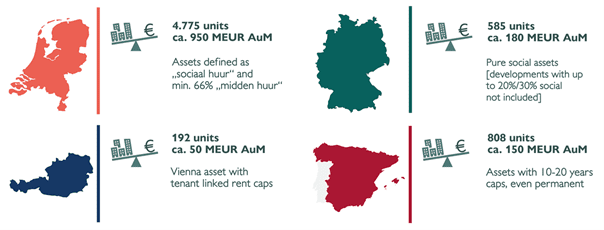
Catella has been active in this field for over 15 years, based on the two cornerstones of social housing and affordable housing. Accompanied and supported by investors who emphasise the ‘S’ in ESG as much as the unambiguously important ‘E’, Catella has developed into a leading institutional manager of social housing in Europe, with a strong presence in Germany, the Netherlands, Spain and, most recently, Austria.
Including Dutch apartments, now referred to as ‘midden huur’ in the extended social housing sector, the portfolio of 50 residential assets gives more than 6,700 households the opportunity to live affordably in line with their household income (see Exhibit 4).
Over 1,100 households in Spain live in Catella social housing in Madrid, Vitoria and Pamplona. As in Germany, there are regional differences in Spain in terms of occupancy restrictions and individual subsidy conditions. Various subsidy programmes require local knowledge and have different economic implications – from capped rents based on market rents to construction subsidies. Madrid region in particular, with its annual growth of approximately 120,000 new inhabitants in recent years but only 20,000 completed flats, faces a Herculean task.
What is the local government doing? It is trying to help by creating incentives and streamlining reasonable regulations: fewer parking spaces needed for building permit; activating tertiary use land plots to quickly change usage to regulated residential. These will have a 10% construction bonus and the possibility of 20% higher density. Initial plan of granting 40 years cost-free leasehold were increased to 75 years. Modular construction is to be favoured in order to accelerate delivery. Rents will be regulated, however at a still profitable level, depending on locations and individual building specifics, approximately 20-30% lower than market rents.
When quicker permits, higher density, leaseholds, faster construction, and fewer parking spaces result in 20-30% lower construction costs – protected housing or freely categorized social housing in Spain is as profitable as conventional housing – at lower risk and a clear advantage: bringing desperately needed affordable housing to the Madrid region.
Affordable housing in the free market is the second cornerstone of Catella’s strategy.
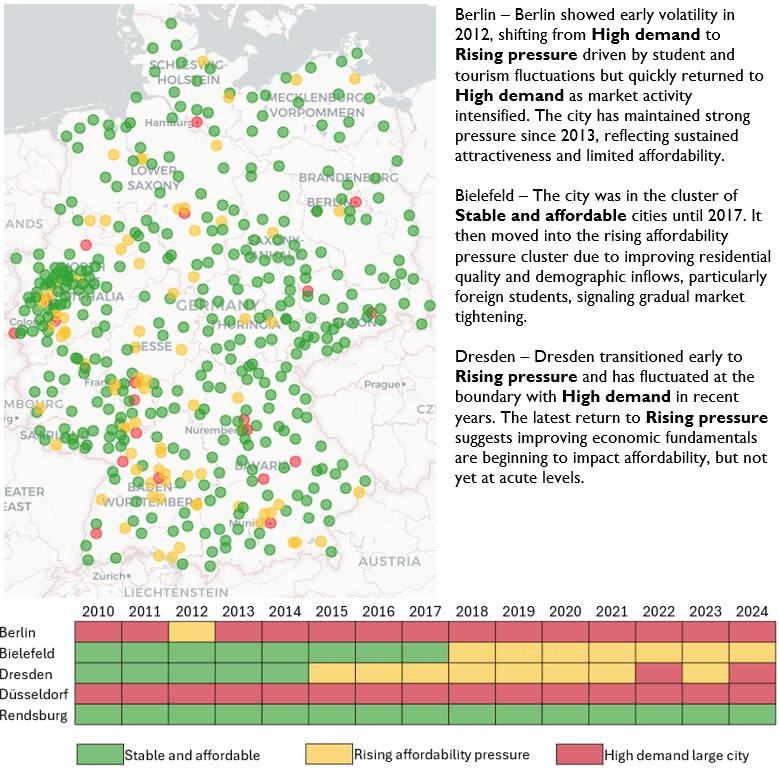
Therefore, Catella is identifying Affordability Clusters of German cities and their transition pattern between being affordable overall, showing increasing market pressure, and moving into high demand status. This way, Catella can identify long-term needs of affordable housing at an early stage. So not only Berlin, Munich and Cologne are highly pressurized cities but also regional centres like Bielefeld or Dresden as important centre in Eastern Germany experience rising affordability pressure. These cities are likely to record above-average rent growth and, consequently a growing need for affordable housing. By contrast, Düsseldorf has consistently been a high-demand market with persistent affordability challenges throughout the period under review, whereas the city of Rendsburg has remained broadly affordable (see Exhibit 5).
Although the EU is stepping in to help solve the different living issues each member state has: in the end solutions will be local and only knowledge and experience in legal and cultural habits of the rental market, subsidy systems, construction costs and obstacles as well as market research will be a profound base to lay your decision on social responsible investments in Europe to really make a change for the “SG” in ESG.
Catella is committed to further expanding its already significant investments in social and affordable housing, together with its institutional partners, thereby actively contributing to the solution to housing pressures across Europe.