
The energy transition is not merely replacing power stations. It is breaking down their physical properties into individual services. What used to be provided free of charge by machines weighing several tonnes now increasingly has to be metered, generated using technology and paid for. Physics is becoming an asset – and new markets for infrastructure are emerging.
The European Investment Bank is investing 19 million euros in a company whose product sounds, at first glance, surprisingly abstract: Reactive Technologies measures, amongst other things, the inertia of the electricity system, grid strength, oscillations and voltage stability in real time for electricity network operators. The technology is designed to give network operators a more accurate picture of just how stable their grid actually is.
Why is a public development bank investing millions in measuring a characteristic that most electricity customers have probably never even heard of?
The answer begins with one of the oldest rules of physics: mass is inert.
What happens if a power station suddenly breaks down?
Let’s imagine that a large power station fails in the blink of an eye. One moment it was still generating electricity; a second later, its output is missing from the grid. Because generation and consumption must be in balance at virtually all times, the grid frequency begins to deviate from its 50 hertz.
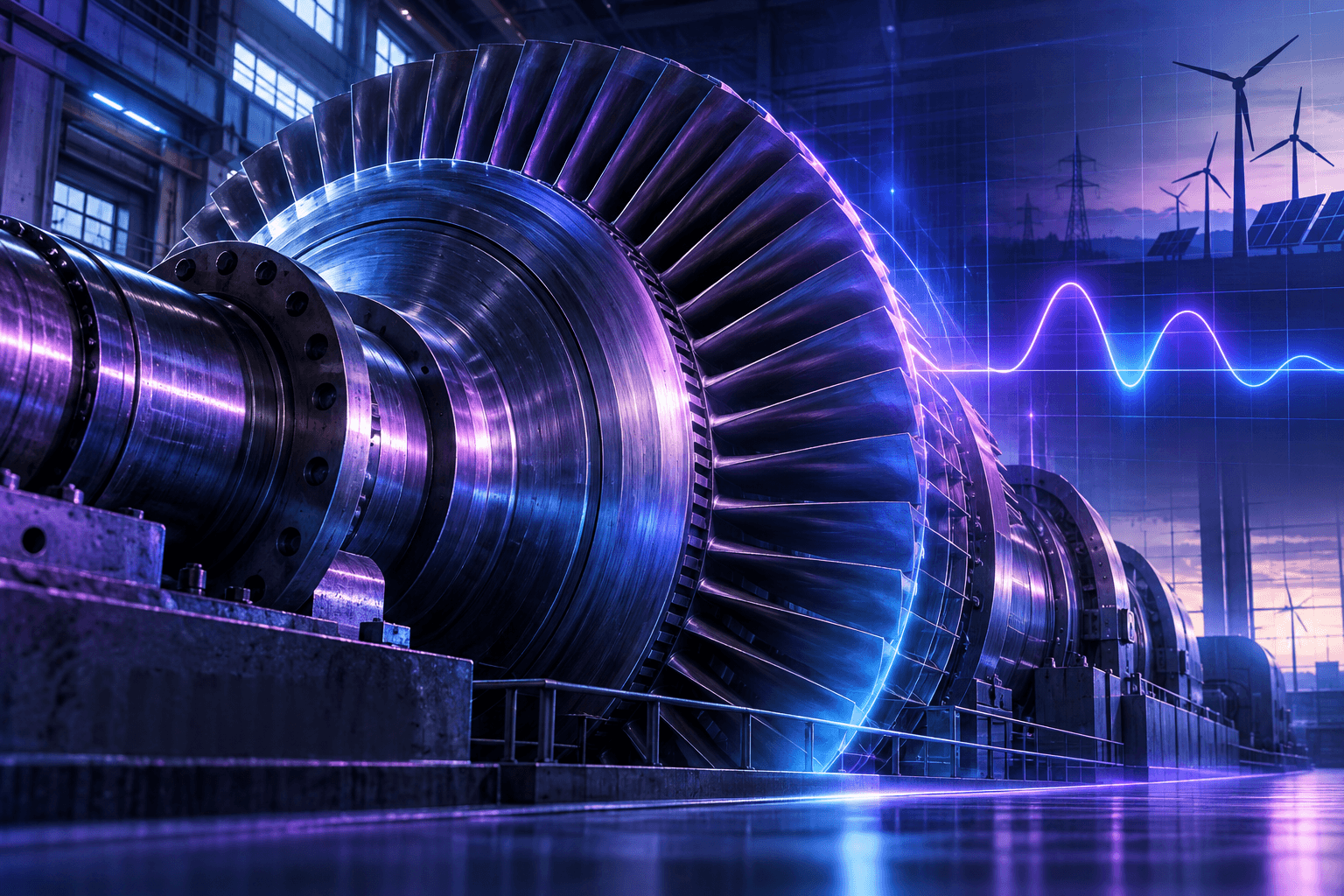
In a conventional power system, the following happens: the huge turbines and generators at the remaining conventional power stations initially continue to turn. They contain many tonnes of rotating mass – and thus kinetic energy. Due to their inertia, they immediately feed energy into the grid, thereby slowing down the change in frequency.
And, crucially, this happens immediately. No one needs to notice the drop in frequency at first. No control room needs to press a button. No market participant needs to react. The physics take care of it by themselves.
It is precisely this inherent and immediate response to a power imbalance that the Federal Network Agency refers to as ‘instantaneous reserve’. Its purpose is to prevent the frequency from reaching critical limits too quickly following a disturbance.
Rotating masses do not provide a permanent solution to the problem. But they buy the power system something extremely valuable: time. Time during which other mechanisms can take over to stabilise the frequency.
The energy transition is robbing the grid of its flywheel effect
Photovoltaic modules do not have turbines. Whilst wind turbines do have rotating parts, they are typically connected to the grid via power electronics; their mechanical inertia is therefore not automatically available to the grid in the same way as with a conventional synchronous machine. Nor does a battery storage system have a flywheel weighing hundreds of tonnes.
The more the electricity system shifts from conventional synchronous generators to renewable and inverter-based generation, the less we can assume that sufficient instantaneous reserve will simply be available. The Federal Network Agency now also speaks of an “enormous demand that must be met in the short term” and of the need to tap into new potential (Federal Network Agency).
The power station is broken down into its constituent parts
This illustrates the services that conventional power stations have, until now, provided as a matter of course as an added bonus. From an economic point of view, a conventional large-scale power station has never been merely an electricity-generating plant.
With its large synchronous machines, it supplied not only electrical energy but also physical properties such as inertia and, consequently, momentary reserve. These capabilities were technically included as part of the package, but did not constitute a standalone business model.
With the restructuring of the electricity system, this package is being unravelled. Characteristics that could previously be taken for granted must increasingly be measured, procured and remunerated. What was previously an implicit physical characteristic is now becoming an explicit economic good.
Measure first, pay later
This brings us full circle to the EIB’s investment in Reactive Technologies.
Among other things, the GridVerix platform measures the actual inertia of the electricity system in real time. The EIB also cites system strength and voltage stability as key indicators. The aim is to enable grid operators to identify vulnerabilities more effectively, integrate more renewable energy and, at the same time, ensure the stability of the grid.
Reactive Technologies thus epitomises one aspect of this new market: making scarcity visible.
On the other hand, there are technologies that can provide what is lacking.
The battery is fitted with an electronic flywheel
A battery storage system cannot conjure up a rotating mass. However, it can replicate some of its stabilising effects electronically. To do this, it requires so-called grid-forming inverters.
The difference may sound technical, but it is conceptually simple: a conventional grid-following inverter operates in line with an existing, stable grid. A grid-forming inverter, on the other hand, can actively impose a voltage itself and thus contribute to stabilising the grid within its technical limits. The Federal Network Agency expressly points out that, with such inverters, the inertia can even be configured within the operating limits.
The stabilising effect of the rotating steel can thus increasingly be replicated using power electronics, control technology and stored electrical energy.
This also changes the role of the asset. A suitably equipped battery storage system is not merely a container that stores electricity cheaply and releases it later at a higher price. It can provide various services to the electricity system – including functions that were previously provided by conventional power stations. This broadens the potential revenue profile.
The 2025 System Stability Report identifies significant potential, particularly in large-scale battery storage systems. Technical development is already at an advanced stage; thanks to numerous pilot projects, these systems are expected to make a significant contribution to instantaneous reserve capacity within just a few years.
Physics is becoming a market
Germany has now set up its own procurement mechanism for this purpose.
Since 22 January 2026, German transmission system operators have been procuring instantaneous reserve on a market-based basis. For the initial period up to January 2028, there are basic and premium products with fixed remuneration rates. For 2030, the transmission system operators have already set out their requirements by control area; from the first quarter of 2027 onwards, they also intend to publish annually the amount of instantaneous reserve that has been contracted.
The Federal Network Agency describes market-based procurement as a “key pillar” for meeting the identified demand (Federal Network Agency). Its reasoning behind the initial choice of a fixed-price system is revealing: given the discrepancy between supply and demand, and the fact that grid-forming technologies still need to be developed, the aim is to create targeted market incentives and enable the emergence of a functioning market.
The regulator is therefore not waiting for this market to emerge of its own accord. The procurement framework is designed to encourage investment in the necessary technologies and provide suppliers with planning certainty.
Everyone’s talking about energy shortages. But physics is also becoming scarce. Scarcity becomes measurable. Measurable scarcity becomes a resource. And a resource generates a cash flow.
📌New sources of revenue for institutional investors
The EIB’s funding for Reactive Technologies is a prime example of a new infrastructure economy: what used to be readily available as a physical property is now becoming scarce – and anything that is scarce and indispensable comes at a price.
This shift can be observed particularly clearly in the case of the instantaneous reserve. In the past, rotating steel weighing several tonnes was sufficient for this purpose. In future, the same function will increasingly be generated using technology and remunerated as a service in its own right.