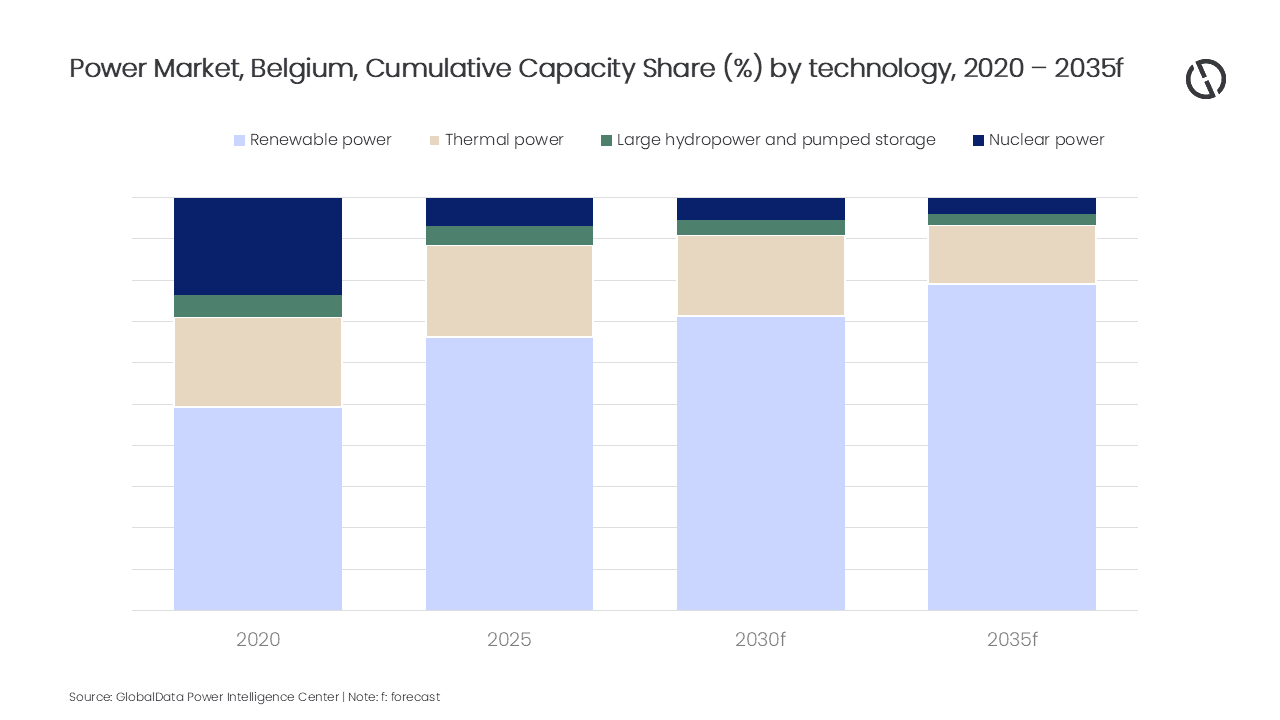
Belgium’s power sector is restructuring around solar and wind power as its nuclear fleet shrinks, with installed nuclear capacity falling to 2.1 GW in 2025. As output from the remaining reactors declines, security of supply increasingly depends on the expansion of renewables, flexible capacity secured through the Capacity Remuneration Mechanism (CRM), and imports from neighbouring markets, according to GlobalData, a leading intelligence and productivity platform.
GlobalData’s latest report, “Belgium Power Market Trends and Analysis by Capacity, Generation, Transmission, Distribution, Regulations, Key Players and Forecast to 2035”, reveals that Belgium’s installed power capacity is projected to grow at a compound annual growth rate (CAGR) of 5.8 per cent between 2025 and 2035. Over the same period, the share of renewables in total capacity is expected to rise from 66.3% to 79.0%, whilst the share of nuclear capacity is projected to fall from 7.0% to 4.0%.
Attaurrahman Ojindaram Saibasan, Power Analyst at GlobalData, comments: “Belgium’s nuclear phase-out has been partly reversed but not undone. The 10-year extension of Doel 4 and Tihange 3 to 2035, together with the repeal of the phase-out law in 2025, retains around 2GW of firm, low-carbon capacity in the system and reopens the option of extended operation or new builds. However, with no new reactor having been committed to, the bulk of future supply growth must come from solar PV and wind.”
Solar PV is already the largest technology in Belgium’s energy mix, accounting for 43.4 per cent in 2025, and is forecast to more than double from 12.8GW to 28.6GW by 2035. Offshore wind is expected to rise from 2.3 GW to 5.6 GW as the Princess Elisabeth Zone in the North Sea is developed, supported by Princess Elisabeth Island, the world’s first artificial energy island. As these new installations operate at lower capacity factors than the nuclear power stations they are expected to replace, generation is expected to grow more slowly than capacity, from 69.2 TWh in 2025 to 95.3 TWh by 2035.
Saibasan adds: “The CRM has become Belgium’s main tool for keeping the lights on during the nuclear transition. Its auctions are underwriting new combined-cycle gas-fired power stations such as Flémalle and Seraing, alongside a rapidly growing fleet of battery energy storage systems and demand response capacity. With electricity demand forecast to rise from 77.8 TWh in 2025 to 93.4 TWh by 2035 as transport, heating and industry become electrified, winter evening peaks – rather than annual energy requirements – will determine the limits of system adequacy.”
Belgium was a net electricity importer in 2025, with net imports of around 13.4 TWh, drawing on interconnections with France, the Netherlands, Germany, Luxembourg and the UK, including the Nemo Link and ALEGrO HVDC cables. Planned hybrid interconnectors routed via Princess Elisabeth Island could further deepen this integration. However, onshore grid reinforcements such as the Ventilus and Boucle du Hainaut lines, which face local opposition and lengthy permitting processes, will determine how quickly North Sea wind power can reach industrial demand centres.
GlobalData expects new power generation investment of approximately $11.9 billion in Belgium between 2026 and 2030, with wind accounting for 47.9 per cent and solar PV for 44.8 per cent. This excludes the substantial expenditure required for transmission, interconnectors, the energy island and battery storage.
Saibasan concludes: “Belgium’s transition now hinges on implementation rather than direction. Delivering the Princess Elisabeth Zone, strengthening the onshore grid, and securing sufficient firm and flexible capacity through the CRM will determine whether the country can replace lost nuclear generation without increasing its reliance on imports or exposing consumers to higher prices.”