
The market for retail real estate continues to show clear polarisation: while classic inner-city prime locations and many shopping centres are still in the process of pricing in many places, food-anchored specialist stores and retail parks confirm their role as the resilient core of the investment market. This became clear at the online press conference “Retail real estate 2026 – dead retail, lively specialist stores?”. Participating experts were Nicole Römer (Head of Retail Germany, Colliers), Prof. Dr. Andreas Link (Managing Director, imtargis), Jens Nagelsmeier (Head of Transaction Retail & Healthcare, HIH Invest) and Patrick Brinker (Head of Real Estate Investment Management, Hauck Aufhäuser Lampe).
According to Colliers, the transaction volume for retail investments in Germany in 2025 was around €5.8 billion (2024: €5.0 billion), well above the €5 billion mark again. In 2025, retail reached a share of around 23 percent of the total commercial real estate market – at a similar level to offices and industry/logistics. Nicole Römer classifies: “So much for the topic, the retail trade is dead. The systemically important retail sector has already proven its resilience during the Corona years and is currently confirming this role. Investors reward the combination of predictable cash flows, long-term leases and a high level of relevance to everyday uses. Against this backdrop, it is hardly surprising that specialty stores and retail parks accounted for a large part of the total retail transaction volume in 2025.”
Specialist stores and retail parks accounted for around 48 per cent of the retail transaction volume in 2025. Within the segment, food retailers and drugstores will remain the central anchor tenants; the share of food-anchored specialty stores and retail parks was around 28 percent of the total retail transaction volume in 2025. In terms of net initial yields, the food retail and specialty stores segment has recently stabilized. Compared to the ten-year German government bond, the yield differential was around 240 to 270 basis points, according to Colliers.
Structurally, the market continues to be fragmented and granular. In the retail park segment, Colliers registered a total of 133 deals with a volume of around 2.8 billion euros in 2025. Only 23 transactions were portfolios; however, they accounted for around two-thirds of the volume. 63 percent of the transactions were below EUR 10 million per asset. Foreign investors were involved in only around ten percent of transactions in 2025, but accounted for more than half of the volume via large-volume portfolios.
In 2026, Hauck Aufhäuser Lampe will continue to focus on food-anchored properties with a manage-to-core/value-add approach in retail. Patrick Brinker explains: “Large-scale approved hypermarkets are particularly suitable for developing them into modern local supply centres by dividing up space and supplementary tenants, such as full-range retailers, discounters and drugstores.” Patrick Brinker also points to the stable demand side in the local supply segment: “The expansion of food retail and drugstores continues to ensure solid demand for space. We see a high level of rental security, especially at established locations.” This is a key factor for investors: “This stability of use forms the basis for reliable cash flows – even in an overall challenging market environment.”
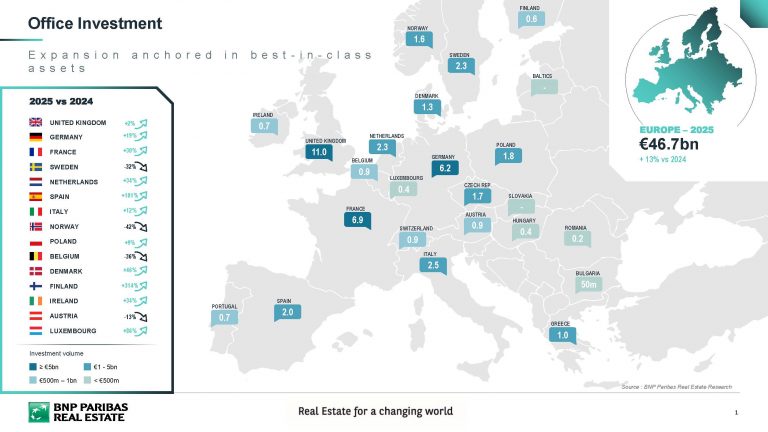
HIH Invest is also sticking to its focus on local supply properties and at the same time is working on expanding its investment universe – both in terms of larger volumes and geographically. Jens Nagelsmeier, Head of Transaction Retail & Healthcare at HIH Invest, points to a resurgence in demand for European investments: “We are observing that institutional investor interest is moving more strongly towards Europe again. In some European markets, the real estate cycle is already more advanced than in Germany and offers correspondingly attractive return opportunities.”
In Spain, HIH Invest sees net initial yields of around seven percent for food-anchored retail parks and thus a significant spread compared to the German core segment. In addition to Spain, the house examines France, Benelux, Austria, the United Kingdom and northern Italy, among others.
In contrast, there is growing interest in inner-city commercial buildings and prime locations, but buyers remain predominantly private investors and family offices. Institutional players continue to act cautiously in view of outstanding rent adjustments, insolvencies and conversion requirements. “If people buy in prime locations, they are currently mainly buying from private and family offices,” says Römer.
For 2026, the panelists expect moderate growth in the transaction markets, in particular due to more supply from portfolio adjustments and a renewed increase in activities on the financing side. In terms of price, the experts expect a sideways movement rather than strong corrections. Additional impetus could come from individual large-volume shopping center transactions, provided that operator and leasing concepts provide the necessary stability and transparency. Nagelsmeier summarises: “We are seeing increasing movement on the supply side, partly due to portfolio adjustments and refinancing pressure: At the same time, pricing in many sub-segments has largely been completed. This creates the necessary planning security to implement transactions more actively again.”