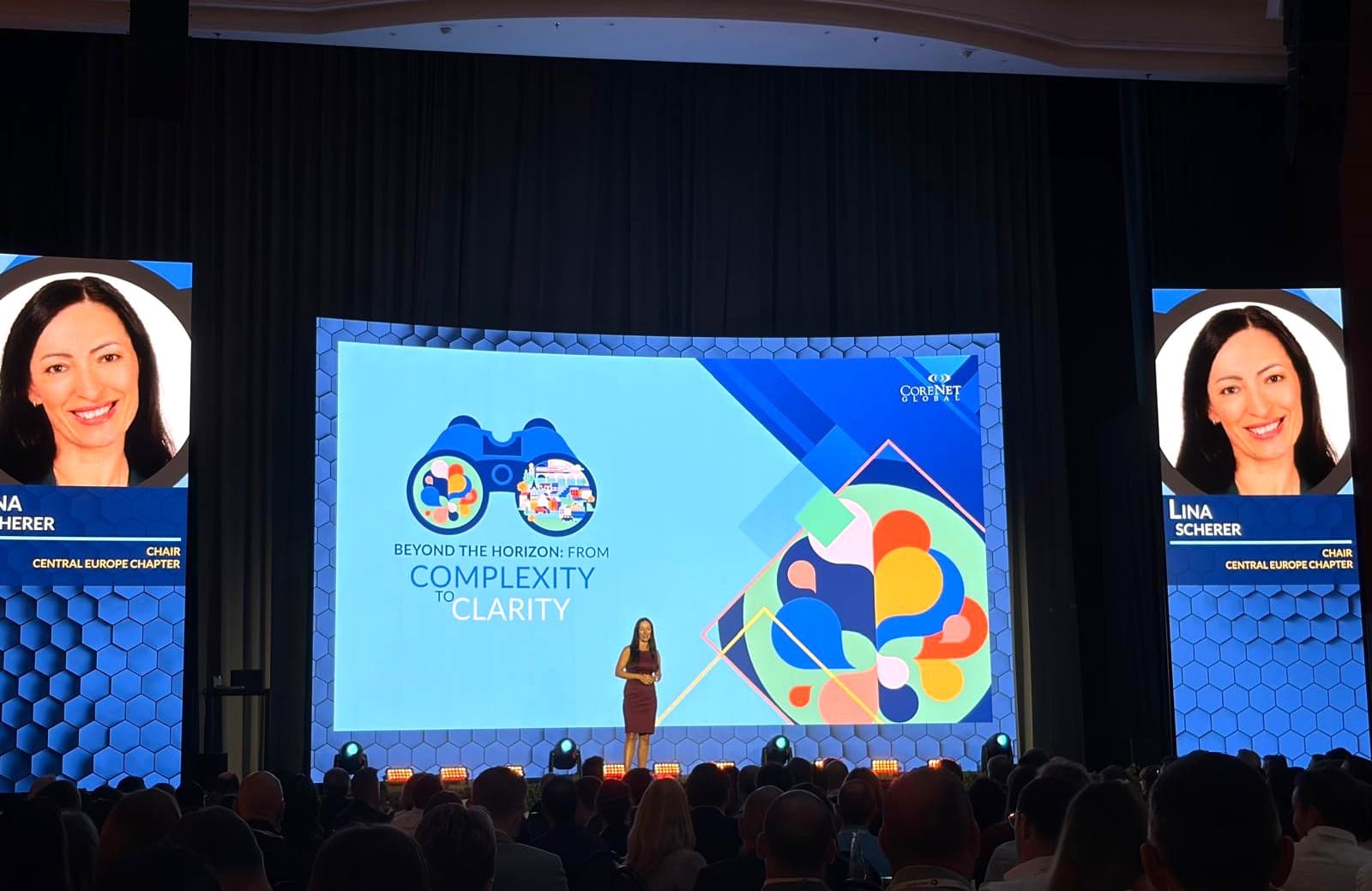
Complexity is becoming the norm and corporate real estate management (CREM) is taking on an increasingly strategic role in companies. This is one of the key findings of this year's EMEA Summit of CoreNet Global (CNG), which took place for the first time in Munich from 8 to 10 September. Under the motto "Beyond the Horizon: From Complexity to Clarity", international corporate real estate experts discussed how real estate strategies must evolve in the face of geopolitical uncertainties, technological changes and new demands on working environments.
"Today, corporate real estate is thought far beyond space, locations and costs. Real estate decisions must make a measurable contribution to the overarching corporate goals, namely resilience as well as to attracting talent, corporate culture and the performance of an organization," says Lina Scherer, President of CNG's Central Europe Chapter. "The summit in Munich showed very clearly how much this is changing the self-image of our profession."
Resilience is becoming more of a focus
Geopolitical developments, energy supply, climate issues and demographic changes are increasingly influencing real estate decisions. Companies must therefore align their portfolios more closely to be able to react to different developments. Scenario planning and flexible strategies are becoming increasingly important.
For CRE managers, this means no longer just reacting to changes. Rather, it is about recognizing possible developments at an early stage, playing through different scenarios and setting up real estate portfolios in such a way that they support the company's ability to act.
"The past few years have shown that we can no longer assume a return to long-term stable conditions," says Scherer. "The decisive ability will therefore be to make good decisions even under uncertainty. To do this, companies need reliable data, different scenarios and real estate strategies that can adapt to changing conditions."
From the area to the result
Another key development is the changed view of the workplace. Instead of just asking how much space a company needs, the focus is increasingly on what this space should do for the company. Working environments are thus increasingly viewed from the point of view of productivity, collaboration, corporate culture, employee loyalty and user experience. Especially in view of hybrid working models, the focus remains on people. Personal encounters, belonging and shared identity are becoming increasingly important. The task of corporate real estate is therefore increasingly to create places that offer recognizable added value compared to purely digital work.
"The discussion about the future of the office is no longer just a space discussion," Scherer explains. "The decisive factor is what contribution a place can make to collaboration, identification and performance. Technology is becoming increasingly important, but it does not replace human connection."
AI is changing decisions in corporate real estate
Accordingly, the increasing importance of artificial intelligence took up a lot of space in Munich. AI is already influencing workplace strategies, portfolio analyses, forecasts and decision-making processes, among other things. At the same time, technological progress is increasing the requirements for the quality and interpretation of data. After all, data alone does not create added value. It is crucial to place it in the respective corporate context and to derive concrete options for action from it. This is also changing the demands on CRE teams. In addition to real estate expertise, technological skills and a deeper understanding of the business models and strategic goals of one's own company are increasingly required.
Corporate real estate moves closer to the core business
According to CoreNet Global, these developments are leading to corporate real estate working more closely with other divisions. Today, real estate decisions touch on questions of corporate strategy, personnel recruitment, sustainability, digitalization, energy supply and business continuity in equal measure.
"For me, this is one of the most important messages from Munich: Corporate real estate is increasingly sitting at the table when strategic corporate decisions are made," Scherer sums up. " Our task is to understand global developments and to derive concrete decisions for locations, portfolios and working environments. If you think technology, data and human needs together, you can make corporate real estate a real strategic value driver."
The CoreNet Global EMEA Summit took place from September 8 to 10, 2026 in Munich. The focus was on strategy and portfolio management, workplace, sustainability, technology and leadership, among other topics. In 2027, the EMEA Summit will take place in London from September 20 to 22.