In the seven largest German office letting markets, a total of 2.6 million square metres of take-up was achieved in 2025. This means that the result is around 2 percent above the previous year's figure. Frankfurt showed the strongest momentum with an increase of 57 percent, followed by Cologne with an increase of 14 percent. Düsseldorf was able to confirm the previous year's result. In the other cities, on the other hand, a decline was recorded due to declining large-scale deals over 5,000 square metres. The largest losses were recorded in Stuttgart (-27 percent) and Berlin (-15 percent).
Continued strong competition for premium new construction
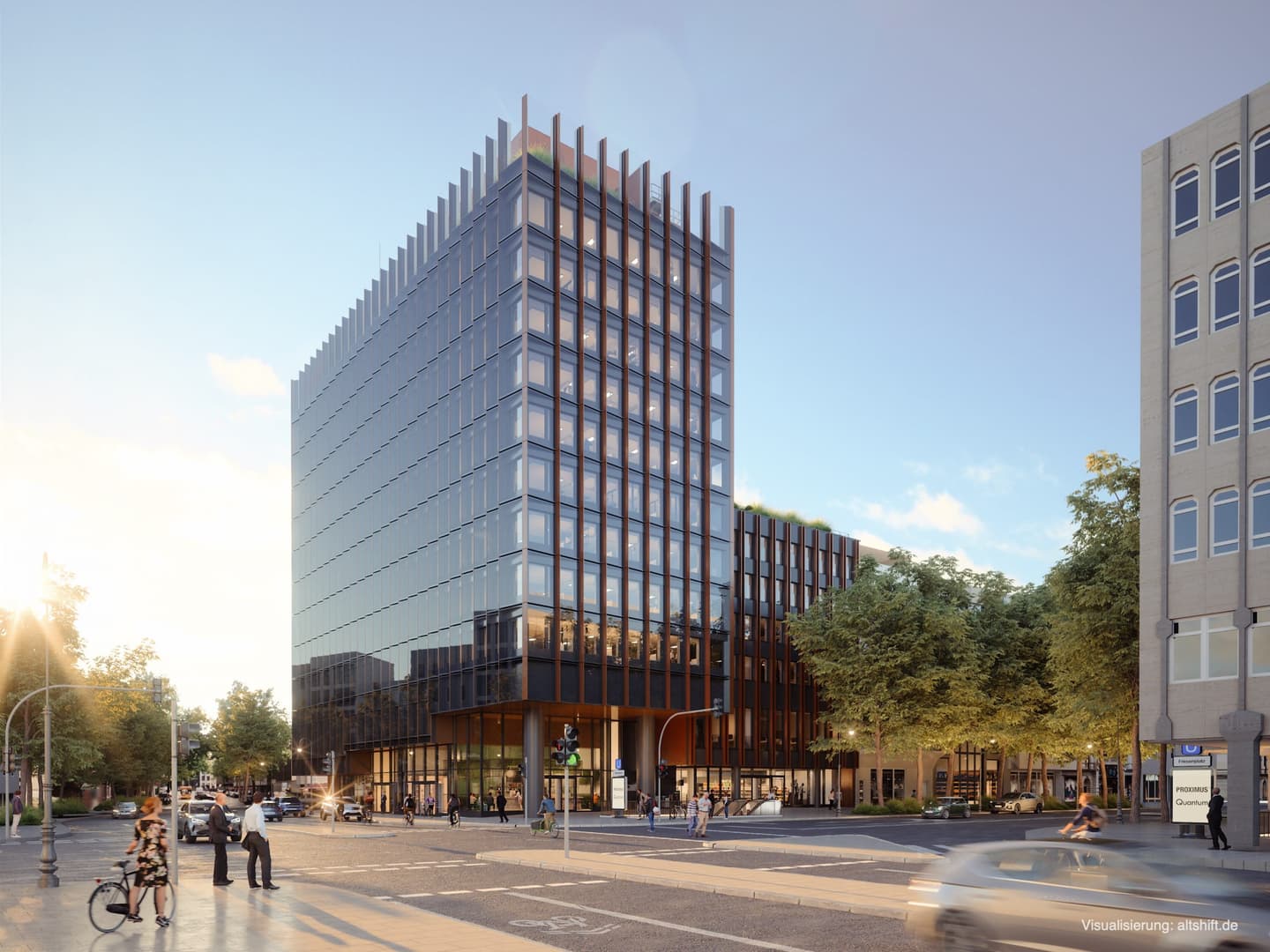
Cem Ergüney, Head of Office Letting Germany at Colliers: "Take-up in 2025 confirmed the previous year's result despite declining large-scale deals. Deals of more than 5,000 square metres reached around 725,800 square metres, a similarly low level as in the previous year. At the same time, the 1,000–2,000 square meter and 2,000–5,000 square meter size segments showed a slight upturn, with an increase of 4 percent each. While even larger lettings dominated the market in the first half of the year, a significant number of large-volume requests shifted to the leasing activities of 2026. It is also noteworthy that nine of the ten largest deals are for project developments. This underlines the continuing high importance of high-quality new construction space and confirms the continuing characteristic flight-to-quality."
Slump in completion volume expected from 2027
With a completion volume of around 1.3 million square metres and an occupancy rate of 66 per cent, new construction activity in 2025 was slightly below the previous year's figure. The project pipeline of around 1.4 million square metres expected for 2026 is directly linked to the previous two years in terms of volume. Looking ahead to 2027, it is foreseeable that the project volume will decline by around 25 percent. There are clear differences in the top 7 locations. While a comparatively high volume of new construction will come onto the market in Berlin in 2026 at 616,500 square meters, the pipeline will almost halve in the following year. A similar development can be seen in Hamburg and Stuttgart. In Düsseldorf, the declines go even further: With only two project developments for 2027, new construction activity there is almost at a standstill. Frankfurt and Cologne, on the other hand, are moving sideways. Only in Munich does an increase to 348,500 square meters of new construction space indicate a recovery.
Vacancy rate not yet at its zenith
At the end of 2025, the vacancy rate rose by 1.2 percentage points year-on-year to 8.5 percent, reaching its highest level since 2011. The trend of increasing space availability is thus continuing as forecast, as the vacancy rate has more than doubled since 2020. "For 2026, we expect a further increase in the vacancy rate in all top 7 locations. Despite the low project development pipeline, it should be noted that not all new construction sites are directly absorbed by the market and in some cases even enter the statistics directly as vacancies. Large-scale deals also primarily concern project developments and therefore do not lead to the use of existing space. In addition, the market is characterized by continued negative absorption. Land levies and consolidations exceed demand, so that even without significant new construction impulses, additional vacancies are created. In principle, owners continue to face the challenge of making their properties fit for the future and adapting them to current demand patterns," Ergüney analyses.
Prime rents continue to rise
Prime rents continue to rise in six of the top 7 cities and are thus above the previous year's level. The driver of this development is the continuing high demand for high-quality, modern office space. The strongest growth was recorded in Munich with 59.00 euros per square metre and Frankfurt with 54.00 euros per square metre – each with an increase of around 10 per cent. Hamburg follows with an increase of 9 percent to 38.00 euros per square meter. Berlin, Düsseldorf and Cologne are recording moderately rising prime rents of around 5 percent. Only Stuttgart is declining and recording a decline for the first time with a minus of 3 percent to 36.00 euros per square meter. Average rents, on the other hand, are developing more heterogeneously: The largest increases are in Frankfurt with 24 percent and Hamburg and Munich with 10 percent each. Düsseldorf and Cologne recorded moderate growth of one percent each, while Stuttgart (-17 percent) and Berlin (-11 percent) showed a declining trend. "Due to the high demand for high-quality office space, especially in central locations, a further increase in prime rents in the current year is extremely likely. Existing areas that do not receive any investment and thus do not receive a sustainable use perspective, on the other hand, are likely to show a sideways development at most. A differentiation is also evident in central locations, where top products continue to prevail, while less modernized spaces are noticeably losing their attractiveness, even in CBDs," summarizes Francesca Boucard, Head of Market Intelligence & Foresight at Colliers.
Private sector gains market share
For the first time in 2025, consulting firms will again represent the strongest sector with 363,300 square metres of take-up (around 14 per cent of total take-up). This is followed by the manufacturing industry with 13 percent, but its take-up is strongly concentrated in Munich and Hamburg. The public sector is in third place with 12.5 percent. The banking and finance sector recorded significant growth: large-volume deals increased take-up by 46 per cent to 237,000 square metres. The development of the research and development sector is also remarkable, which, driven by structural megatrends, shows a dynamic that is largely independent of the economic cycle and recorded growth of almost 45 percent compared to the previous year's figure to 87,400 square meters. Due to a lack of specialised existing space, almost half of the space take-up in this segment is accounted for by project developments.
Solid starting point for 2026
Despite regional differences, the overall result for 2025 exceeded expectations due to increased market activity, signalling a positive development in both take-up and rent dynamics. The continuing rise in prime rents combined with a simultaneous increase in vacancies illustrates the far-reaching structural change in the market and the increasing spread between premium products and unrenovated existing space. "Due to the consistently high demand for high-quality products, we expect a further differentiation of the rental price level according to location and property quality in 2026. In addition, in view of further large-scale searches on the market, we consider take-up of around 2.7 million square metres in 2026 to be realistic. However, economic stimulus from the federal government is necessary for a more significant upward trend. If the planned measures prove effective and growth impulses are created, we expect a stronger increase in take-up in the office rental markets in the medium term," concludes Ergüney.