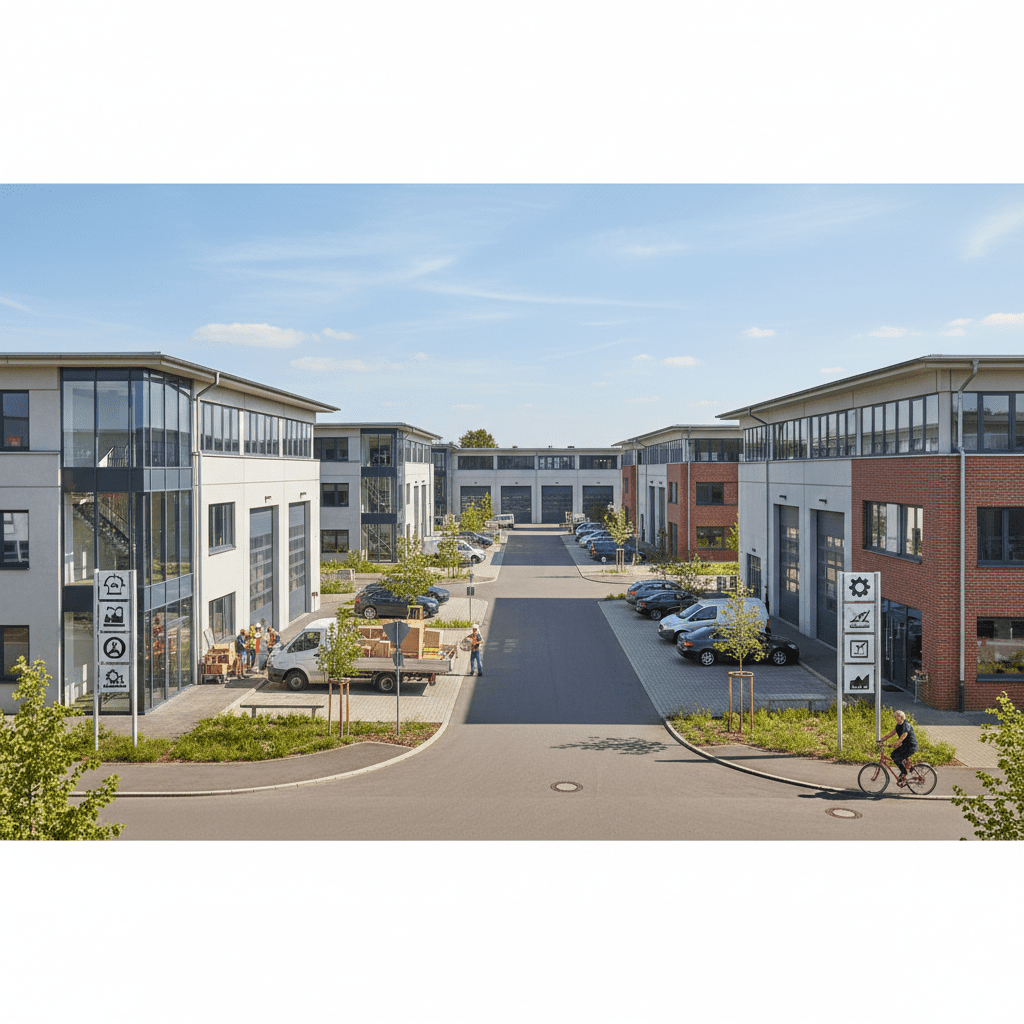
Around 64 percent of the rental demand is accounted for by space up to 3,000 square meters. The market for commercial and craft parks has developed into an independent and structurally growing segment. This development is driven above all by the continuing high demand for small-scale, flexibly usable space in urban and well-connected locations.
As part of the webinar organized by RUECKERCONSULT “Business parks: growing market segment or short-term hype?” with company representatives from Colliers, GreenPlaces, SQUARE PARKS and PGIM, it became clear that the segment is becoming more professional on both the user and investor side. According to Colliers, around 64 percent of leases in the industrial and logistics sector were recently for space up to 3,000 square meters. Units between a few hundred and about 3,000 square meters are particularly in demand, offering trades, technology-oriented companies, production-related companies and e-commerce providers.
Christian Kah, Head of Industrial & Logistics Germany at Colliers, says: “We see a clear structural demand for small-scale space in the urban environment. This demand is driven by changing value chains, on-demand production and the desire of many companies to operate closer to their sales markets.” Henning Nietz, Managing Director of SQUARE PARKS, adds with regard to the location and property criteria: “We are observing a permanent shift towards urban new-build business parks with flexible, expandable units. Companies are increasingly attaching importance to location quality, energy availability and digital infrastructure.”
Markus Eberhard, Managing Director of GreenPlaces, confirms this development and also observes demand at the municipal level: “Many regions are undergoing economic transformation. This creates a concrete need for functional, modular spaces that enable growth – especially for small and medium-sized companies that have been looking for suitable locations for a long time. Commercial parks with small, flexible rental units are the right solution for supporting this transformation in line with demand.”
Progressive institutionalization: Operations and management come to the fore.
To make the division attractive to more institutional investors, professionally organised asset and property management of the multi-tenant properties is key. At the same time, the segment offers stable and diversified cash flows thanks to its mix of uses. Kah says: “In terms of rents, we see premiums of up to 18 percent for prime rents and 9 percent for average rents compared to classic logistics – at the same time, accessibility and management at the location are more important for many users than a pure price comparison.”
Nietz says: “Ongoing operations are particularly decisive for intrinsic value. Compared to classic big-box logistics, the higher management intensity is compensated for by the broad user structure and the third-party usability of the space. Professional asset and property management is therefore an integral part of the business model.”
Eberhard adds: “Standardized, modular-serial construction helps to better control construction time and costs and make them more efficient. At the same time, adapting to local demand profiles remains crucial. We see that specific user enquiries often arrive at an early stage, making pre-letting possible on a selective basis.”
Industry sees segment on its way to becoming its own asset class.
As part of the webinar, the participants were asked about their assessment of the market positioning of commercial and craft parks, in which 102 people participated. The majority of respondents, around 54 percent, see the segment either already as an independent asset class (15 percent) or on the way to becoming one (39 percent). Another part of 37 percent classifies business parks as an integral part of logistics or light industrial real estate. One percent considers commercial and craft parks to be a purely cyclically driven market segment. Just under eight percent were unable to give a clear assessment due to the lack of transparency in the market.
In this context, Christian Kah classifies the previous market perception: “For a long time, business parks were not assigned to a clearly defined asset class. In particular, transactions in the small-scale space segment of less than 3,000 square metres have not always been reported separately for statistical purposes. However, with increasing market standardization, transparency improves – this is an important prerequisite for further institutional establishment.”