For the majority of institutional investors, investments in the residential segment are an integral part of a balanced portfolio. The asset class has proven to be very stable over the past three difficult years. In order to successfully lead their portfolio into the future, investors should focus on energy and cost efficiency – and take advantage of the opportunities offered by subsidized housing.
The situation on the housing market, dominated by excess demand, has further deteriorated. For investors, residential real estate therefore remains an interesting asset class in principle, as stable rents and value developments can be expected here for the foreseeable future. Supply surpluses are to be expected at best in rural areas or in smaller cities with a weak local economic structure, but by no means in the investment-eligible sub-markets of the German housing market, which are mainly concentrated in the metropolises and conurbations.
However, challenges in the selection of suitable investments arise from the growing importance of CO2 neutrality and energy efficiency as well as the still high construction costs. In addition, licensing authorities and local politicians attach great importance to the creation of affordable housing for households with medium and lower incomes, which are encountering particularly great difficulties in finding housing in the current market environment. Institutional investors should consciously focus on these challenges as they further develop their portfolios and examine the extent to which they can be used to derive specific opportunities and approaches for a corresponding investment strategy.
Young housing stock: stable cash flows, little need for renovation
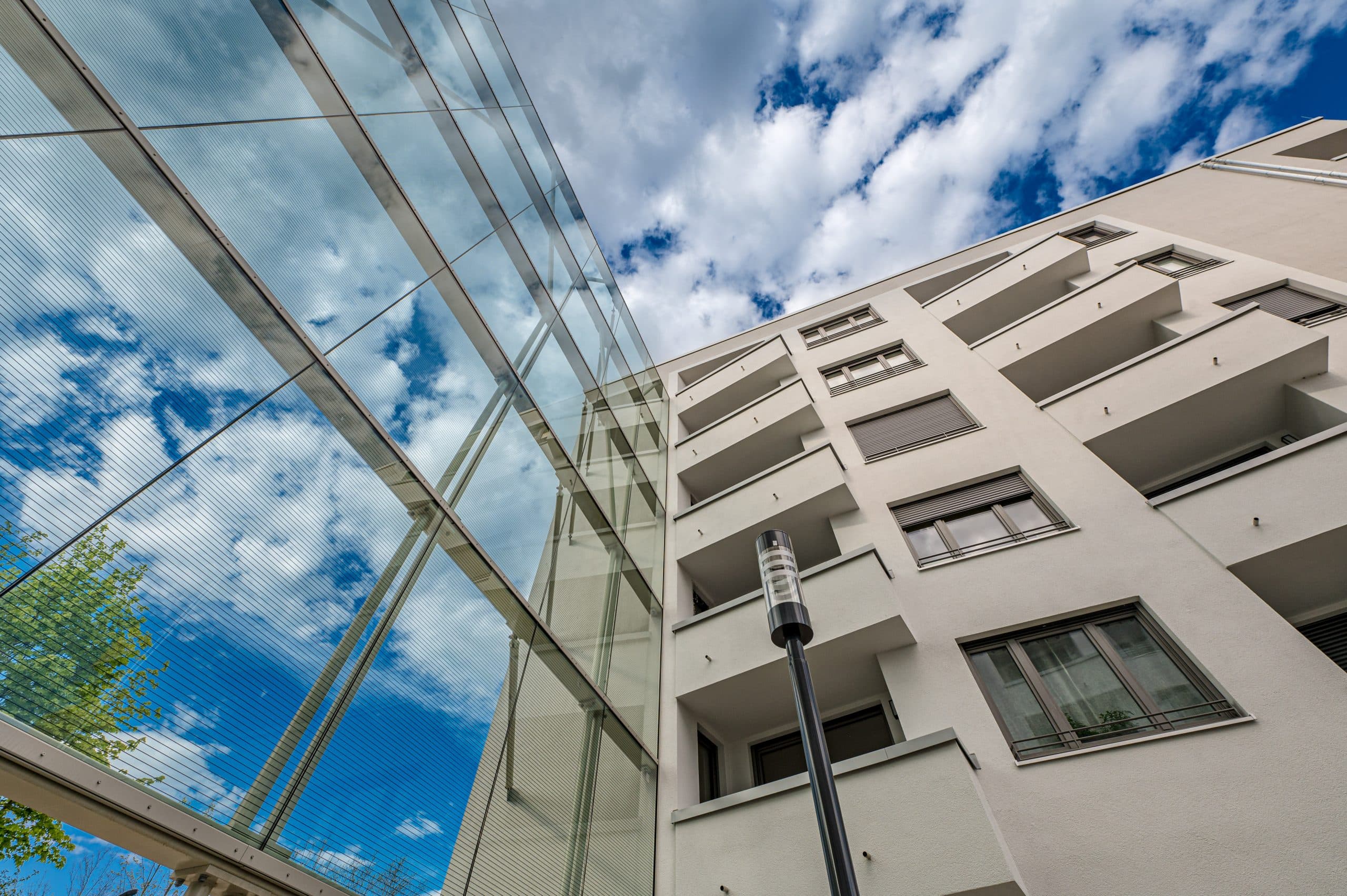
In recent years, INDUSTRIA has mainly invested in new construction, and young stock has also been purchased in isolated cases. Due to the market changes, it was decided to intensify investments in young housing stocks that already meet modern requirements in terms of limiting CO2 emissions and energy efficiency. Such properties were usually built in 2014 or later, but in contrast to residential properties that are still under development, they are already generating continuous rental income. In addition to their positive energy properties, they usually have a good quality of their relatively young building fabric and usually only minor need for renovation.
Modular and serial construction: Focus on increasing efficiency
The increase in construction costs represents one of the greatest challenges for residential construction in Germany. Modular and serial construction offers innovative solutions here and also helps, for example, to shorten construction times and reduce sources of error. With the growing interest from builders and investors, the range of products and services in this area is likely to become even more differentiated and expanded in the coming years. The Federal Ministry of Construction has already set the course for accelerating construction and planning processes, lowering individual minimum technical requirements and thus reducing construction costs. Overall, new scope for action is to be opened up for builders in order to create living space faster and more cost-effectively.
Subsidized housing: Underestimated investment opportunity
A third key point is residential construction projects, which are realised with the use of state subsidies and are often underestimated by institutional investors. The state provides financial support for housing projects under certain conditions, in particular through low-interest loans, construction costs, rent or repayment subsidies. Compared to projects without state funding, the cost structure and financing can be optimized. In addition, the yields are easy to calculate and can be predicted relatively accurately. As a result, apartments can be built in a real estate market segment that is in high demand with the help of state subsidies. In order to make subsidized housing interesting for investors, however, the availability and combinability of subsidies is a necessary prerequisite. A statement that subsidies per se lead to "good" investments is not tenable. Identifying interesting investment options requires the know-how of an experienced residential property manager.
If the three aspects mentioned above – focus on young portfolios, use of modular or serial construction methods and use of government funding opportunities – are consistently taken into account, attractive investments in the German residential real estate market can be realised even under the current framework conditions, which in particular meet the expectations of long-term oriented and conservative institutional investors.