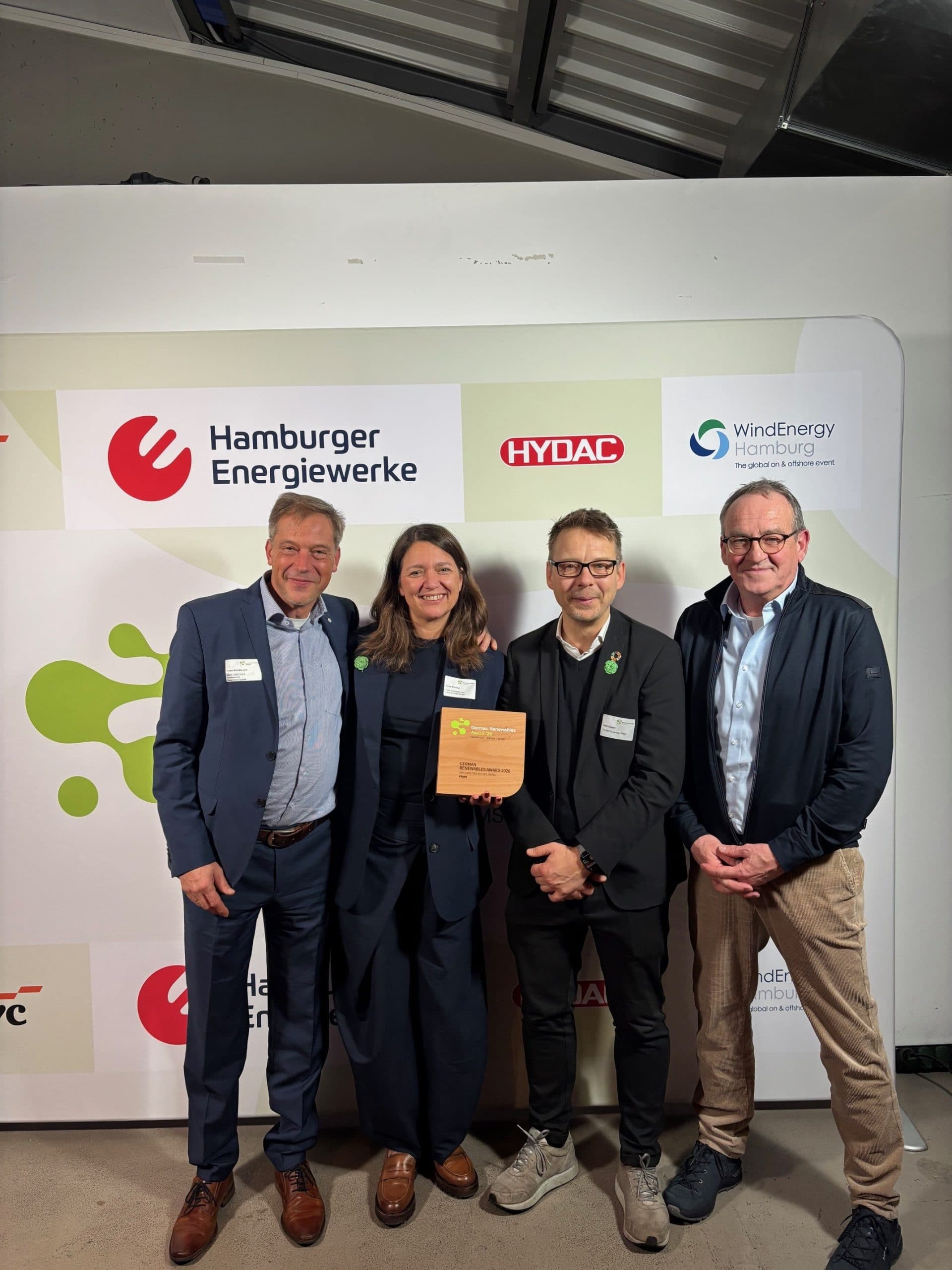
FRANK has won the German Renewables Award in the ‘Project of the Year’ category. The award recognised the energy supply concept for five blocks of flats owned by the Neue Lübecker Norddeutsche Baugenossenschaft eG on Lindwurmstraße in Lübeck-Travemünde. The award was accepted by the FRANK project team and their partner, Neue Lübecker Norddeutsche Baugenossenschaft GmbH, at 7.30 pm at the venue in Hamburg.
“We are overwhelmed and grateful that the jury has recognised the Lindwurmstraße project. Our thanks go to the jury, the organisers and everyone who made this evening possible. Above all, the award belongs to the team that has worked on the neighbourhood for years, and to our partner, the Neue Lübecker Norddeutsche Baugenossenschaft. The project demonstrates how energy supply in existing buildings can be reimagined: with an energy centre that grows alongside the neighbourhood,” said Indra Renzler, Managing Director at FRANK.
The buildings, which date from the 1960s, are being renovated to improve energy efficiency and extended in five construction phases. The aim is to achieve the ‘Effizienzhaus 55 EE’ standard. For the heat supply, FRANK is connecting PVT collectors and 18 geothermal probes via a so-called ‘cold’ local heating network to two heat pumps. The network transports ambient heat at a low temperature to the heat pumps, which convert it for use in heating and hot water. There are no plans to use fossil fuels for heat generation.
The supply system is designed to allow for phased refurbishment. The central energy supply is being expanded as construction progresses. Currently, three out of five construction phases are already supplying heat. Upon completion, around 90 residential units with approximately 5,500 square metres of living space are expected to be connected.
Under the contracting model, FRANK is responsible for planning the overall concept, as well as for the operation and billing of the heat supply. Looking beyond the specific neighbourhood, the project demonstrates how renewable heat supply and phased refurbishment can be combined. The concept can therefore serve as a blueprint for the further development of similar existing neighbourhoods and points the way towards making the energy supply in the existing building stock fit for the future.