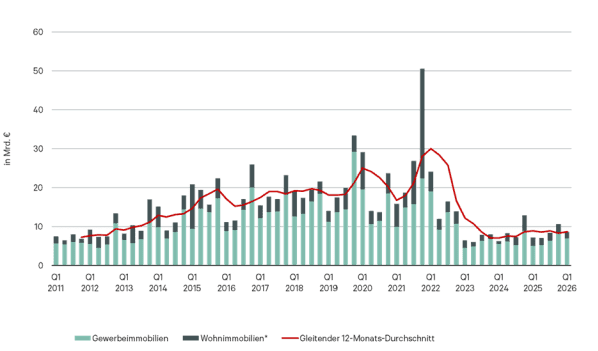


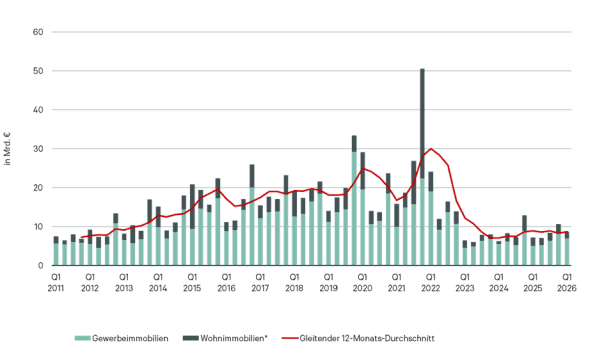
The real estate transaction volume in Germany amounted to around 8.6 billion euros in the first quarter of 2026, almost 20 percent higher than in the same quarter of the previous year. Compared to the exceptionally strong final quarter of 2025, however, the volume fell by around 19 percent, which was mainly due to the pronounced year-end rally and traditionally lower transaction momentum at the beginning of the year. These are the results of a recent analysis by the global real estate service provider CBRE.
"The investment market started dynamically in 2026, at least until the recent geopolitical escalation in the Middle East. Although most ongoing transactions have continued, many players have become noticeably more cautious with regard to new processes. The following applies: cash flow is king," says Marcus Lemli, Head of Investment at CBRE in Germany. "But it is also clear that to a certain extent people are getting used to external geopolitical shocks. Because real estate is still an investment with low volatility. Against this backdrop, security, value retention and long-term stable rental income are highly valued thanks to an active asset management approach." At 61 percent, the majority of the investment volume went into security-oriented investments. Value-add accounted for 18 percent and another 13 percent opportunistic.
"Our underlying economic outlook suggests that real estate fundamentals are leading to stable, albeit more selective, demand on the occupier side. At the same time, investors in the real estate capital markets will act somewhat more cautiously in view of the new inflation environment and the general increase in uncertainty," explains Dr. Jan Linsin, Head of Research at CBRE in Germany.
Office at the top again
With a volume of around EUR 2.1 billion, office properties were the strongest asset class in the market. The share of the total volume was around 24 percent, the increase compared to the first quarter of 2025 was a good 60 percent. This means that Büro recorded both the highest market share and the largest absolute growth. Twelve of the 24 largest transactions above the EUR 50 million mark were in this asset class. With the acquisition of a new building ensemble in Kaarst for the tax administration of the state of North Rhine-Westphalia, the public sector completed the largest office deal of the quarter. In addition, the acquisition of the Alte Akademie in Munich from the Signa insolvency by the OPES Real Estate Group contributed to the transaction turnover.
The residential segment followed in second place with around 1.7 billion euros and achieved a market share of around 19 percent. Despite the continued high volume, earnings were significantly below the previous year's figure. Industrial and logistics properties ranked third with a transaction volume of around EUR 1.4 billion, around 16 percent more than in the same quarter of the previous year – thus confirming a stable demand base.
In addition, healthcare real estate recorded a significant increase and reached a volume of around EUR 1.1 billion, in particular due to the pan-European majority takeover of Cofinimmo by Aedifica, which is reflected in the high three-digit million range in relation to the acquired portfolio in Germany. Land and other types of use also showed high growth rates, but remain subordinate in terms of volume. Retail and hotel investments, on the other hand, declined.
Top 7 markets gained
In Germany's seven largest real estate markets, the investment volume in the first quarter of 2026 totalled around three billion euros, also an increase of around 20 percent compared to the first quarter of 2025. While the aggregate results indicated moderate stabilization, there were still significant differences within the top 7 cities. Berlin recorded a decline in volume, while other locations showed positive deviations. With the sale of the new "Deiker Höfe" quarter to HIH Invest, Düsseldorf achieved an investment volume more than three times as high as in the same quarter of the previous year and was thus close to the long-term average level. Frankfurt also showed a noticeable revival compared to the previous year, among other things due to the sale of two existing buildings in the banking location of the financial metropolis to companies from the banking and insurance sectors.
German investors particularly active
The market development in the first quarter of 2026 was mainly driven by domestic investors. They realized a transaction volume of around EUR 5.1 billion and increased their activities by around 26 percent compared to the same quarter of the previous year. The share of domestic buyers thus amounted to almost 60 percent of the total volume.
Foreign investors achieved a transaction volume of around 3.5 billion euros, around twelve percent higher than in the first quarter of 2025. Compared to the previous quarter and in the longer-term context, however, the commitment of international investors remained below average, although there were signs of a gradual recovery. "Germany continues to be one of the most important target markets for a large number of foreign investors for their real estate allocation, especially for investors with a value-add approach," says Lemli. "However, the local market is considered too expensive for these investors compared to some other European locations – despite its size, liquidity and transparency. This is also reflected in the continued high bid-ask spread."
Stable price level for the time being
"In view of the geopolitical challenges and an associated slowdown in the economic recovery, higher inflation expectations and rising capital market and financing interest rates, the market is facing a possible further recalibration of prices and thus real estate yields," Linsin expects.
So far, net initial yields have remained mostly stable compared to the end of 2025. While the recent rise in oil prices does not have a direct impact on the real estate market, it does increase pressure on capital markets due to rising inflation expectations. In Germany, the current elevated level of yields on ten-year German government bonds limits the scope for further yield compression. "Real estate yields are more likely to move sideways or moderate upward pressure than to ease quickly," says Sandro Höselbarth, Head of Valuation & Advisory Services Germany at CBRE in Germany. Interest-rate-sensitive and energy-intensive types of use are particularly vulnerable, while residential real estate remains comparatively stable due to demand-driven demand. Against this backdrop, investors are increasingly focusing on current income – stable cash flows, long lease terms and defensive asset classes are becoming increasingly important.
Many individual transactions – but also large transactions took place
"The transaction structure in the first quarter of 2026 was clearly characterized by individual transactions. With a volume of around 6.2 billion euros, the majority of the market activity was accounted for by individual properties, which corresponded to an increase of around 28 percent compared to the previous year. Ten large individual deals in the various asset classes also contributed to this, especially in the office real estate segment as well as residential, logistics and retail. By far the largest single deal of around 400 million euros was concluded outside the top markets: the aforementioned purchase by the Ministry of Finance of the State of North Rhine-Westphalia.
In contrast, the package purchase segment remained comparatively weak at around 2.5 billion euros, although several large portfolio deals were concluded; in addition to two deals in the healthcare real estate sector, one each in the logistics, leisure, retail and office real estate segments.
Major transactions over 100 million euros increased significantly in both volume and number compared to the first quarter of 2025, but still did not reach the level of previous years. In the first three months of this year, a total of 16 trades of this magnitude were concluded, totalling almost 3.6 billion euros; of these, five were package sales and ten individual transactions, 14 commercial real estate and two residential investments. "Large-volume investments were still characterized by high selectivity and a limited supply of marketable products," says Lemli.
There was a significant market upturn in the smaller segment in particular. Transactions under ten million euros recorded significant growth compared to the previous year and in some cases reached their long-term average level again or were above. The mid-size classes between ten and 50 million euros developed moderately positively. Accordingly, the average volume per deal fell by ten percent to just under 22 million euros, after a good 24 million in the first quarter of 2025, and is currently around one-fifth below the five-year average of the first quarters. In total, almost 100 transactions or a third more than in the same quarter of the previous year were registered.
Outlook for the rest of the year
"We assume that the market will revive due to a larger product range. Open-ended real estate funds will continue to clean up their portfolios, and in some cases even more so. At the same time, banks will also bring properties onto the market – because the NPL ratio for real estate loans from German banks is the highest in Europe," says Lemli.