Hydrogen is pivoting from an envisioned mainstream electricity fuel to a targeted asset for long-duration balancing and grid adequacy, as round-trip efficiency losses and competition from battery storage restrict its viability for routine generation. The focus is now shifting to covering extended renewable shortfalls, securing critical backup infrastructure, and extending the life of gas-fired generation via blending and regional industrial hubs, says GlobalData, a leading intelligence and productivity platform.
GlobalData’s latest report, “Strategic Intelligence: Hydrogen in Power (2026)” reveals hydrogen adoption in the power sector is shifting toward projects with clear economics, contracted demand, and reliable policy support. Higher electricity and project development costs, slower-than-expected electrolyzer cost reductions, complex subsidy rules, and limited bankable offtake agreements have delayed or reduced many large-scale clean hydrogen initiatives. Utilities are also weighing hydrogen against lower-cost alternatives. Recent project cancellations, pauses, and target reductions across the US, Europe, and Chile reflect the sector’s reassessment.
Rehaan Shiledar, Power Analyst at GlobalData, comments: “However, hydrogen remains relevant where industrial demand provides an anchor, renewable power is inexpensive, storage is available, and policy frameworks are stable. The long-term global capacity is still projected to scale significantly, driven by targeted industrial mandates, heavy transport needs, and specific power grid balancing requirements.”
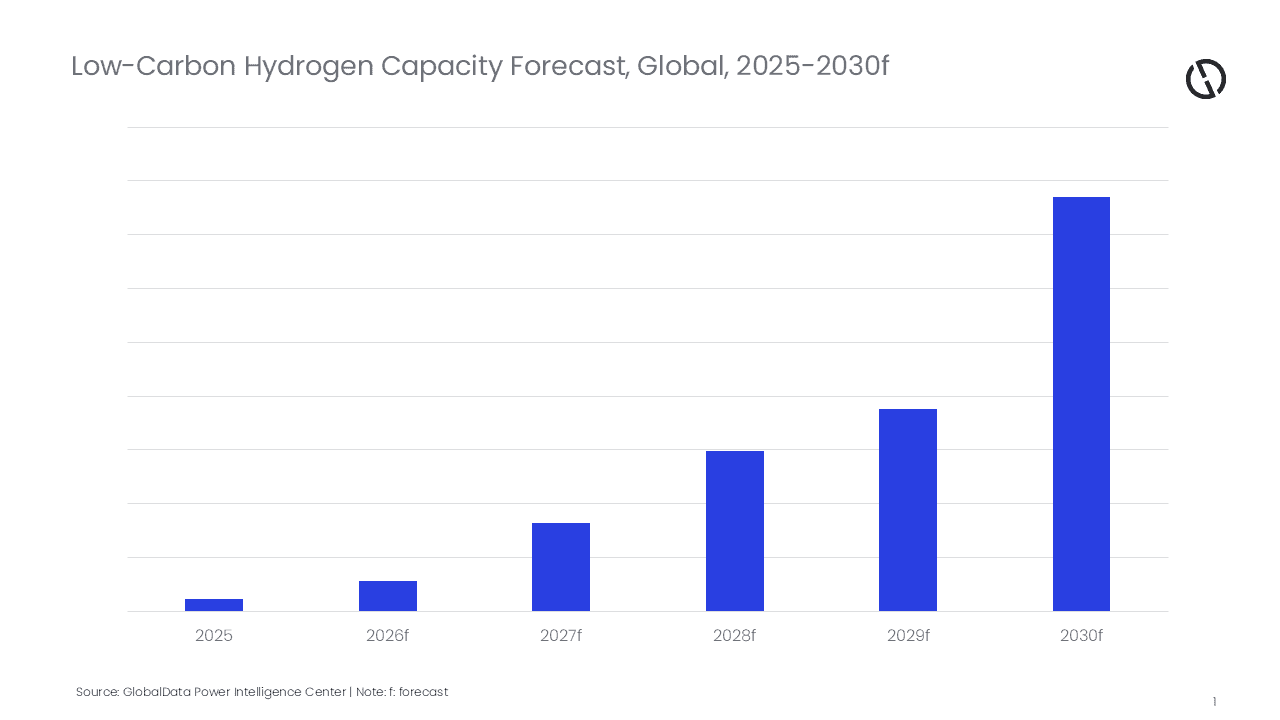
According to GlobalData estimates, global low-carbon hydrogen production capacity remained nascent in 2025, with substantial growth expected by the end of 2026, driven primarily by blue and green hydrogen. By 2030, production capacity is projected to expand significantly, with green hydrogen holding a dominant share.
Blue hydrogen will lead low-carbon hydrogen capacity in the near term before green hydrogen overtakes it to dominate the market by 2030. Green hydrogen’s capacity is expected to be approximately 5.5 times greater than that of blue hydrogen by 2030, driven by expanding wind and solar generation. Primary regional contributors to green hydrogen expansion between 2026 and 2030 will include Spain, Australia, China, the US, Germany, and Brazil.
Shiledar continues: “Utilities and independent power producers are increasingly deploying hydrogen-ready gas turbines and engines to secure flexible, fast-ramping generation to balance intermittent renewables. OEMs and developers are addressing key technical challenges, such as higher flame speeds, materials embrittlement, and stringent NOx emissions, through combustor upgrades and specialized plant retrofits. Recent project commitments by operators including EnBW, RWE, Ansaldo Energia, and YTL PowerSeraya, alongside equipment developments from GE Vernova and Rolls-Royce, highlight growing industry adoption.”
Governments across major hydrogen markets are adjusting policy and funding frameworks to address high costs, infrastructure constraints, and slow project development. The European Commission has accelerated its review of Renewable Fuels of Non-Biological Origin (RFNBO) additionality rules, while China’s 2026–30 strategy strengthens hydrogen’s role in heavy transport, chemicals, and industrial decarbonization.
Brazil is funding domestic electrolyzer development, while the Indian state of Bihar has approved a draft policy to support green hydrogen and ammonia production, manufacturing, and demand aggregation.
Shiledar concludes: “Hydrogen is not losing relevance, but its role in the power sector is becoming more selective and commercially disciplined. Investment is shifting from large standalone hydrogen-to-power projects toward blending trials, limited peaking applications, and industrial offtake-led developments supported by firm demand. The strongest near-term opportunities are emerging in regions with stable policy frameworks, low-cost renewable electricity, and large-scale storage, including salt caverns, enabling more reliable and competitive hydrogen deployment.”