


The German property investment market: Increased supply meets new price realities
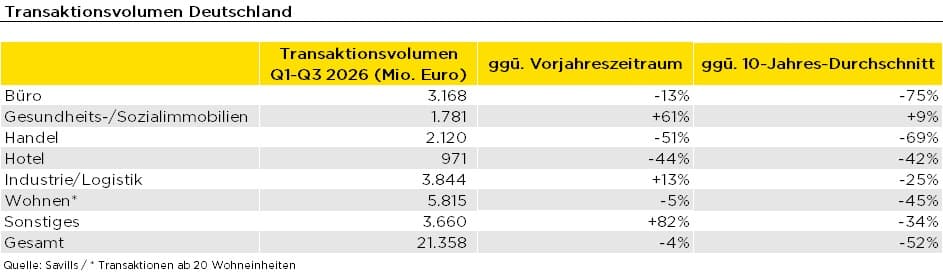
In the German investment market for commercial and residential property*, the transaction volume in the first three quarters of 2026 amounted to just under 21.4 billion euros, which was slightly below the previous year’s level (approximately 22.3 billion euros). This volume is spread across more than 830 transactions, representing a 4 per cent increase on the previous year’s figure. Karsten Nemecek, Deputy CEO Germany at Savills and head of Capital Markets, comments on market developments as follows: “Despite the numerous uncertainties, the investment market has lost little of its momentum so far this year. At the same time, the number of properties for sale has risen noticeably in recent months. This fundamentally increases the potential for more transactions. However, the significant rise in interest rates over the summer has caused fresh uncertainty. Whether the increased supply will actually lead to more deals depends largely on how sellers respond to the changed interest rate environment. Experience from numerous transactions shows that those who are willing and able to adjust their asking prices to the new realities will attract interested capital. Overall, however, liquidity remains limited.”
Initial yields are rising – and are likely to continue doing so
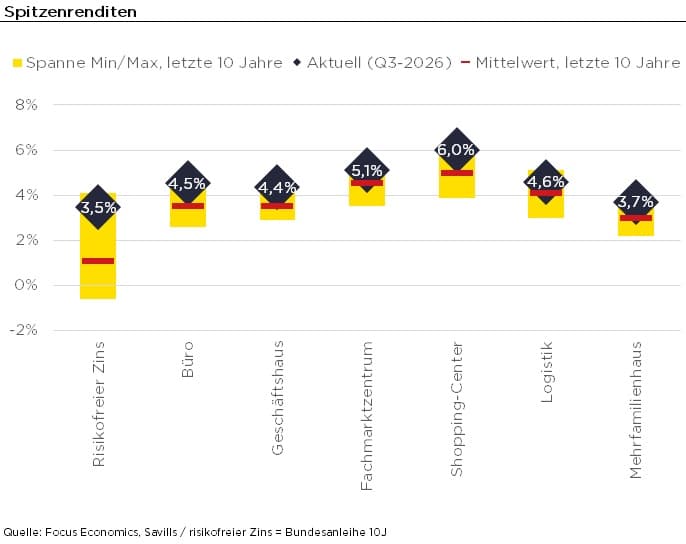
Against a backdrop of a fairly significant rise in bond yields and interest rates, as well as increasing selling pressure, Savills has observed an upward trend in initial yields across most property sectors in recent months. As at the end of September, prime yields ranged from 3.7 per cent for multi-family dwellings (+10 basis points compared with Q2-26) to 6.0 per cent for shopping centres (+/- 0 basis points). “It remains to be seen to what extent the rise in interest rates over recent months and the large supply of properties will lead to even higher initial yields,” says Nemecek, looking ahead. Private investors and family offices (accounting for 7 per cent of purchase volume), as well as the public sector (11 per cent), continued to play a disproportionately large role as buyer groups this year, whereas institutional investors typically remained net sellers. A prime example of this is the insurance sector, which has reduced its property portfolio by around a quarter of a billion euros on balance so far this year and has numerous other properties currently on the market. This means that the trend towards deinstitutionalisation in the investment market is continuing for the time being, and Savills does not foresee a reversal of this trend. Nemecek states: “The past three years have shown that owners who have postponed a sale in the hope of a better market environment have often found themselves in an even weaker negotiating position. Unless one has a great deal of patience, there is little to be gained from a wait-and-see approach even today.”