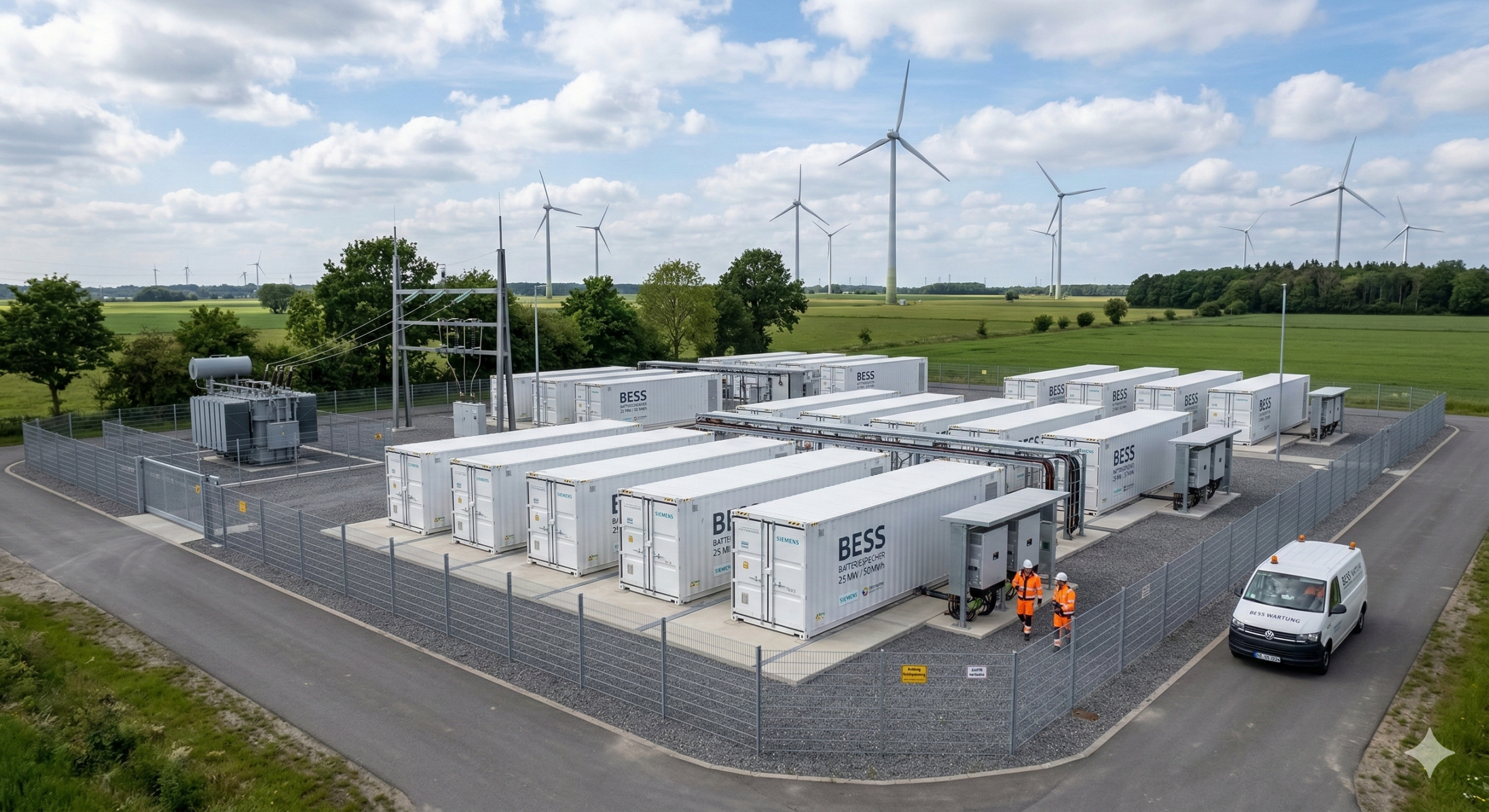
On 16 January 2026, the Federal Network Agency (BNetzA) presented its guidelines for future storage network charges. Previously, newly built purely grid-connected battery storage systems were exempt from grid charges for 20 years until 4 August 2029 in accordance with Section 118 (6) sentence 1 of the EnWG. In the paper, the BNetzA has indicated that it may even change this regulation retroactively.
What are the reasons from the BNetzA’s point of view? Battery storage systems or BESS systems (Battery Energy Storage Systems) incur costs – depending on the existing bottleneck situation in the grid – by feeding electricity into and out. The goal of the BNetzA is to reduce or distribute these costs, but without thwarting the function of BESS plants for grid stabilization and security of supply.
Dynamic grid charges are intended to create incentives for storage operators to use the plants in a grid-friendly manner. Future grid charges are to be based on the actual behaviour of the system in order to reward grid-friendly charging and discharging and to avoid negative incentives for meaningful arbitrage transactions.
Details still blurred | Uncertainty among market participants
At first glance, the new grid fee system outlined in the paper has a significant impact on the project planning, financing and operation of large-scale battery storage systems in Germany. There is uncertainty among the relevant market players, in particular because of the lack of specification of dynamic charges, timing and any transitional rules.
With a view to the date of the introduction of grid charges coming into force, investors and project developers see considerable investment risks. It is very likely that new BESS installations (especially those with commissioning after a cut-off date before 2029, which has yet to be defined) will have to calculate with a new grid charge system.
Significance for the use of storage systems from an investor’s perspective
For investors in funds that invest in such storage systems, it is important to note that any grid fees are incurred as operating costs at the level of the storage operators or energy traders. It would be different if the fund, as the owner of batteries, leased them to a suitable operator for marketing. In this case, the operator would have to design the use of the storage facilities in such a way that he generates adequate income to finance the lease payments. The immediate cost risk no longer lies with the fund.
In addition, storage operators who follow the multi-use approach will be successful in the new grid fee regime. Multi-use means a combination of arbitrage on the spot market and the provision of balancing power and local flexibility marketing. The pure arbitrage approach on the spot markets (day-ahead / intraday) is expected to become much less attractive due to local grid fees.
In this context, storage operators or energy traders will have significant competitive advantages if they have good trading systems/software that can ideally anticipate which BESS products the grid will demand at what yields/costs and at what times via artificial intelligence.
It is therefore very likely that there will be a consolidation of the market of BESS plant operators / energy traders. Plant operators who have focused on the pure arbitrage business on the spot markets and have not mastered the multi-use approach are unlikely to have much success in the market.
In addition, many storage system project developers are holding back on new projects due to the grid fee reform – it is very likely that significantly fewer plants will be planned and built in the future. Incidentally, the choice of location of storage facilities will also become more important due to control via construction cost subsidies (avoidance of expansion at grid connection points subject to bottlenecks).
This can be positive from the point of view of an existing plant operator, because the uncontrolled expansion of storage facilities is contained and thus the competitive environment remains more calculable (avoidance of cannibalization effects in BESS services). In Germany, depending on the source, there are already over 500 GW to more than 720 GW of grid connection requests for large-scale battery storage systems, and in 2024 alone, 9,710 formal grid connection requests were made. This flood of applications poses major organisational challenges for transmission and distribution system operators.
Result
The investment fantasy for battery storage has not disappeared – but it is changing as a result of a grid fee reform. Those storage systems that can be operated flexibly, efficiently and in a way that serves the system and are built in the “right” location remain successful.