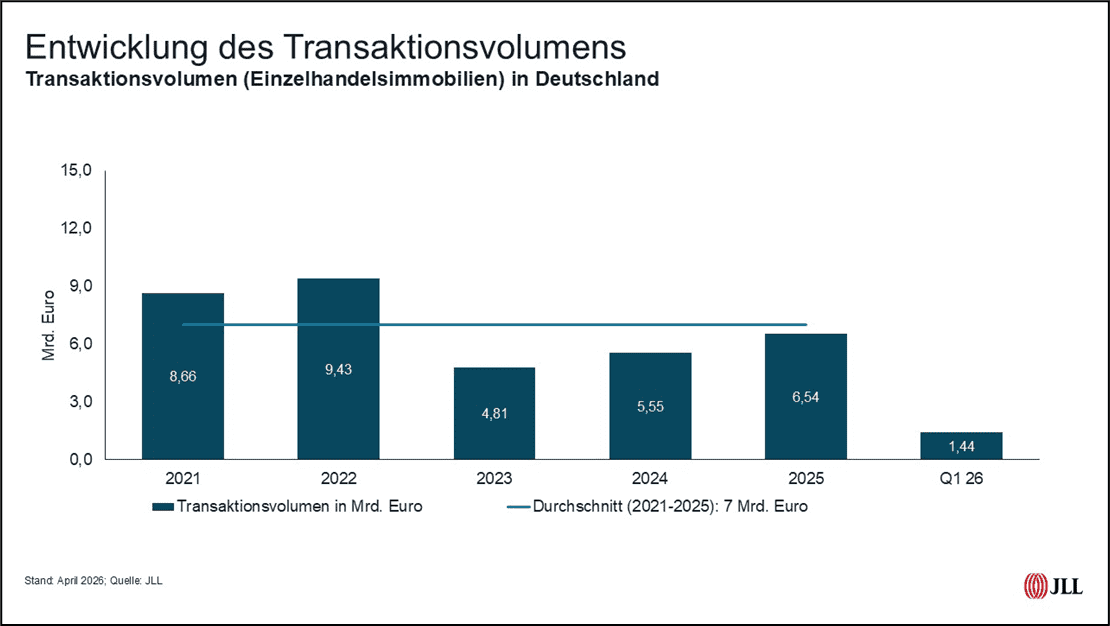


A large number of small and medium-sized transactions gave the German investment market for retail real estate a strong boost at the start of the year. A total of 83 deals generated a transaction volume of 1.44 billion euros. This is the highest number of first-quarter sales since 2021 and the highest volume since 2022. Compared to the previous year, sales increased by 16 percent, and the number of deals grew from 56 to 83.
Sarah Hoffmann, Head of Retail Investment at JLL Germany: "In the first three months, we saw a very agile market in which many properties were traded across all types of use. These included numerous transactions that were already initiated in the final quarter of 2025 and have now been completed. The fact that the transaction volume was not higher is due to the fact that large deals in excess of 100 million euros were rare. Although two transactions of this size were registered, just like in the previous year, this time they achieved a total of 370 million euros, compared to 610 million euros in the previous year."
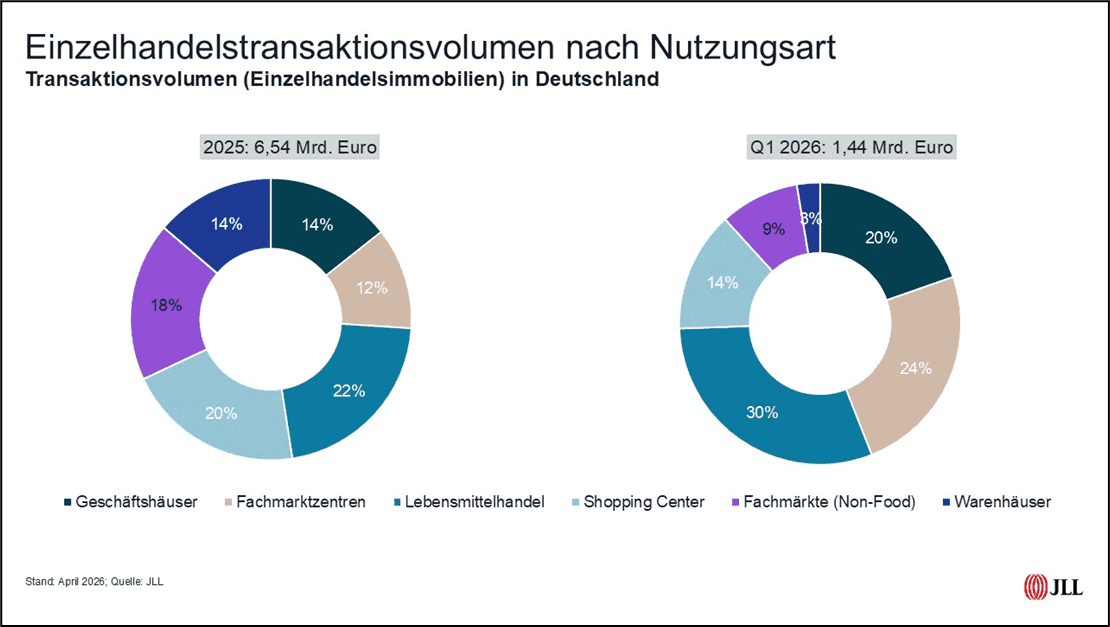
Once again, specialty store products dominated the scene and together accounted for 63 percent of the total volume. Of these, 30 percent were accounted for by the food trade, 24 percent by retail parks and a further nine percent by non-food stores. In addition, commercial buildings generated a fifth of the volume, ahead of shopping centers with 14 percent and department stores, which contributed only three percent this time. "For the current year, we assume that shopping centers will continue to increase their share. Several properties are currently in the marketing process," says Sarah Hoffmann.
In general, investors focused on security and invested 53 percent in core real estate and a further 37 percent in core-plus. Value-add (two percent) and opportunistic objects (seven percent) played only a minor role. In general, there is a lot of international capital available in the risk segment, but the buying opportunities are currently limited.
On the buyer side, asset and fund managers once again accounted for the lion's share with 47 percent of the transaction volume, followed by real estate companies with 22 percent and corporates with eleven percent. On the seller side, however, the gap between asset and fund managers and real estate companies was much smaller from 27 percent to 20 percent.
German players dominated the market in the first quarter with 77 percent share on the buyer side and 69 percent on the seller side. "Demand from abroad remains high, but these players are focusing on larger volumes that have not yet been included in the balance sheet in the first quarter. However, some large-volume properties are currently being marketed and there is very strong demand from international investors who are considering entering the market or expanding their existing portfolios," Hoffmann analyses.
Prime yields remained largely constant. Individual specialist stores alone rose by ten basis points to six percent. Shopping centers remained at 5.9 percent and retail parks at 4.6 percent. On the main shopping streets, Munich leads the field with 3.2 percent.