

Concerns about interest rates and inflation overshadow better economic data
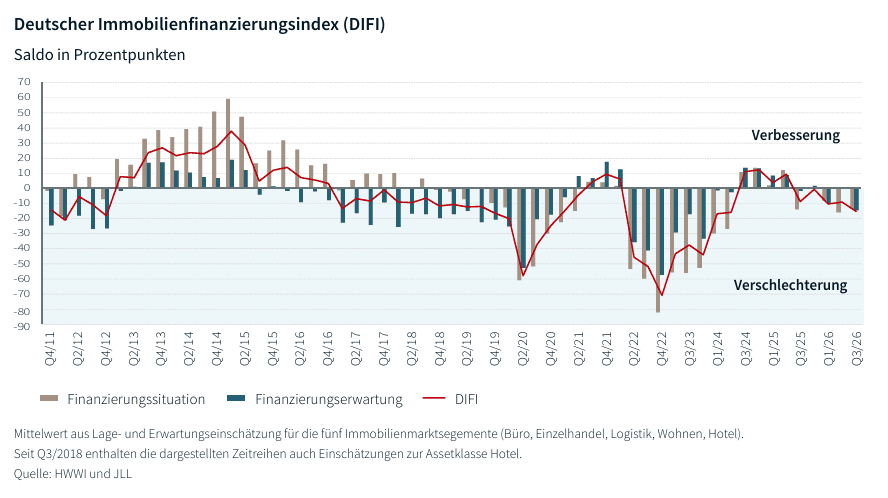
Sentiment among real estate financiers deteriorated significantly in the third quarter of 2026. The German Real Estate Financing Index (Difi)* lost 6.1 points to trade at minus 14.0 points. The index thus completely wiped out the moderate stabilisation from the previous quarter, when it had improved by 1.1 points.
The Difi is collected and published by JLL and the Hamburg Institute of International Economics (HWWI) and reflects the assessments of financing experts. The situation on the credit market in the past six months and the expected development in the next six months are assessed on a quarterly basis. The difi is calculated as an unweighted average of the balances of the two sub-indicators financing situation and financing expectation of all types of use.
The expectations indicator is primarily responsible for the renewed deterioration. While the current financing situation is recovering slightly from an increase of 2.0 points to minus 13.6 points, the expectations indicator has deteriorated significantly, falling from minus 0.3 to minus 14.4 points. This completely reverses the picture from the previous quarter: In the second quarter, market participants had still hoped for an imminent trend reversal despite the difficult present – now concerns prevail that financing conditions could tighten slightly again in the next six months.
"The recent rise in interest rates and the return of inflation are weighing on financing conditions and noticeably dampening the medium-term prospects of market participants, although the economic fundamentals have recently brightened," says Helge Scheunemann, Head of Research at JLL Germany. "Apparently, concerns about rising capital costs and a renewed rise in price levels currently weigh more heavily than the recently improved economic data."
Only housing maintains the plus zone – logistics is losing significant ground
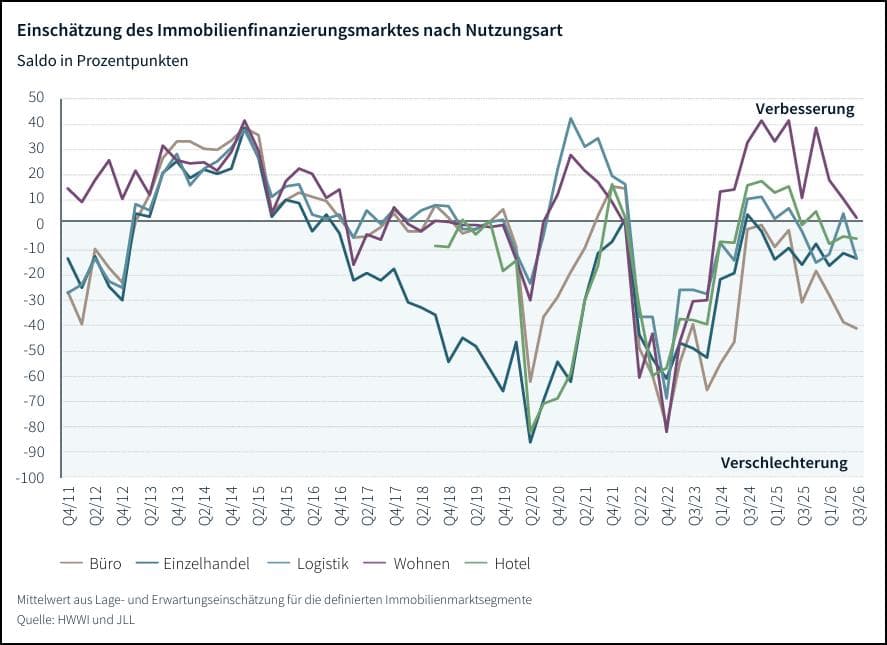
The picture for the individual types of use is clearly cloudy. Only the residential segment remains in positive territory with a plus of 2.9 points, despite a decline of 7.5 points, and thus continues to lead the field. The strongest slump was recorded in logistics: After the strong jump into the plus in the previous quarter (plus 4.5 points), the segment lost 17.8 points and fell to minus 13.3 points – on a par with retail, where the decline was more moderate at 1.9 points. Hotels also fell slightly and closed at minus 5.4 points. Despite a smaller loss of 2.4 points, the office segment remains by far the worst performer at minus 41.0 points.
The current assessment of the situation, on the other hand, shows a more differentiated picture: After the crash in the previous quarter (minus 59.1 points), the office segment was able to recover by 19.1 points to minus 40.0 points, but remains at a very low level. Residential (plus 0.5 points to plus 8.8 points), hotel (plus 1.2 points to minus 3.6 points) and retail (plus 1.5 points to minus 16.7 points) also recorded slight improvements in their location values. In contrast, there was a significant setback in logistics, where the situation indicator slipped from minus 4.5 to minus 16.7 points.
The expectations indicator, on the other hand, turned negative in all five segments. The office segment was again hit hardest, with a decline of 23.7 points to minus 41.9 points. Logistics lost 23.6 points, falling from plus 13.6 points to minus 10.0 points. The residential segment also lost 15.4 points and, with minus 2.9 points, left the plus zone for the first time in a long time. Retail and hotels fell by 5.5 and 2.3 points respectively and closed at minus 10.0 and minus 7.1 points, respectively. This means that in the third quarter of 2026, every asset class without exception has a negative expected value.
"In the office segment, the location and expected values are almost on a par at a very low level of minus 40.0 and minus 41.9 points respectively. This indicates that the difficult financing conditions in this segment are likely to continue in the next six months," explains Andreas Lagemann, Senior Researcher at HWWI. The development in the residential sector is remarkable: "Here, for the first time in a long time, expectations are below the current situation. This is a clear signal that even the most stable sector to date is no longer immune to the general trend."
Almost three-quarters of the experts expect AI to be highly relevant in financing decisions
The current special survey is dedicated to the importance of artificial intelligence (AI) for real estate financing. Currently, AI-supported models play a clearly subordinate role in the credit and financing processes of the institutions surveyed: Half of the experts classify the relevance as low, while only 2.9 percent consider the use of technology to be "very relevant" today.
For the next three years, however, the financing experts expect a significantly greater use of the technology. Around three-quarters of those surveyed then consider the use of AI to be "quite relevant" or "very relevant". "This is a clear sign that AI-supported models are likely to rise from a supplementary tool to a central component of the credit decision," says Dominik Rüger, Senior Director Debt Advisory JLL Germany.
With regard to the risks for real estate financing, the majority of respondents (70.0 percent) do not see any change at the overall market level as a result of the increased use of AI. While confidence prevails in the residential, hotel and logistics sectors that AI can even slightly reduce risk, a much more differentiated assessment is evident in the office and retail segments, which are structurally under greater pressure. In Rüger's view, this polarization is less related to the technology itself. Rather, the decisive factor is the uncertainty about the future use of these properties. "Where cash flows are already more difficult to assess today, the additional factor AI has a risk-increasing effect on some of the respondents, while in more stable segments, AI is predominantly seen as a risk-reducing analysis tool."
New business grows in the first half of 2026 – inventories shrink slightly
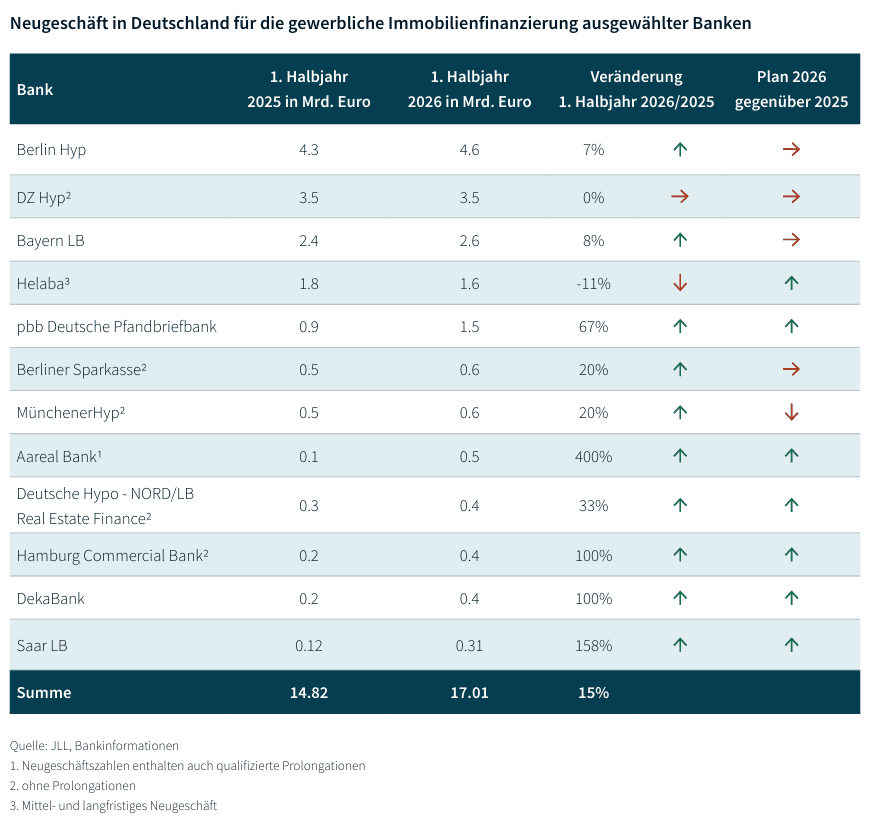
For the quantitative analysis of commercial real estate financing in Germany, JLL looks at the banks' new business and the development of their loan portfolios every six months. The activities of twelve German banks are considered. Only newly issued financing for German real estate is taken into account. Both commercial and residential properties that are used for capital investment are recorded.
In the first half of 2026, banks granted loans worth around 17 billion euros. Compared to the same period last year (14.8 billion euros), this is an increase of 15 percent. "Despite the deterioration in the general conditions, new business developed positively in the first half of the year. There was a significant upturn in the second quarter in particular," observes Rüger. Hotel properties, among others, benefited from this, which were increasingly integrated into the institutions' lending guidelines.
Berlin Hyp was once again the most active in the first six months of the year, with new business of €4.6 billion (previous year: €4.3 billion), followed by DZ Hyp with €3.5 billion (previous year: €3.5 billion) and BayernLB with €2.6 billion (previous year: €2.4 billion). With the exception of Helaba (€1.6 billion), all financiers recorded growth in new business.
The loan portfolios of the banks analysed (domestic and international) fell by one per cent year-on-year to EUR 282.9 billion. The portfolio of eight institutions shrank, most sharply at Hamburg Commercial Bank at 21 per cent. With a portfolio of EUR 54.8 billion, Berlin Hyp is the frontrunner, followed by DZ Hyp (EUR 41.9 billion), Aareal Bank (EUR 32.4 billion) and Helaba (EUR 32.4 billion).
The outlook for the year as a whole is cloudy. Growth in new business in the first half of the year is likely to turn into a sideways movement, especially among the market-leading banks. In Rüger's view, the German real estate financing market is in a phase of qualitative consolidation. "In view of geopolitical uncertainties and structurally higher interest rates, lenders are acting much more selectively and are increasingly relying on a 'flight-to-quality' strategy. Despite more cautious, quality-oriented lending and rising financing costs, most institutions are nevertheless sticking to their annual targets, but are monitoring their portfolios more closely than before."
*Note: 34 experts took part in the survey of the German Real Estate Financing Index from 18 August to 26 August 2026. The assessments of the market situation (past six months) and market expectations (next six months) were queried. The percentage shares of the response categories as well as the changes in percentage points compared to the previous quarter (Δ previous quarter) are shown. The balances result from the difference between the positive and negative response categories (such as "improved" and "deteriorated"). The DIFI is calculated as an unweighted average of the balances of the financing situation and the financing expectations of all types of use.