
German consumers want multifunctional shopping experiences
JLL Retail Change Survey Examines Behavior and Expectations
“Experience economy”, gastronomy as a social contact point and car-free city centres: German retail has changed massively in recent years – but this change is far from complete. This is underlined by the current JLL study “NextGen Shoppers: Germany’s Consumers in Transition”. According to the analysis, consumer habits and expectations depend heavily on age, place of residence and commodity category and will drive a further transformation of retail.
This will have direct consequences for the real estate industry and its strategies. Gastronomy, for example, is developing from an optional addition to a strategic core element of successful retail concepts. Retail parks are proving to be a stable portfolio component with broad acceptance across all age groups. Successful strategies must reflect the diversity of demand in asset allocation and tenant mix.
For the representative survey, JLL asked around 10,000 consumers in Germany about their shopping habits and expectations for the future
“A special focus was placed on the ten most important retail markets – Berlin, Düsseldorf, Frankfurt, Hamburg, Hanover, Cologne, Leipzig, Munich, Nuremberg and Stuttgart. The analysis took into account demographic factors, settlement structures and different categories of goods,” says Christian Giesemann, Senior Director Research at JLL Germany and head of the analysis.
Electronic products are now preferred to be bought online
The results illustrate considerable regional differences in shopping behaviour. In the metropolises, consumers prefer different formats than the national average. When it comes to electronics, 42 percent nationwide prefer online shopping, compared to 41 percent in major cities. Specialist stores reach 38 percent nationwide, in metropolises only 34 percent. At 16 percent, shopping centers are used significantly more in large cities than the national average of twelve percent.
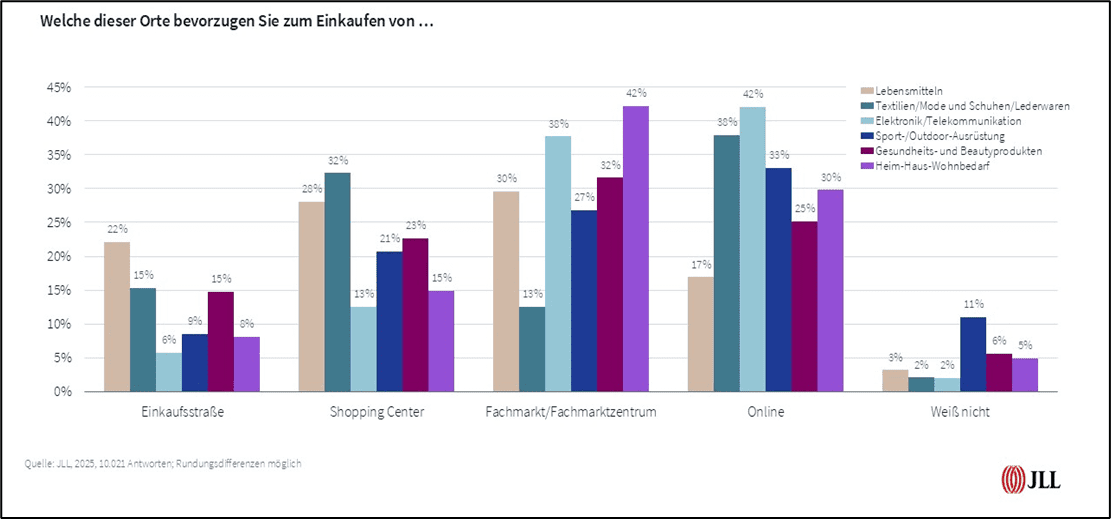
The differences are particularly pronounced in fashion and shoes. Nationwide, online shopping dominates with 38 percent, in metropolises shopping centers lead with 38 percent, just ahead of online retail with 35 percent. Stuttgart achieves the highest online share with 44 percent, Leipzig the strongest shopping center use with 47 percent.
Younger people use the savings potential via the app
Generation-specific preferences are even more evident. Generation Z between the ages of 18 and 29 is price-conscious and relies heavily on digital solutions. 77 percent are considered price-sensitive, 44 percent use app-based discounts, and 40 percent use online ordering with pick-up. Remarkably, 58 percent visit restaurants as a social meeting place.
The middle Generation X appreciates the ability to combine shopping with other activities the most. 29 percent call for more gastronomy, 29 percent want digital networking at future shopping locations.
“Older generations, on the other hand, cling to traditional structures. 59 percent of seniors appreciate personal advice, and among baby boomers the figure is as high as 61 percent. These groups prefer convenient accessibility and classic specialist store formats,” observes Giesemann.
The older the customers, the more likely they are to come by car
Meanwhile, mobility is changing fundamentally. While 76 percent of seniors use the car, only 49 percent of Generation Z do. Public transport reaches 26 percent across all age groups, and 33 percent among young adults. In the metropolises, the total share of 32 percent is well above the national average.
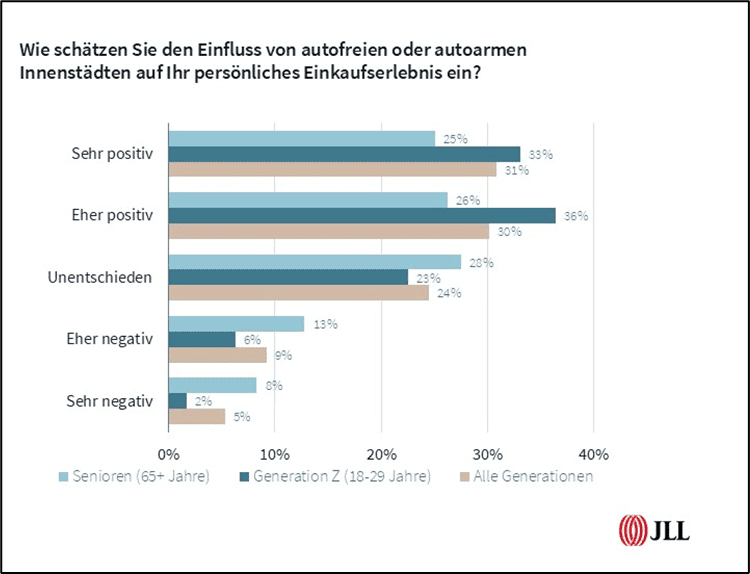
54 percent of all respondents are in favor of car-free or low-car city centers, compared to 61 percent of Generation Z. Even in rural regions, a narrow majority of 55 percent see positive effects on the shopping experience.
When it comes to grocery shopping, there are also generational differences. Online shopping dominates among consumers between the ages of 18 and 29 with 24 percent, while only eight percent of seniors prefer digital shopping. Conversely, the popularity of retail parks has risen from 20 percent among younger people to 37 percent among older people.
When it comes to future wishes, the focus is on sustainability and healthy nutrition across all ages. However, organic quality shows an inverse age distribution: 21 percent among young adults, only 16 percent among seniors. Regional products, on the other hand, gain in importance with age: from 29 percent for the youngest to 48 percent for the oldest.
Technology adoption varies widely. App-based offers interest 44 percent of Generation Z, but only 16 percent of seniors. Online ordering with pick-up is used by 40 percent of young adults compared to 23 percent of seniors.
For the players in the market, this means: “Success lies in intelligent orchestration. A flexible portfolio strategy is needed that combines the stable cash flow of retail parks with the value appreciation potential of experience-oriented inner-city locations and shopping centers. Leasing must think beyond rigid space concepts and offer tenants the flexibility to adapt their formats to granular, local demand – whether through a flagship store with an event focus in the city or a service-oriented local supplier on the outskirts,” Giesemann analyses.