Property can provide long-term protection against inflation, but often fails to fully offset short-term price surges. Where price rises are anticipated, the protection against inflation is more pronounced than in the case of unexpected inflationary spikes. Residential property tends to perform better than commercial property in this respect. In addition to the trend in rental income, the purchase price, the timing of the investment, the financing arrangements and the economic environment are key factors in maintaining real value. These are the conclusions reached by KGAL in its latest Research Spotlight, for which it analysed numerous academic studies and market data.
“Expected price rises can already be factored in at the time of purchase and when arranging financing. In the event of unexpected surges in inflation, however, interest rates and valuations often react more quickly than rents. A long-term investment horizon therefore allows rent adjustments time to take effect,” says Andreas Trumpp, Head of Research at KGAL.
Over periods of ten years or more, broadly diversified property investments have, for the most part, maintained purchasing power according to the European data analysed. However, this does not demonstrate reliable protection against unexpected surges in inflation. The long-term findings support the role of property as a component of an investment strategy aimed at preserving real wealth.
Residential property offers advantages over commercial property
Research suggests that residential property often offers better protection against inflation than office and retail property. This may be due to the comparatively stable demand for housing and the limited supply. Whilst commercial property more frequently has inflation-indexed tenancy agreements, these do not automatically protect against losses in purchasing power. In a weak economy, vacancies, rent defaults and falling market rents can erode the benefits of indexation.
Rising rents do not protect against falling property values
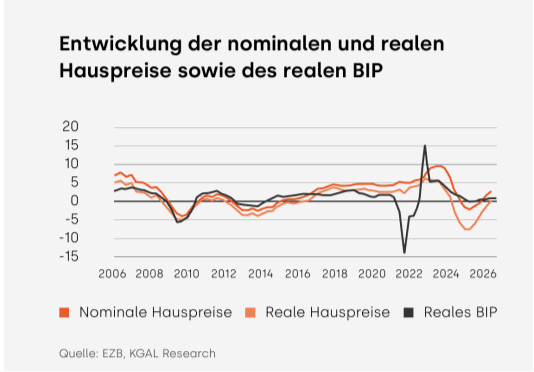
The study also highlights that rising rental income and falling property values can occur simultaneously. This was evident between 2022 and 2024: despite rising rents, property values came under considerable pressure. In April 2024, according to a market survey, European property values (excluding the UK) were around 19 per cent below their 2022 peak.
“A long holding period and index-linked tenancy agreements alone do not guarantee protection against inflation. What is crucial is that net income remains resilient even under less favourable economic conditions and that the financing provides sufficient flexibility,” said Trumpp.
For investors, therefore, in addition to adjustable rental income, the financing structure, the timing of entry and the cause of inflation are crucial. Whilst strong demand makes it easier to increase rents, rising costs in a weak economy can put pressure on returns. Long-term fixed-rate mortgages can help protect against inflation, whereas variable interest rates and upcoming refinancing can erode that protection.
Read more in the in-depth Research Spotlight