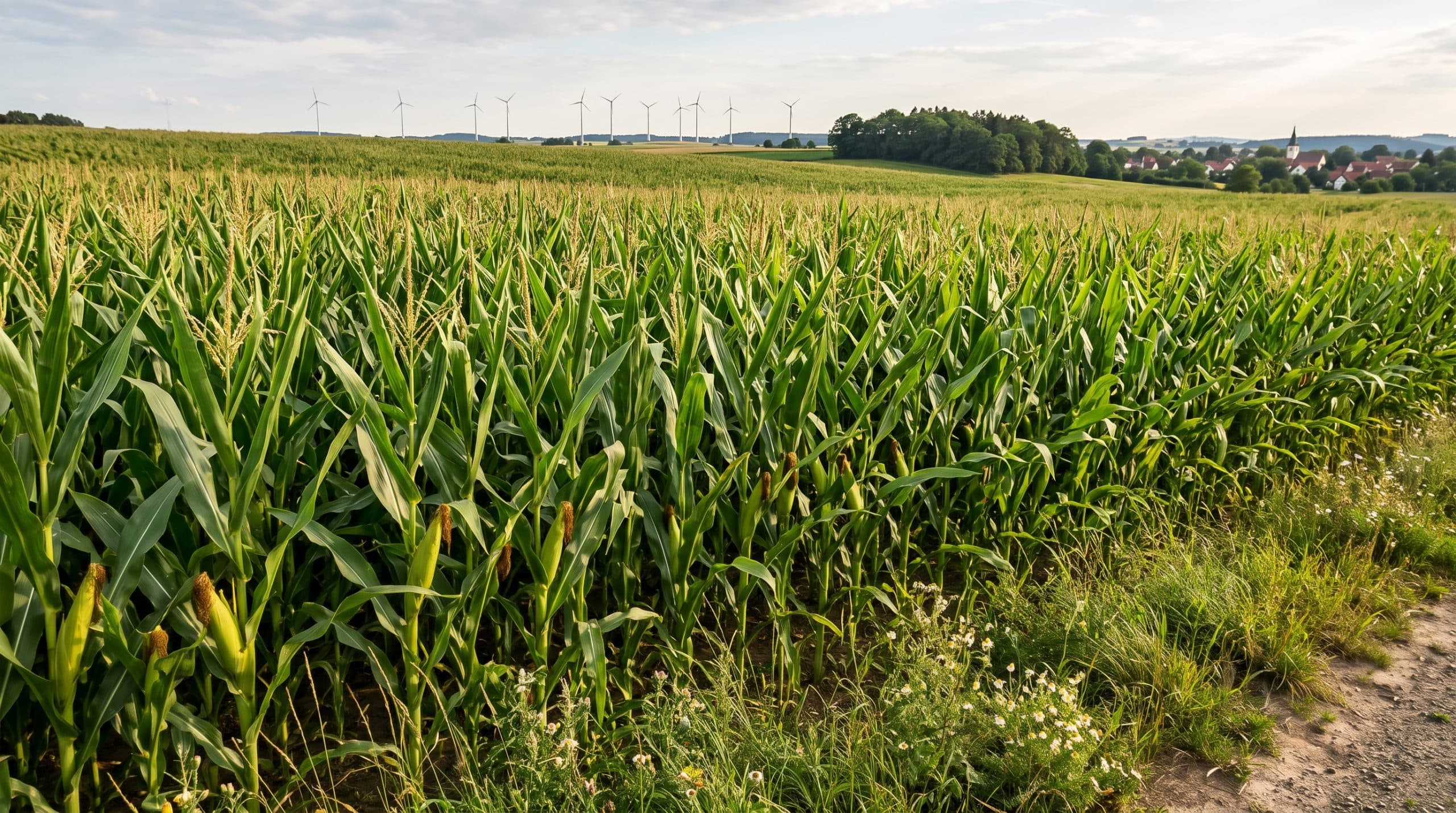
10.6 per cent of Germany’s total land area dedicated solely to silage maize cultivation: this is the amount that could potentially be required to meet the planned green gas quota by 2045. According to the German government’s recently published policy paper, from 2028 gas suppliers are to provide a gradually increasing proportion of climate-friendly gases for heating private households, which is set to reach 100 per cent by 2045. Aroundhome (https://www.aroundhome.de/), the leading independent platform for connecting specialist firms with homeowners, has calculated gas consumption in Germany’s 150 largest cities and illustrates the associated hypothetical land requirements using the example of silage maize for biomethane production. The following four scenarios were calculated for the currently planned green gas quota levels from 2030 to 2045:
-
Scenario 1: Green gas share of 5 per cent (2030)
-
Scenario 2: Green gas share of 20 per cent (2035)
-
Scenario 3: Green gas share of 50 per cent (2040)
-
Scenario 4: 100 per cent green gas share (2045)
Disclaimer: The model calculation considers only the potential land requirements for silage maize in the event of a hypothetical fulfilment of the green gas quota through biomethane. Other climate-friendly gases, such as green hydrogen – the use of which in private households is subject to considerable uncertainties regarding availability, infrastructure and competing demand – as well as possible changes in future gas consumption, are not taken into account. The results therefore do not constitute a forecast of the actual land requirements.
Potentially, almost the entire area of Berlin would already be required for a five per cent green gas quota
According to the Federal Statistical Office, the 150 most populous towns and cities in Germany comprise around 17 million dwellings. Of these, approximately 10.3 million are still heated by gas. The energy required for space heating and hot water amounts to an average of 12 MWh per dwelling per year. One hectare of silage maize yields, on average, between 39 and 59 MWh of biomethane. These figures were used to calculate the area of silage maize required for four scenarios per city, based on both an optimistic estimate (yield of 59 MWh/ha) and a conservative estimate (yield of 39 MWh/ha). For the calculation, it was assumed that maize would continue to account for 49.8 per cent of the energy-related raw material input for biomethane production. This proportion corresponds to the figure reported by the dena Biomethane Industry Barometer 2025 for the year 2024 and was applied to the required volume of biomethane to determine the hypothetical land area required for silage maize.
Overall, with a biomethane share of five per cent, this results in a land requirement of around 52,000 to 79,000 hectares for supplying the 150 largest cities alone. In the conservative scenario, this figure corresponds roughly to two and a half times the area of Munich or around 90 per cent of the area of Berlin. With over two million homes, the German capital itself accounts for the highest heating demand, even though the proportion of gas-fired heating systems – at 45.6 per cent – is significantly below the average of 63.7 per cent across the cities studied.
Potentially around 1.6 million hectares for the largest cities alone
With the planned increase in the share of green gas, the amount of land required for growing the necessary silage maize is also set to rise significantly. With a share of 20 per cent, between 208,000 and 315,000 hectares will already be required. At 50 per cent, the figure stands at 521,000 hectares for the optimistic estimate and 788,000 hectares for the conservative estimate. If the share rises to 100 per cent, the land required increases accordingly to up to around 1.6 million hectares. By way of comparison, the total area of Germany is around 35.8 million hectares.
Furthermore, if we consider all homes in the country that are heated by gas (56 per cent), the area potentially required to meet demand if they were powered exclusively by biomethane (100 per cent) would be up to 3.8 million hectares. This corresponds to 10.6 per cent of the total land area of Germany.
“Our model calculation illustrates the enormous amount of agricultural land that might potentially be required to meet the green gas quota. However, it remains to be seen how much of this is actually feasible and what costs this will entail for producers and consumers,” says Swen Dreßen, an expert in “energy-efficient housing” at Aroundhome. “In the context of private housing, the environmental and economic viability of heating with biomethane is highly questionable. The land requirements are enormous, whilst availability is limited. This makes it all the more important to move away from traditional gas heating systems as quickly as possible – whether by connecting to a modern district heating network in urban areas or by switching to electric heating systems. For homeowners, this means, in practical terms, prioritising energy efficiency right now. Those who renovate, reduce their heating requirements and opt for future-proof heating technology will save costs in the long term and become independent of fluctuations in fossil fuel prices. Above all, the combination of heat pumps, solar panels, battery storage and energy management makes a home self-sufficient and future-proof – without requiring any additional space.”
You can find all the results for the various scenarios at the following link:
About the study
As part of the analysis, the potential agricultural land requirement for the production of biomethane from silage maize was calculated for Germany’s 150 most populous towns and cities. According to the Federal Statistical Office, these comprise around 17 million dwellings, of which approximately 10.3 million are heated by gas. Assuming an average annual energy requirement of 12 MWh per dwelling – derived from energy consumption data for private households provided by the Federal Environment Agency – the theoretical gas demand for space heating and hot water was first determined. On this basis, the respective quantities of green gas required for the proposed quota levels of 5, 20, 50 and 100 per cent were calculated.
For the subsequent calculation of the potential land requirement, it was assumed, for the sake of simplicity, that maize would continue to account for 49.8 per cent of the energy-related raw material input for biomethane production. This corresponds to the proportion reported for 2024 in the dena Biomethane Industry Barometer 2025. Assuming a biomethane yield of 39 to 59 MWh per hectare of silage maize, based on a synthesis of scientific findings, an optimistic and a conservative estimate of the land area required was produced for each city and quota level. The calculation assumes constant gas consumption and an unchanged raw material composition. It expressly does not constitute a forecast of the actual future land requirements.