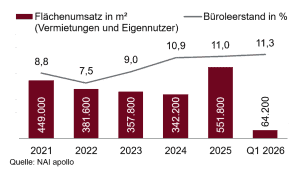
After a very positive annual result in 2025, the Frankfurt office space market, including Eschborn and Offenbach-Kaiserlei, was characterised by restrained market activity in the first quarter of 2026. According to the NAI, apollo , member of NAI Partners Germany, the take-up by lettings and owner-occupiers in the first three months of 2026 was 64,200 square metres. This represents the weakest start to the year since 2013. The average of the last ten quarters at the beginning of the year has been undercut by more than 40 percent (Q1 2016 – Q1 2025: 109,500 square meters). The decline compared to the previous year is even more than 68 percent. "However, it must be taken into account that there was a special market situation at the beginning of 2025. The two project leases by Commerzbank and ING Germany with a total of over 100,000 square metres shaped the events and led to a record sales result," says Dr. Konrad Kanzler, Head of Research at NAI apollo. The largest deal of the first quarter of 2026 is now the purchase of Fifty Avon with over 20,000 square meters of office space by DZ Bank. With this acquisition, which was accompanied by NAI apollo, the financial institution plans to further expand its campus on Mainzer Landstraße - already the largest contiguous location of a bank in Frankfurt, explains Martin Angersbach, Director Business Development Office Germany at NAI apollo.
Certainly, the renewed tightening of the economic framework conditions, including the Middle East conflict and the recurring burgeoning customs disputes with the USA with corresponding consequences for inflation, interest rates and economic development, is casting its shadow on the Frankfurt office market. The main reason for the current decline in sales, however, lies in another point. User demand for office space continues to exist. However, this focuses on properties in the top segment in the central locations of the city, where there is an increasing lack of corresponding supply. "The relevant new-build properties that will come on the market in the Central Business District in the next few years are already almost fully let or potential tenants are in final contract negotiations. There are still smaller remaining spaces and individual sublet spaces, but they are not sufficient to be able to meet space requests in the medium-size segment," says Michael Preuße, Head of Office and Retail Letting at NAI apollo.
Lack of deals in the mid-range segment slows down market momentum
In the medium and large space segments, a massive decline was registered in the first quarter of 2026. Particularly striking is the lack of deals in the 5,000 to 10,000 square metre segment, which otherwise plays an important role in the Frankfurt market. The 2,500 to 5,000 square metre segment also recorded only two deals, which means that take-up fell by 54.6 per cent compared to the first quarter of 2025. In the size class above 10,000 square metres, only one deal was registered with the DZ owner-occupier deal, which is high-volume, but represents a special case as an owner-occupier purchase. The smaller size classes under 2,500 square meters were the only pillar of the market, but also fell sharply compared to the previous year with a minus of 42.2 percent.
Banking, Financial Services & Insurance Sector Again the Strongest Sector
"Despite the subdued overall momentum, a basic trend from previous years is continuing: banks, financial service providers and insurance companies remain the most important industry group by a clear margin. In the first quarter, they accounted for almost 23,600 square meters, which corresponds to a market share of 36.7 percent. However, the high share of this industry group is largely due to DZ Bank's owner-occupier financial statements," said Kanzler. In second place is the communication, IT and IT industry, which generates around 7,600 square meters and thus 11.8 percent of total sales. Almost the same volume comes from the traffic, transport & logistics segment with just under 7,400 square meters or 11.5 percent market share. The DZ Bank deal has also led to the banking situation once again forming the strongest sub-market at around 23,500 square metres. Without this agreement, however, the Westend would have taken the top position with around 8,000 square meters, which now lands in second place. This is followed by the West financial district with around 4,900 square metres.
Vacancy rate rises to 11.3 percent
The market-active vacancy rate on the Frankfurt office market continued to rise in the first quarter of 2026. At the end of March 2026, around 1.30 million square meters will be available at short notice, which is an increase of almost 40,000 square meters compared to the previous quarter. The vacancy rate has thus increased from 11.0 percent at the beginning of the year to 11.3 percent. "While the vacancy rate in the city as a whole continues to rise, a different picture emerges in the central locations: the main CBD location remains the most sought-after location in the city for users with high demands. However, modern, high-quality and representative areas are almost completely absorbed there. In the sought-after premium properties, the vacancy rate is virtually zero," says Preuße.
New construction activities do not lead to any relief
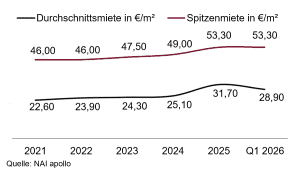
A look at the current completion pipeline shows that hardly any additional relief is to be expected for the Frankfurt office market in the coming quarters. Around 120,000 square metres of completions are planned for 2026 as a whole. Of these, 63,500 square metres are currently still available for rent. "About 40,000 square meters of this are accounted for by the Omega House in Offenbach Kaiserlei alone. In 2027, according to current knowledge, the completion volume will fall just below 100,000 square metres, of which only 18,000 square metres are still rentable. This means that the supply of modern, high-quality and ESG-capable new construction space will remain limited in the coming years," says Angersbach. Rents have recently shown a different development. The prime rent has remained unchanged compared to the beginning of the year at 53.30 euros per square metre. Compared to the same quarter of the previous year, this represents an increase of 1.80 euros. On the other hand, there has been a normalization in the average rent. "Last year, the leasing of the entire Central Business Tower in particular led to a significant increase. However, since the rent calculations refer to the financial statements of the last 12 months, this special effect is now eliminated. As a result, the average rent has fallen to 28.90 euros per square metre and thus well below the 30 euro mark again," explains Kanzler.
Lack of demand-driven space is slowing down market development
So far, user demand on the Frankfurt office market continues to exist. However, a prolonged war in the Middle East will have a significant impact on the German economy, which is already affected by structural problems, and weaken the expected slight economic recovery. This will also lead to caution and restrained activities on the part of local market players. At present, the lack of demand-driven space is the main obstacle to market development. "In the coming months, the focus of demand will continue to be on premium properties in top locations. Here, however, almost all the corresponding space is fully let. Existing properties offer a possible alternative, provided that they meet the essential user requirements in terms of location and quality. However, this requires a greater willingness to compromise on the part of potential tenants," says Preuße. In the case of older existing properties, there is a risk of vacancy if no revitalisation is sought. "The persistently high demand for high-quality space in central locations with a simultaneous hardly any increase in new construction activity is likely to drive the prime rent further up. The average rent, on the other hand, is expected to continue to normalize and stabilize. In terms of vacancy, a further increase at the overall market level is to be expected due to further vacancies of older properties – especially in decentralised sub-markets," explains Angersbach.