- Transaction volume of EUR 2.0 billion, 11.5 percent below the previous year's result
- Increasing portfolio trading, especially in the low- and high-priced segment
- Core and core-plus products form the strongest demand segments
- Large forward deals in the top 7 drive the market share of project developments above the 50 percent mark
- Public sector dominates the field of buyers, project developers and property developers are the strongest seller group
- German investors by far the most active buyers, international investors with losses
- Outlook for 2026: The transaction volume is likely to remain below the long-term average and thus at the low level of the past three years (below EUR 10 billion). Persistent geopolitical risks and weak economic signals are slowing down the momentum. At the same time, increasing interest in large-volume core portfolio deals, stable fundamentals in the residential segment and a growing willingness to sell unrefurbished value-add properties and distressed assets are providing selective impetus.
At the beginning of 2026, market activity on the German transaction market for residential portfolios (30 residential units or more) slowed down again. As the latest analysis by NAI apollo, a member of NAI Partners Germany, shows, residential portfolio transactions worth 2.0 billion euros have been traded in the past three months – a result that is at the level of the second and third quarters of 2025. Compared to the same quarter of the previous year (Q1 2025: EUR 2.3 billion) and the final quarter of 2025 (Q4 2025: EUR 2.4 billion), however, a more significant decline can be observed. In the current quarter, around 12,500 residential units were traded. Compared to the same period last year, this corresponds to a decrease of 28.2 percent. The main reason for this is the absence of large-volume transactions of more than EUR 500 million, as took place in the previous year. On the other hand, the number of registered transactions has increased compared to the beginning of 2025.
"Residential real estate continues to demonstrate remarkable resilience in the current tense and geopolitically uncertain environment – even though the residential portfolio transaction market is also under pressure," explains Dr. Konrad Kanzler, Head of Research at NAI apollo.
"The market is predominantly dominated by domestic buyers. They are responsible for 84.3 percent of sales or 1.7 billion euros. Foreign investors have lost market shares of almost 40 percentage points compared to the previous year, as they have mainly made small to medium-sized transactions in contrast to the previous year," adds Dr. Marcel Crommen, Managing Director of NAI apollo.
"Overall, low-risk assets in A and B cities as well as in university cities are becoming the focus of institutional investors. At the same time, the public sector continues to gain market importance, especially with a focus on project developments," says Stefan Mergen, Managing Partner of apollo valuation & research GmbH.
Cluster of 100 to 500 million euros dominates the market
The performance of the high-priced cluster between 100 and 500 million euros improved significantly in the first quarter of 2026. With a market share of 29.6 percent or a transaction volume of EUR 601 million, it represents the strongest size segment. The market cluster below EUR 10 million was also particularly dynamic, more than tripling its sales volume compared to the previous year. The "EUR 50 < 100 million" and "EUR 10 < 25 million" segments grew by 69.7 percent and 27.6 percent, respectively. "In contrast to the previous year, the transaction volume in the mid-range segment between EUR 25 million and EUR 50 million fell by 29.4 percent to EUR 455 million. In the area of megadeals above the 500 million euro mark, no transaction took place, also in contrast to the same quarter of the previous year," reports Kanzler.
Real estate companies are the second strongest investors after the public sector with a significant increase in turnover
"The public sector has significantly expanded its market presence compared to the previous year. It increased its acquisition volume by almost 40 percent compared to the first quarter of 2025 and takes over the top position in the investor ranking with a market share of 23.4 percent. An increase in real estate companies is also striking. Their investment volume increased from EUR 203 million to EUR 453 million, thus securing second place," said Mergen. On the seller side, project developers and property developers continue to dominate, increasing their sales volume to almost EUR 900 million (Q1 2025: EUR 640 million). This is followed by asset and fund managers, who achieved an increase of 64.5 percent to over EUR 300 million. "The real estate stock corporations, which currently occupy third place in the seller ranking with 288 million euros, were also able to make significant gains. Many of its portfolio properties from the value-add and opportunistic segments, especially properties with manage-to-green potential, met with interest from investors with strong equity. However, the pricing phase in this market cluster has still not been fully completed, which has partially slowed down transaction dynamics," adds Kanzler.
Revenue from project developments doubles to EUR 1 billion
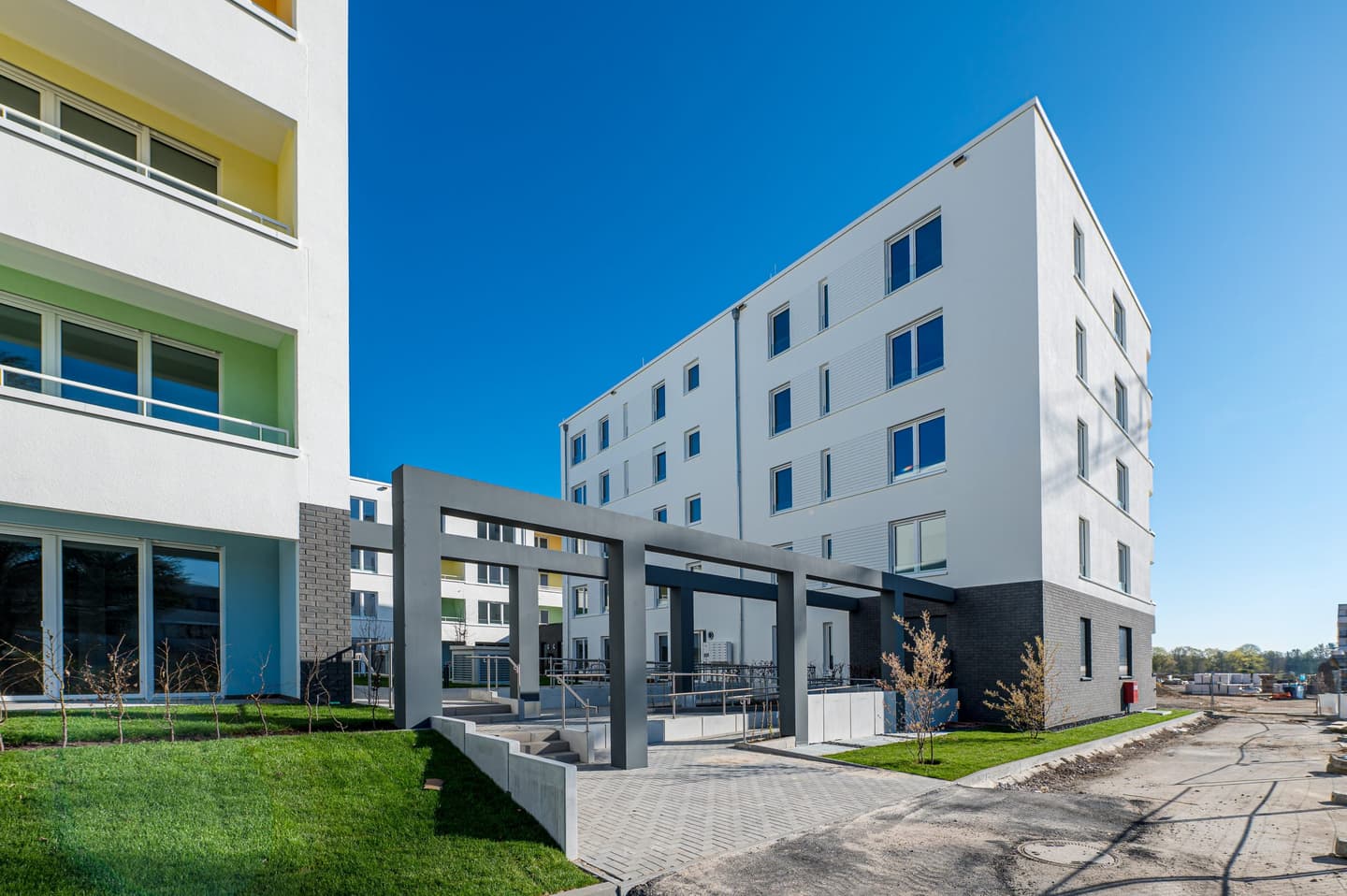
The market for project developments has picked up speed despite the challenging conditions and the resulting lack of supply. The transaction volume of forward deals rose to EUR 1.0 billion in the first quarter of 2026, almost twice as high as in the same period of the previous year (Q1 2025: EUR 511 million). The market share climbed accordingly from 22.3 to 50.5 percent. "The focus is currently increasingly on project developments in mixed-use districts, on serial and modular construction methods in subsidized housing construction, and on projects with semi-detached and terraced houses," says Mergen. In view of the potential for further increases in construction costs, project development in social housing construction in secondary locations in particular is becoming more economically attractive, as lower construction and planning costs can be achieved here. "At the same time, the demand for new buildings is increasing in front-row cities, as the rent brake for properties built from 2014 onwards does not apply. At the same time, the planned limitation of indexed rent increases is likely to reduce the profitability of many new construction investments and slow down investors. Particularly affected would be the metropolises in which institutional landlords rely heavily on index-linked leases – and thus react particularly sensitively to regulatory interventions," says Crommen.
Market activity will remain at a low level in the coming months
"Uncertainty on the investment market will remain high in the coming months. At the same time, the institutional residential segment, supported by the ongoing shortage of housing and long-term rent increase potential in growth regions, is proving to be a key stability factor for the 2026 real estate year. This increases selling pressure – especially for owners of unrenovated portfolios who continue to rely on liquidity. In view of increased renovation and modernization costs, these owners are coming under increasing pressure and are more often forced to accept price reductions. At the same time, the German market will become more attractive for international capital, which will increasingly be redeployed from politically unstable regions to comparatively safe markets such as Germany," says Mergen.
As in previous years, the market environment remains challenging. Despite the unchanged key interest rate, construction interest rates have recently risen significantly. "The main reason for this is the rise in yields on the ten-year German government bond, triggered by rising inflation risks. If you want to keep your financing costs under control, you should react early. This applies in particular to project-related real estate financing, which is particularly sensitive to interest rate movements due to short-term maturities. At the same time, there are opportunities for investors with strong equity capital, as they are less exposed to interest rate changes due to their lower borrowing requirements. Risk-averse investors are structuring their portfolios more defensively and directing demand more towards core products, while opportunistic buyers remain attractive on a selective basis," Crommen explains.
"The subdued market momentum at the start of the year and the increased volatility due to geopolitical risks indicate that the EUR 10 billion threshold will be undercut again in 2026. For the second quarter of 2026, a largely stable, slightly declining willingness to deal is expected. However, a moderate increase in investment volumes seems possible at the end of the year – even if there are still no signs of a sustainable trend reversal," Kanzler predicts.