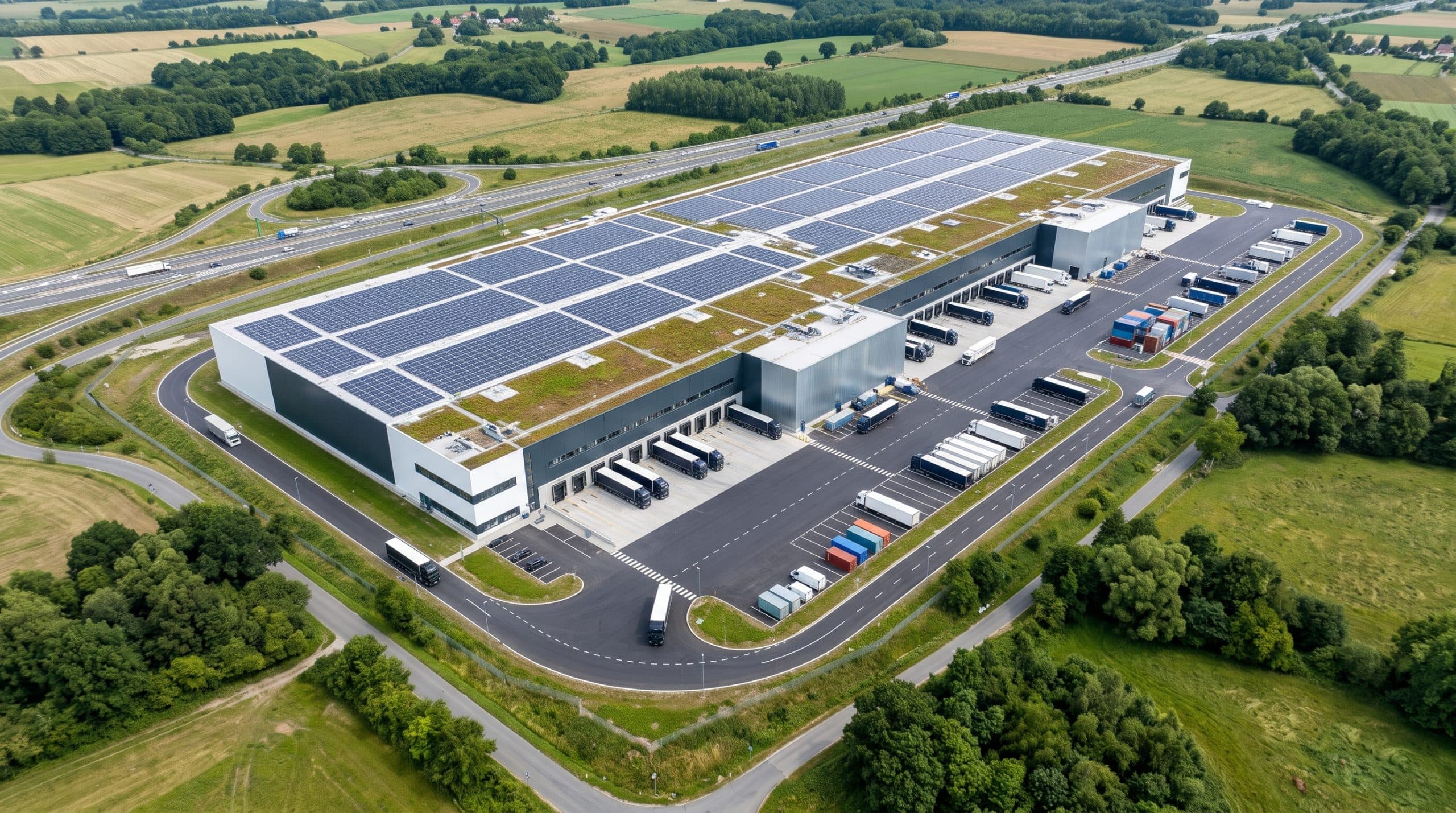
The warehouse and logistics property market in the Rhine-Main region showed further signs of recovery in the third quarter. According to NAI apollo, a partner of NAI Partners Germany, a total of 167,400 square metres of space was let or taken up for owner-occupancy over the past three months. Take-up has thus risen steadily over the course of the year, reaching its highest quarterly figure since the end of 2023. The last time take-up was higher in the July to September period was in 2021. So far this year, take-up totals 393,400 square metres.
“As at the end of September, this represents the highest figure since the record year of 2021. Consequently, the five-year average has also been exceeded by 4.2 per cent, whilst the long-term ten-year average of 432,600 square metres has once again not been reached,” said Stefan Weyrauch, partner at NAI apollo.
“However, this long-term analysis also includes exceptional results achieved in 2017, 2018 and, above all, 2021. Given the economic and geopolitical conditions, which remain challenging at present, the current result is therefore to be viewed very positively, with the increase in market activity over the course of the year deserving particular mention,” said Sven Tilse, Head of Industrial and Logistics at NAI apollo.
Large-scale segment accounts for the highest share and shows the strongest growth
The current trend is being driven significantly by the large-scale market segment, and in particular by a sharp rise in transactions ranging from 10,000 to 20,000 square metres. “The size category of warehouses exceeding 10,000 square metres accounts for a total of 235,500 square metres, with just under 50 per cent of this figure attributable to the third quarter of the year alone. Space take-up in this segment is thus currently almost 90 per cent higher than the figure for the first three quarters of the previous year,” said Dr Konrad Kanzler, Head of Research at NAI apollo. Growth has also been recorded for smaller warehouse spaces of less than 1,500 square metres, which have totalled 35,900 square metres so far this year. By contrast, the medium-sized segments have seen declines compared with the previous year. Taken together, spaces between 1,500 and 10,000 square metres have totalled 122,000 square metres. This represents a fall of 38.2 per cent.
“Consequently, the large-scale industrial property segment dominates the breakdown of turnover, accounting for 59.9 per cent. This represents a record over the last ten years, although higher space-based turnover was also recorded in this segment in the years up to 2021. At the same time, this trend highlights the great importance of the large-scale segment for turnover growth, which is currently characterised predominantly by a small number of larger deals,” explains Tilse.
Siemens secured the largest lease of the year to date in the second quarter, taking around 32,000 square metres of industrial space in Offenbach am Main. Between July and September, the largest deal – facilitated by NAI apollo – took place in Nieder-Olm: a subsidiary of an international retail group leased an existing property there measuring just under 30,000 square metres.
Warehouse and logistics service providers continue to expand their market dominance
To date, transport, warehousing and logistics companies have by far been the most significant group of demand in 2026. In the first three quarters of the year, they accounted for a take-up of 235,100 square metres. “This is the highest figure since 2018 and almost double that of the previous year. They clearly dominate the medium-sized space segment in particular. For example, in the size range between 5,000 and under 20,000 square metres, almost all transactions can be attributed to transport, warehousing and logistics companies,” says Kanzler. With the exception of utilities and waste management companies, which saw growth due to a major transaction, all other sectors show clear declines. Warehousing and logistics service providers are followed, by a considerable margin, by companies in the industrial and manufacturing sectors, which came second with 47,100 square metres. The retail sector takes third place; although it has managed to narrow the gap with industrial companies over the past three months, its figure of 41,700 square metres remains below the results of previous years.
Proportion of new-build properties at a ten-year low
In the third quarter, too, the focus of market activity was clearly on existing properties. In the first nine months of 2026, space take-up in this segment totalled 339,600 square metres, representing a market share of 86.3 per cent. The new-build segment, which comprises lettings in new-build projects and the construction of owner-occupied projects, accounted for 53,800 square metres, or 13.7 per cent, respectively. Despite an increase in recent months, this is the lowest nine-month figure of the last ten years. The low proportion of new-builds in the take-up is less a reflection of weak demand than a consequence of limited supply. “However, an improvement is on the horizon on the supply side. More than 300,000 square metres of new-build space is expected over the next 18 to 24 months. Among other projects, Baytree is planning a logistics property in Nieder-Olm with around 50,000 square metres of warehouse space on a former Mercedes-Benz site. Demolition work is due to begin before the end of this year. Another example is a development by Swiss Life on the site of the former Griesheim industrial park in Frankfurt, where around 60,000 square metres of logistics space will be created,” explains Tilse.
“The prime rent for warehouse and logistics space of 5,000 square metres or more stood at 9.00 euros per square metre at the end of the third quarter. Compared with the previous quarter, this represents an increase of 10 cents per square metre. For smaller spaces, initial deals and current offers are now reaching 10.00 euros per square metre and above. This points to a further rise in rents in the coming quarters,” adds Weyrauch.
Despite challenging market conditions, the warehouse and logistics market remains stable
The geopolitical and economic conditions have shown little or no improvement recently. Nevertheless, the warehousing and logistics market in the Rhine-Main region has performed well so far this year. This is due to two key factors. “The growth in turnover stems almost exclusively from the activities of transport, warehousing and logistics companies, which account for a market share of around 60 per cent, as well as from an increase in turnover in the large-scale segment (over 10,000 square metres), which also holds a market share of just under 60 per cent. By contrast, almost all other size categories and sectors have seen declines compared with the previous year, although the retail sector has again recorded more significant growth over the past three months,” said Kanzler.
This trend is expected to continue largely unchanged in the coming months. Industrial companies, particularly those in the automotive sector, are more severely affected by the economic downturn and structural problems and continue to adopt a cautious approach. The focus is on responding to changes in supply chains, including by expanding storage capacity. More positive trends are evident in the retail sector. “In e-commerce in particular, companies from the Asian region are showing a growing demand for space. They either act as direct tenants or commission external service providers to handle their logistics processes. This also supports warehousing and logistics companies. In particular, 3PL providers – that is, service providers who take over the entire warehousing and logistics process on behalf of clients – are thus becoming increasingly important,” said Tilse. Positive momentum is also coming from the defence sector, which is establishing itself as an additional driver of demand for the German logistics property market.
“With regard to the expected take-up for the full year 2026, the forecast made in the summer can be raised slightly as a result of the positive performance in the third quarter. The 500,000-square-metre mark is expected to be exceeded, which would mean the final figure would be higher than the results for the past four years,” predicts Weyrauch.