New all-time solar high in Germany: 12 billion kWh of solar power in one month for the first time – IWR explains misunderstandings about EEG subsidies
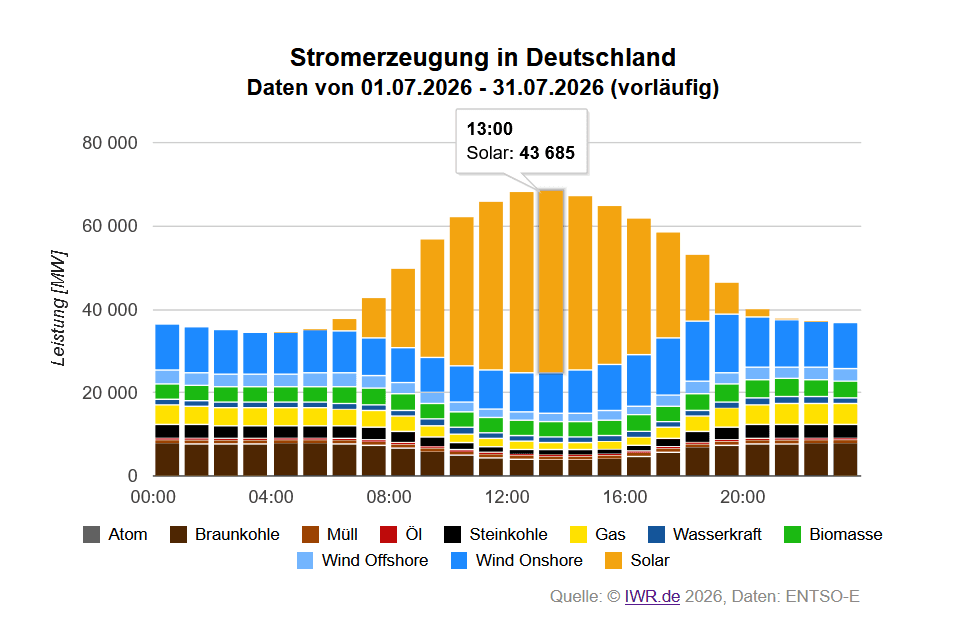
Photovoltaics reached a historic milestone in Germany in July 2026. For the first time, 12 billion kilowatt hours (kWh) of solar power were fed into the public power grid in a single month. This is the result of an evaluation of quarter-hourly feed-in data from the European grid operator platform ENTSO-E by the International Economic Forum for Renewable Energies (IWR) in Münster. In fact, the total solar power generation is even significantly higher, as the solar power consumed directly on site is not recorded in the feed-in statistics.
At the same time, the evaluation illustrates the significantly increased importance of photovoltaics for Germany's electricity supply. At lunchtime, the monthly average solar power in July was over 40,000 MW. This corresponds to the electrical output of more than 40 nuclear power plants, each with 1,000 MW. Throughout the day, photovoltaics thus displaced a significant part of electricity generation from coal- and gas-fired power plants.
Photovoltaics will become the mainstay of the power supply
The July data mark a structural change in the German electricity system. Photovoltaics has long since ceased to be a complementary technology, but is one of the central building blocks of the power supply. Over the past two decades, this development has been made possible by millions of private homeowners, farmers, commercial enterprises and medium-sized companies that have invested in solar systems.
Against this background, the current legal framework, especially for smaller photovoltaic systems, is changing the economic conditions for precisely the operator group that has made the expansion so far possible.