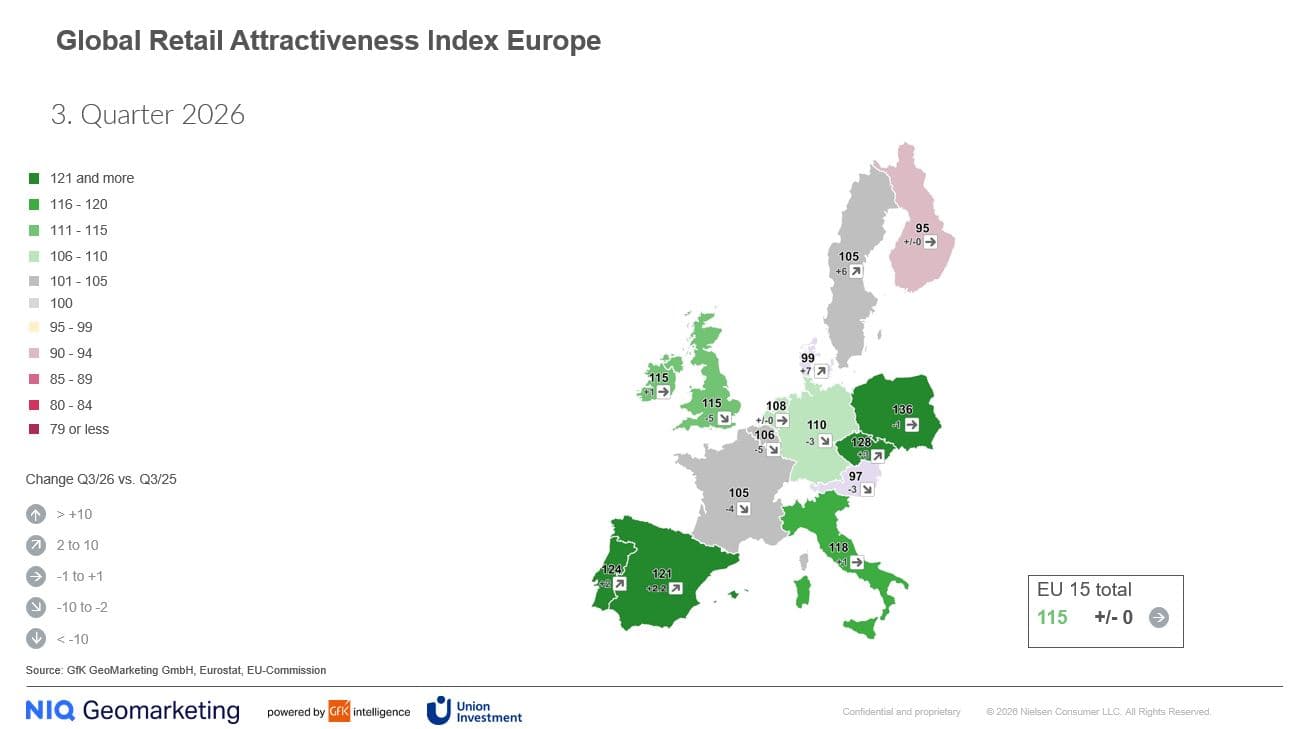
The European retail sector is picking up momentum again. The latest Global Retail Attractiveness Index (GRAI), compiled by NIQ-GfK and Union Investment across 15 EU countries plus the United Kingdom, rose to 114.8 points in the third quarter of 2026. This represents a slight increase of 0.4 points compared with the same quarter last year and brings to an end a brief period of two consecutive quarters of falling index figures.
“The latest results give cause for cautious optimism. Robust retail sales, rising confidence amongst retailers and positive developments in several Northern European markets suggest that the European retail sector is back on track,” says Roman Müller, Head of Investment Management Retail at Union Investment.
Compared with the previous quarter, all 15 markets recorded growth. However, compared with the previous year, the picture remains mixed. “Consumer confidence has not yet returned to its previous level, labour market conditions continue to weigh on several national markets, and the differences between individual countries remain considerable,” said Roman Müller.
In terms of national indices, Poland (136 points) and the Czech Republic (128 points) continue to lead the way. Portugal (124 points) and Spain (121 points) are also well above the EU-15 average of 114.8 points.
The results also highlight the need to distinguish between a market’s current attractiveness and its short-term momentum. Despite a slight year-on-year decline, Poland remains Europe’s most attractive retail market. Denmark, on the other hand, recorded the strongest annual increase in the overall index, rising by 7.2 points; however, with its current index value of just 99 points, it remains below the European average. Sweden follows with the second-strongest growth of 5.8 points, but this still only brings its index value to a below-average 105 points.
Several of Europe’s largest retail markets remain under pressure. The United Kingdom recorded a year-on-year decline of 5.2 points. Belgium suffered the sharpest fall, down 5.3 points. In Germany, the index fell by 3.2 points, and in France by 3.8 points.
In all three major European markets, the positive trends in retail turnover were not sufficient to offset the declines in the other indicators. In Germany and France, consumer sentiment and retailer confidence remained subdued, whilst labour market indicators in the United Kingdom, in particular, deteriorated significantly.
Retail sales remain the strongest driver of growth
The strongest positive contribution to the European index came from the trend in retail turnover. This sub-indicator rose by 5.1 points compared with the same quarter of the previous year. All the countries surveyed recorded positive developments in this area. The largest increases were seen in Portugal (+8.9 points), Poland (+7.6), Spain (+7.4) and the Czech Republic (+7.3). Germany (+4.4) and the United Kingdom (+5.8) also recorded increases here.
Retailers’ confidence improved by 0.8 points overall. The rise was particularly marked in Denmark (+27.6 points), Finland (+18.7) and Sweden (+12.1). This points to a noticeable improvement in business expectations across the Nordic region.
Consumer confidence, on the other hand, continued to decline and stood 3.5 points below the previous year’s level in the EU-15. Labour market trends also had a dampening effect on the overall index. The growing discrepancy between actual developments in the retail sector and sentiment indicators thus remains one of the key features of the current market situation.
Europe maintains its strong position in international comparisons
An international comparison confirms that Europe continues to hold a strong position in the global retail sector. At 114.8 points, the EU-15 index is well ahead of the indices for North America and the Asia-Pacific region.
The index for North America improved by 1.8 points in the third quarter compared with the previous quarter, rising to 100.4 points. This meant the region was 2.9 points above the figure for the same period last year. The Asia-Pacific region also recovered by 2.2 points in the third quarter to 94.4 points, but remained 1.9 points below the figure for the same period last year.
The European index is therefore more than 14 points higher than that of North America and more than 20 points higher than that of the Asia-Pacific region. This gap has also remained largely stable over the longer term in the GRAI.
About the Global Retail Attractiveness Index
The Global Retail Attractiveness Index (GRAI) is compiled by NIQ-GfK and Union Investment and assesses the attractiveness of retail markets on the basis of four equally weighted indicators: consumer confidence, retailer and business confidence, unemployment and retail turnover. The indicators are standardised to ensure they are comparable. A score of 100 points corresponds to the average. The overall index for the EU-15 is weighted according to the population of each country.