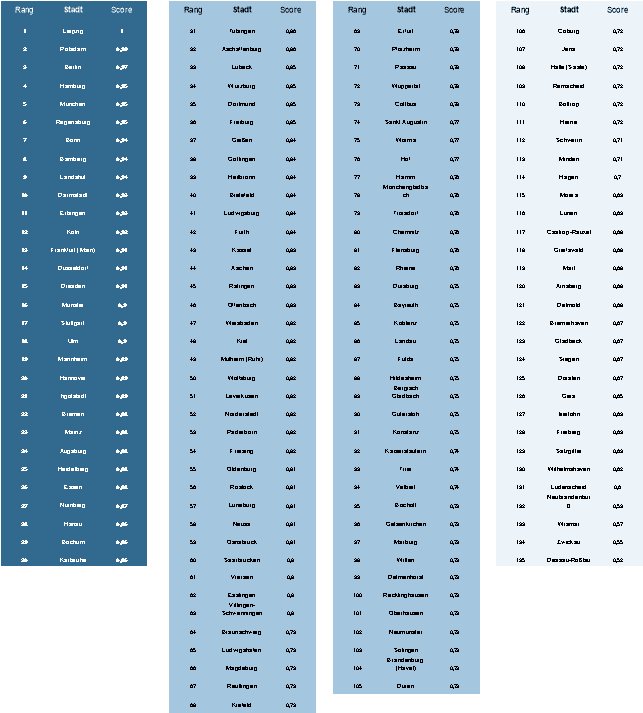
Leipzig, Potsdam and Berlin are the most attractive cities for residential investments in Germany. This is the result of the current risk-return ranking 2026 of Lübke Kelber AG, which examines 135 German residential real estate markets for the first time. Almost all A-markets are among the top 30; at the same time, Bamberg, Landshut, Ingolstadt and Hanau are also B and C cities in the top ranks. In the lower part of the evaluation, there are mainly C-markets, mostly from structurally weak regions of eastern Germany and the Ruhr area. Between the top markets and the weaker cities, there is a very pronounced midfield. Five categories were decisive for these results: population, socio-economics, housing market, rents and purchase prices, and quality of life. The entire risk-return ranking is based on the Lübke Kelber’s website available.
“The above-average predictability of cash flows and the structurally high rental demand make the German residential real estate market an attractive investment destination in 2026 as well,” says Marc Sahling, CEO of Lübke Kelber AG. “In an environment characterized by geopolitical uncertainty and economic volatility, income-driven strategies are clearly in focus.”
The second part of the study relates the attractiveness and risk profile of the cities to the expected return. “In this way, we not only evaluate the quality or development potential of a city, but also the associated price,” explains Mark Holz, Head of Strategy & Research at Lübke Kelber. “For investors, it is precisely this ratio that is ultimately decisive.”
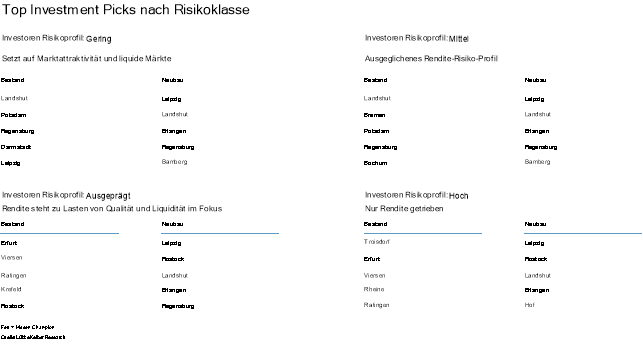
Many markets with high risk-adjusted performance are smaller cities that have an above-average expected return on equity with average or slightly below-average attractiveness, i.e. higher risk. The performance can be explained primarily by the relatively low purchase factors, which lead to a relatively high expected total distribution. “In this way, some hidden champions, such as Landshut, Bamberg or Viersen, can be identified,” explains Holz.
Rents continued to develop dynamically: In 2025, asking rents in existing buildings rose by an average of 4.6 percent, and in new buildings by 5.1 percent. Growth was particularly strong in individual B and C cities. “The excess demand on the housing market remains high despite a slight increase in the number of permits. In the short to medium term, no noticeable easing is to be expected,” says Holz. “In the longer term, on the other hand, the weakening labor market and especially the demographic development pose risks.”
After the pronounced price correction as a result of the interest rate turnaround, the markets increasingly stabilized in 2024. Finally, 2025 was marked by a slight recovery in purchase prices. On average, capital values for apartment buildings rose by 5.5 percent compared to the previous year.
At the same time, the purchase multiples rose moderately again for the first time in 2025. For existing properties, they are on average 15.7 times the annual net cold rent in medium locations and 18.6 times in good locations in all 135 stores. For new buildings, they are higher at 19.3 and 21.2 respectively. There are significant differences at the market level – for example, the A markets remain more expensive than the second- and third-tier markets.
However, the increased rental costs also contributed to the fact that the housing cost burden rose slightly in 2025. On average, households have to pay 21.5 percent of their income for an existing rental apartment (2024: 21.0 percent), and 23.9 percent (2024: 23.7 percent; Assumption: 80 percent debt). Especially in Germany’s top markets, rents have risen in recent years to a level that is difficult for many to afford. As a consequence, a trend can be observed that net internal migration is negative in many large cities, but positive in surrounding municipalities and cities in the second and third tier. In 18 of the 135 markets examined, the purchase burden in the portfolio is now below the rent burden. In new construction, however, the acquisition remains much more challenging due to high construction and financing costs.
For 2026, Lübke Kelber expects investment activity to increase with capital values continuing to rise. The base case is assumed to be an increase in value of around ten percent in selected markets, especially where rental growth and structural demand meet.
At the same time, medium- and long-term risks – in particular demographic developments and a possible slowdown in net immigration – remain in focus. “In an environment with moderate macroeconomic momentum, internal migration and affordability are becoming decisive drivers,” says Holz. “Cities in the second and third tiers with a high quality of life and moderate price levels are likely to benefit disproportionately.”
Lübke Kelber determined the individual market attractiveness and the inverse location risk for each of the 135 cities examined. This results from population development, socio-economic conditions, the housing market, current rents and purchase prices as well as the quality of life of the respective city.
From this consideration, risk premiums are determined, which are credited to the risk-free interest rate in addition to a general surcharge for “real estate”. This results in the recommended minimum return that should be achieved at the respective location in order to adequately price in its individual risk. The risk-free interest rate of 2.75 percent corresponds to the yield on a ten-year German government bond. For the investment analysis of a typical institutional investor on which the risk-return ranking is based, an equity ratio of 55 percent was assumed, with an interest rate of 3.5 percent fixed for ten years for the debt capital. In relation to the difference between the return on equity calculated by Lübke Kelber and the recommended minimum return based on the location risk, a comprehensive picture of the most attractive locations for residential real estate investments in Germany emerges.
With the twelfth edition of the ranking, Lübke Kelber is introducing a new housing market classification. Based on eight structural indicators, 14 cities are classified as A-markets (“International Investment Grade”), 40 as B-markets (“National Investment Grade”) and 81 as C-markets (“Regional Investment Grade”). In addition, the suffices “Uni” and “Metro” characterize cities with a special university character or a pronounced commuter function in the vicinity of large metropolises.
The aim of the new market classification is to map the polycentric structure of the German housing market more precisely and to enable investment decisions to be made in a more differentiated way.