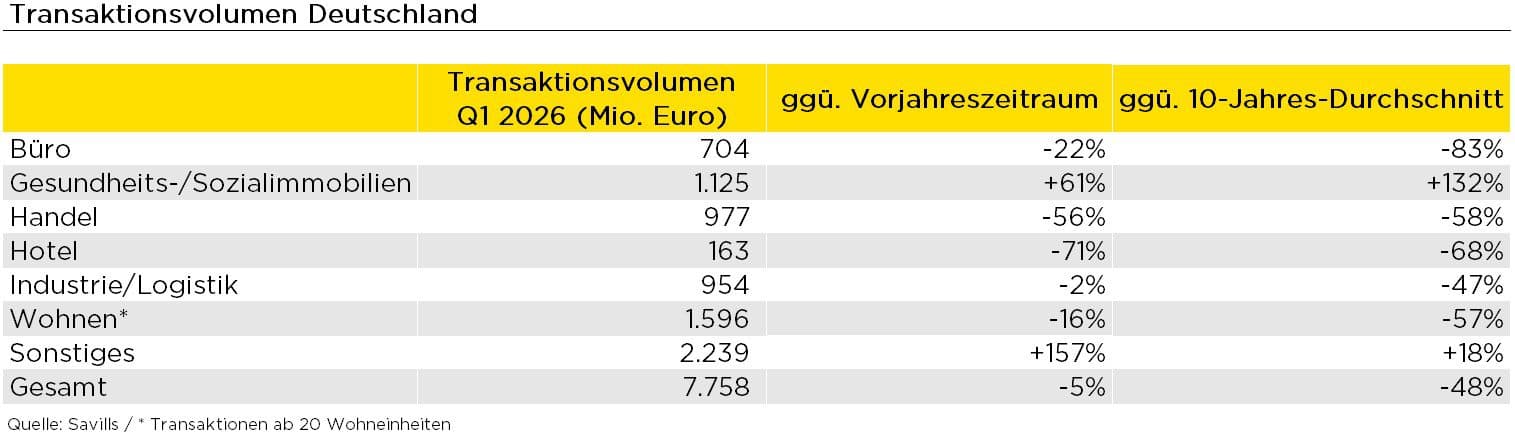



In an environment that continues to be characterised by high uncertainty and volatility, activity on the German investment market for commercial and residential real estate* remained subdued at the beginning of 2026. In the 1st quarter, properties worth approx. 7.8 billion euros changed hands. Compared to the same quarter of the previous year, this corresponds to a decrease of 5%. This volume is spread over around 270 transactions, the number of which was slightly higher than in the same quarter of the previous year. Karsten Nemecek, Deputy CEO Germany and responsible for Capital Markets, comments on the market as follows: "The long list of crises of recent years, in which the Iran war and its economic upheavals are now being added, are putting the real estate investment market under considerable stress. In the short term, the conflict could slow down the transaction dynamic, because some investors will probably wait for further developments. At the same time, the renewed rise in interest rates and the weaker economic outlook are increasing the pressure to act for those owners who had hoped for more favourable sales conditions. In the medium term, the recent crisis could therefore cause the number of sales to rise considerably."
Prime yields still stable, but with upward pressure
In the wake of the Iran war, long-term interest rates and bond yields have risen significantly and have reached long-term highs. If this level becomes entrenched, it is also likely to be reflected in real estate prices. According to Savills experts, prime yields remained unchanged in the 1st quarter for all but one use: the prime yield for logistics properties rose by 10 basis points to 4.5%.
Non-profit-driven purchases are on the rise
"The environment for the real estate asset class remains difficult. This is also reflected in the buyer structure: many purchases are not profit-driven, but are made by the public sector or owner-occupiers. At the same time, the proportion of private investors remains high," says Matthias Pink, Head of Research Germany at Savills. An example of this is the largest single property sale in the 1st quarter: The construction and real estate company of the state of North Rhine-Westphalia acquired the new building of the state tax administration in Kaarst from Landmarken AG for a mid-three-digit million amount. Overall, 14% of the purchase volume was accounted for by the public sector. In addition, 8% are attributable to 'other non-real estate companies', most of which are owner-occupiers. "Around one in five real estate purchases is currently not a capital investment," says Pink. Nevertheless, asset/investment managers remained the largest group of buyers, with a volume share of 33% in Q1. In addition to the public sector, project developers also achieved a double-digit share (11%).
Only healthcare/social properties and mixed-use properties with an increase in turnover
Due to the low transaction dynamics, sales of almost all types of use fell short of the previous year's volume and even more significantly below the 10-year average. Only two segments showed an increase: Firstly , healthcare and social real estate (+61% compared to Q1-25), where the completed acquisition of Cofinimmo by Aedifica accounts for around two-thirds of the total volume. Secondly, other real estate (+157%), which mainly includes mixed-use properties such as the aforementioned state tax administration in Kaarst and the "Deiker Höfe" in Düsseldorf.
Outlook: Short-term damper, then two scenarios conceivable
Nemecek outlines the outlook for the rest of the year as follows: "Until the outbreak of the Iran war, there were many indications of a moderate increase in transaction dynamics: supply increased, sellers' price expectations became closer to the market, and stable interest rates and a recovering economy ensured predictability. The first two factors still apply, but at least a question mark must be placed behind the last two. In this respect, some players may have to regroup. After that, the market can basically turn in two directions: Either the moderate recovery continues, then perhaps at a lower price level. Or banks and owners push more product into the market because of the higher pressure to sell and exploit it, thus creating new dynamism. The second scenario has become at least somewhat more likely in recent weeks." In its baseline scenario, Savills continues to expect a transaction volume for 2026 that is roughly the same as in the two previous years, i.e. around 35 billion euros.