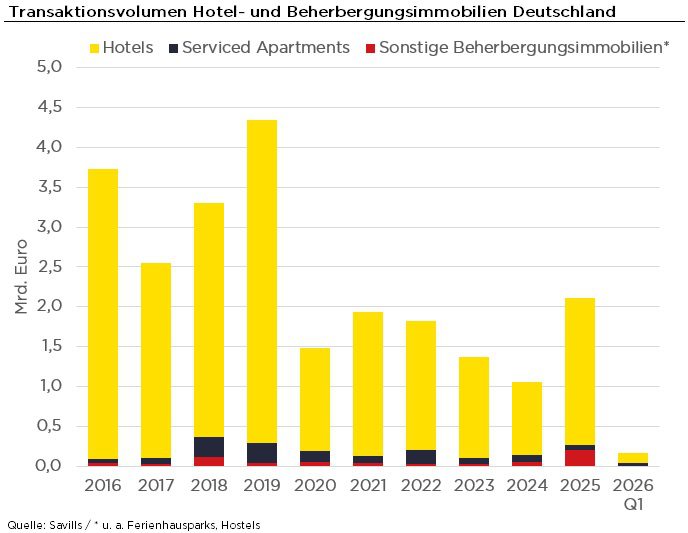
In the 1st quarter of 2026, the transaction volume with hotel and accommodation properties amounted to just under 163 million euros, according to Savills. The transaction volume was 61% below the quarterly average of the past five years. In addition to the sales of pure hotel and accommodation properties, some hotels also changed hands in the 1st quarter as part of mixed-use districts. These include hotels in the Deiker Höfe in Düsseldorf, the Lokhöfe in Rosenheim and the Postquadrat in Mannheim. However, Savills does not attribute these transactions to the hotel transaction volume, but to the mixed properties category.
The rolling transaction volume of the last twelve months was around EUR 1.7 billion at the end of March, which is about 24% higher than a year earlier. Sales of classic hotel properties dominated the market activity in the last twelve months. They generated sales of a good 1.4 billion euros, or 83% of the total volume. Serviced apartments had a volume of 94 million euros, while other accommodation properties came to around 198 million euros. In Q1 2026, around 80% of the transaction volume was attributable to hotels, 18% to serviced apartments and 2% to other accommodation properties.
Tina Haller, Director Capital Markets and Head of Hotels Germany at Savills in Germany, comments on the market as follows: “An increasing number of hotel operator insolvencies, including those of partners who believe strongly, has led to a renewed reflection of the hotel real estate market among investors, owners and operators. Contract structures and the associated distribution of risk between the parties are being put to the test, and uncertainty among investors regarding operator quality and creditworthiness as well as rent levels has increased.”
Rising operating costs, especially for energy and personnel, are increasing the pressure on operators and contributing to the increased uncertainty in the hotel market. According to Savills, however, the current insolvencies also open up the opportunity to rethink strategic partnerships.
This creates new opportunities for investors to participate in the further development of the operator landscape through creative partnerships. Haller comments: “Despite the challenges on the operator side, Germany remains a market with high investor interest. Fundamentals remain compelling, not least due to historically low supply growth in the coming months. While value-add capital dominated the market last year, which was primarily aimed at operator-free hotel properties with the aim of repositioning and operational optimization, we are now seeing stronger interest from core investors again, including from German institutions.”
According to Savills, operators with efficient and flexible concepts as well as a high affinity for technology and digitization are particularly in demand. The growing use of value-add capital in operator platforms is likely to strengthen the confidence of investors and financiers and further underpin the attractiveness of the hotel market in Germany. At the same time, the increased flexibility of brand concepts enables broader use: hotels are increasingly being considered as an alternative to existing office or retail properties as well as part of mixed-use properties. Overall, Savills expects a transaction volume this year at the previous year’s level.