According to a recent study by Savills, investors are becoming increasingly sector-agnostic and focusing more on the quality of properties in order to generate solid returns on their investments. INREV’s latest Q4 2025 investor sentiment survey shows that investors prefer southern European markets the most, with sentiment towards Germany improving significantly in recent months. In addition, there is less discussion about office presence and the obsolescence of office space than 12 to 24 months ago, and investors are more willing to buy again.
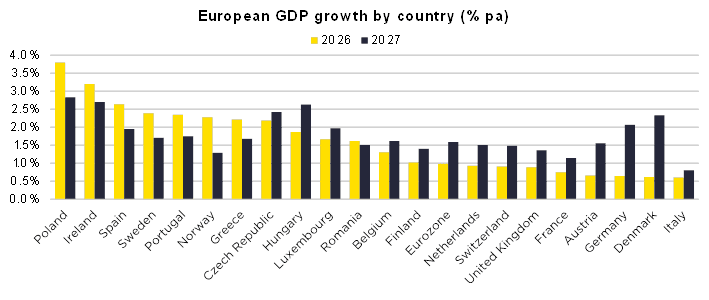
This is closely related to the latest forecasts for GDP growth in Europe. Oxford Economics expects GDP growth in the eurozone to reach 1.0% in 2026 and 1.6% in 2027. Across Europe, the economies of Central and Eastern Europe and Southern Europe are expected to record the strongest GDP growth in 2026, driven by stronger domestic demand and investment. The economic outlook for Western Europe is expected to improve significantly next year. For example, GDP growth of over 2% is expected for Germany in 2027.
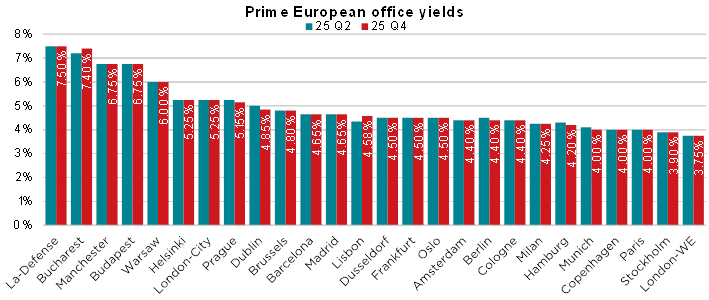
In Q4 2025, average initial yields for prime office properties in Europe remained stable at 4.9%. Munich (-10 basis points), Hamburg (-10 basis points) and Prague (-10 basis points) recorded declines, while the yield in Bucharest rose by 20 basis points.
Mike Barnes, Director European Commercial Research at Savills, says: “Tenants are becoming more loyal and opting for lease renewals due to a lack of well-located office space in prime locations and the cost of fit-outs has risen by an average of 67% over the last five years. Landlords can therefore achieve rent increases on lease renewals, leading to real rental growth and attracting more buyers for prime properties. In view of the low level of construction activity, we expect average prime rents to increase by 3.7% in 2026.”
James Burke, Director Global Cross Border Investment at Savills, adds: “Investor sentiment is changing. For example, we are already seeing a significant increase in interest in Germany, supported by expectations of an economic recovery in 2026. More attractive borrowing costs are attracting a wider circle of investors and we expect to see a further recovery in investment volumes in Europe this year.”
“The growing interest of international investors in the German market is being met with a growing willingness to sell on the part of domestic portfolio holders. This constellation has recently led to a stabilization, but not to a noticeable revival of the transaction figures. For more momentum, the price expectations of the parties must converge further. The fact that many owners have to reach their book values that are not in line with the market in the event of a sale, while investors hope for price reductions, continues to contribute significantly to the low liquidity in the office investment market,” says Karsten Nemecek, Deputy CEO Germany and responsible for Capital Markets at Savills.