

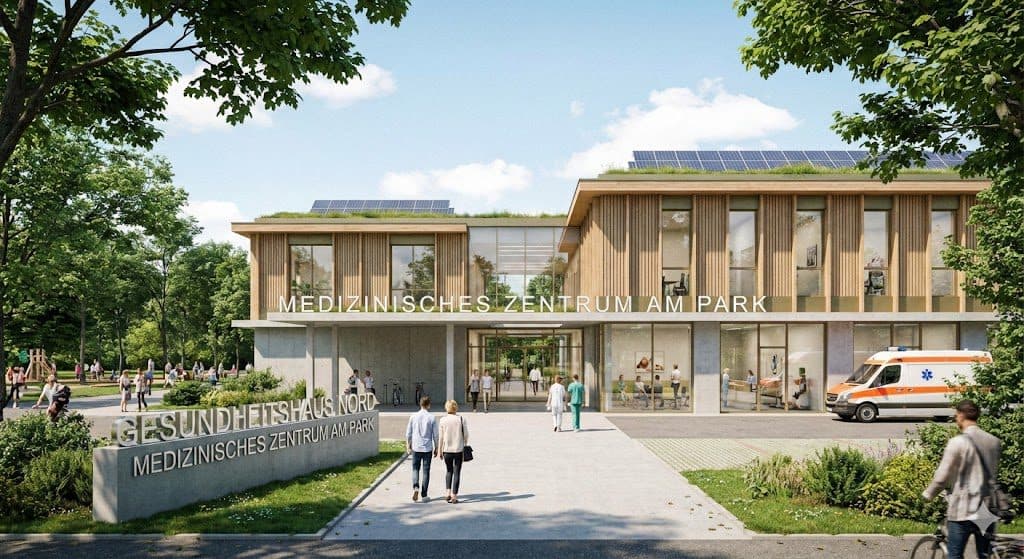
The international real estate consultant Savills reports that the demand from investors for European medical centers and medical care centers – referred to as medical office buildings (MOBs) in the English-speaking world – continues to exceed the supply of investment-eligible properties. This trend is driven by structural changes in healthcare as well as a growing interest in modern, purpose-built real estate for medical care.
While medical centers in the U.S. are already an established, liquid and institutionally recognized asset class, the market in Europe is still at a much earlier stage of maturity. Market development varies greatly from country to country: Germany is leading the way in terms of inventory and market activity, and the Netherlands is gaining momentum. In contrast, in France and the United Kingdom, the supply is limited by the structures of the national health systems, which inhibits the growth of a market for medical centres.
After record investment volumes of almost one billion euros in Germany and the Netherlands in 2021, activity declined in 2023 and 2024. Rising interest rates, economic uncertainties and the limited supply of portfolios prevented the sector from maintaining a sustainable, continuous volume of transactions on an annualised basis.
The market is driven by a growing demand for healthcare services. For example, health expenditure in EU countries has been steadily increasing: annual growth in expenditure has increased from 3.4% in 2015-2019 to 6% between 2019 and 2022. In combination with long-term demographic pressure and the change from inpatient hospital care to outpatient care close to home, this is leading to an increasing demand for space for practices and medical services in modern medical centres. Germany and the Netherlands are at the forefront of this transition to greater outpatient care with reforms such as outpatient care as a central element of hospital reform and the Integraal Zorgakkoord. Savills points out that similar policy developments in France and the UK could create additional opportunities for investors.
Given the lack of large-scale portfolios, Savills expects rental prices to continue to rise, as well as yields to stabilize once market conditions normalize. Early market participants are well positioned to benefit from yield compression and the long-term defensive characteristics of this asset class in the future.
Tom Atherton, Strategy & Market Intelligence Manager at Savills, explains:
"The combination of an ageing population, increasing chronic conditions and
policy-driven decentralisation of healthcare will continue to drive long-term demand for ambulatory healthcare facilities. Medical hospitals will benefit directly from this, as they offer investors stable, countercyclical revenue streams linked to essential services. As the transaction history increases, the standardisation of rental structures and the maturation of the operator landscape, medical centres will develop into an institutional asset class with defensive characteristics that is comparable to primary care or hospital properties in the coming decade."
Caryn Donahue, Head of Healthcare & Senior Housing at Savills, adds: "The US shows what a mature and liquid market for healthcare providers looks like, with extensive multi-asset portfolios and strong institutional interest. Europe is still at an earlier stage of development, but the fundamentals are equally compelling. As portfolios grow, we expect U.S. capital to increasingly view Europe as an attractive market for investing in this sector."
Commenting on the situation in Germany, Max Eiting, Director and Head of Healthcare Operational Capital Markets at Savills in
Germany, said: "We have been noticing a growing interest from investors in medical centres and medical
care centres for some time now. Germany has the largest and most established market for this type of real estate in Europe and its importance is likely to increase further in the course of the hospital reform. Accordingly, the German market for medical centers is strongly in the focus of domestic and foreign investors who want to invest in this sector. The heterogeneous and fragmented ownership structure has so far been an obstacle to even higher transaction volumes, but we expect the sector to continue to be institutionalised and thus to grow the market in the long term."
* Medical Office Buildings (MOBs) – in the USA sometimes also as outpatient medical buildings
facilities – are usually purpose-built commercial properties that provide a
Host a variety of medical services that do not require an inpatient stay
and are used by one or more tenants. These include medical practices
(general practitioners and specialists), pharmacies, diagnostic centres, dental practices, physiotherapy facilities and therapy centres. In Germany, we speak of medical centers and medical care centers