Nursing apartments are considered a possible answer to demographic change and a potentially stable capital investment. However, a recent representative survey* of 1,000 potential investors** shows that the target group is still largely aware of this form of investment and is subject to considerable information deficits. The survey was conducted by the market and opinion research institute Civey on behalf of Pecuria, a specialist in the individual sales of sustainable care apartments.
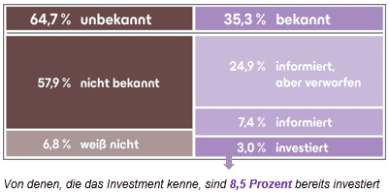
57.9 percent of those surveyed state that they are not aware of the possibility of purchasing individual nursing apartments as an investment. A further 6.8 percent are unsure about their level of knowledge. This means that around 35 percent of potential investors are aware of the investment opportunity. And a total of 10.4 percent say they know the investment option – and either do not rule it out or are even already invested. Accordingly, 8.5 percent of those who know the investment are even already invested. In combination with the large proportion of investors who are not yet aware of the investment, this results in significant market potential.
When asked about arguments that speak in favor of an investment from their point of view, 36.1 percent cite the increasing demographic need for care as the most important factor. 16.1 percent see stable and predictable income as an advantage, 15.7 percent point to tax advantages. 12.9 percent emphasize that the state steps in in the event of insolvency of the residents, while 10.7 percent cite a low risk as an argument. High return opportunities (5.5 percent) and the return leverage through debt capital (2.9 percent), on the other hand, play a subordinate role or are not known to the respondents due to a lack of knowledge about the asset class. However, it is striking that 49.8 percent of those surveyed cannot name any concrete advantages and answer with ‘don’t know’ or ‘nothing’.
“The biggest challenge for the sale of nursing homes to private investors is their ignorance of the market. Because if you think you can’t assess the advantages and disadvantages of an investment well, you are right to hesitate when making your investment decision. Education and transparency, for example in the form of credible and neutral certifications, are therefore extremely important foundations for sales success,” says Edwin Thiemann, Managing Director of Pecuria.
“The return opportunities are completely underestimated in the ‘nursing apartments’ investment option, not least against the background of leveraging the investment through borrowed capital. Despite the current caution of many banks, very high debt financing ratios of up to 100 percent are also possible at present. As a result, returns on equity of ten percent and more are achievable,” explains Pascal Kleine, Managing Director of Pecuria.
Uncertainty and information gaps also dominate among the possible counterarguments. 36.2 percent see the risk of an unreliable operator as a major obstacle. 34.9 percent state that they have too little knowledge of the investment model. 26.3 percent fear conflicts in the owners’ association, 17.6 percent a difficult resale of the property. A fundamentally low demand for nursing places, on the other hand, hardly plays a role: Only 0.6 percent cite low general demand, 1.4 percent low local demand as a risk. At the same time, 34.6 percent also answer ‘don’t know’ or ‘nothing’.
“It is true that the demand for inpatient care is high. Nevertheless, investors should be careful. This is because there may well be insufficient demand locally – for example, if there are already various modern nursing homes locally. The assessment of the respondents is correct that the investment success depends largely on the operator of the nursing home. However, its quality and professionalism can be comprehensively checked in advance and proven by appropriate neutral analyses,” explains Kleine. “Experience shows that the other risks mentioned – conflicts in the owners’ association and difficulties in reselling the property – are significantly overestimated. Because problems among the owners hardly ever occur. The resale of apartments has taken place without any problems in recent years.”
* The survey period was between 19 December 2025 and 31 January 2026; the statistical error in the overall result is around ±5.6 percent.
** 1,000 people in Germany were surveyed a) aged 30 to 55 who live with a partner in the same household and have a net household income of at least 5,000 euros, b) aged 30 to 55 who have a net household income of at least 3,000 euros as a single person, or c) pensioners up to 70 years of age with potential investment assets of 25,000 to 50,000 euros.