
Why Data Centers Are Becoming Perhaps the Most Exciting Infrastructure of the Digital Economy
Anyone who talks about real estate markets is almost exclusively talking about the office crisis, housing construction and logistics.
However, the focus on this and on the question of how the investment market will bounce back should not obscure the view of another exciting asset class. They are still little talked about in relation to their importance for our everyday lives. It is currently experiencing one of the most dynamic developments in the entire real asset universe.
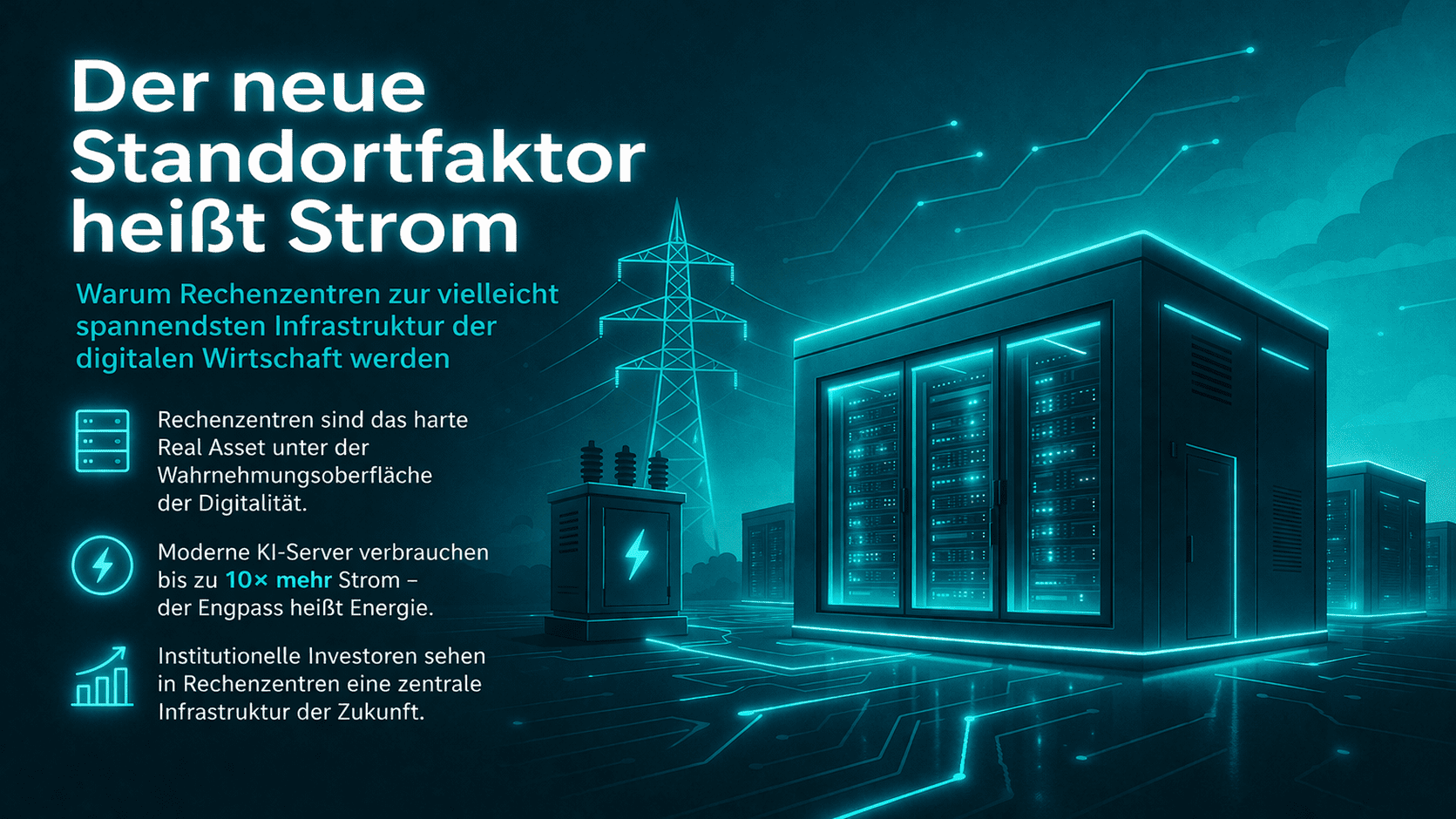
We are talking about data centers. They are the hard real asset under the perceptual surface of digitality. In this way, you shape our everyday life together below our direct perception. Because just as electricity doesn’t just come out of the socket, Insta or LI don’t just come out of a cloud.
For a long time, data centers, with a somewhat cooler connotation than data centers, were considered a special technical segment of the real estate industry. They were left to specialists, just as telecommunications infrastructure or fiber-optic networks used to be. Today, however, data centers are at the interface of digitalization, energy infrastructure and the capital market. And that’s exactly why it’s worth taking a closer look at the complexity behind it.
Digitization needs buildings
To this day, the term “cloud” suggests something weightless – as if data existed somewhere in digital nothingness.
In fact, behind every digital application there is something very physical: buildings, power connections, cooling systems and fiber optic lines.
With the rise of large AI models, this physical infrastructure is becoming much more sophisticated. Modern AI servers can consume up to ten times as much power as classic server architectures. This also increases the demands on the buildings in which these systems are operated. Data centers are thus increasingly developing into energy-intensive infrastructure projects.
The bottleneck is electricity
Interestingly, the biggest problem for many projects is no longer exclusively securing land. The bottleneck has a new name: electricity.
In several European markets, developers report projects that are delayed solely due to a lack of grid capacity . Grid connections are becoming scarce, permits are taking longer and energy suppliers have to set priorities.
This fundamentally changes the location logic of this asset class. In the case of classic asset classes such as offices, for example, transport connections, proximity to the airport or conurbation determine the attractiveness of a location. In the case of data centers, the decisive question is increasingly: Where is there still enough network capacity?
Together with London, Amsterdam, Paris and Dublin, Frankfurt forms the centre of the European data centre landscape around the DE-CIX Internet exchange – the so-called FLAPD cluster. But even these established markets are increasingly reaching infrastructural limits. Here, too, the limiting factor is increasingly not the building, but access to energy.
This is not the only reason why the expansion of data centers now also has a geopolitical dimension. North America is currently building significantly more capacity than Europe. At the same time, the market in Asia continues to grow dynamically. Who is actually building the infrastructure on which the digital economy of the future will run – also here in Europe?
Institutional investors are increasingly interested in the topic
Perception is also changing on the capital market. Institutional investors are sharpening their focus and increasingly viewing data centers as an infrastructure class in their own right. The combination of structural demand growth, long-term leases with major cloud providers, and limited supply can provide investment opportunities.
Rents are therefore expected to continue to rise in several European markets. In a way, this is reminiscent of the development of logistics real estate ten or fifteen years ago – only with one crucial difference: the central production factor is not transport infrastructure, but energy.
📌 Result:
- Data centers have long been more than just a technical niche segment of the real estate industry.
- They combine technology, energy and the capital market – and are thus developing into a central infrastructure of the digital economy.
- This makes them the powerhouses of the digital economy.