


Rising public debt, higher borrowing costs and dwindling confidence in the sustainability of public finances: is Europe facing a new debt crisis?
📊 Europe’s public finances are drifting apart
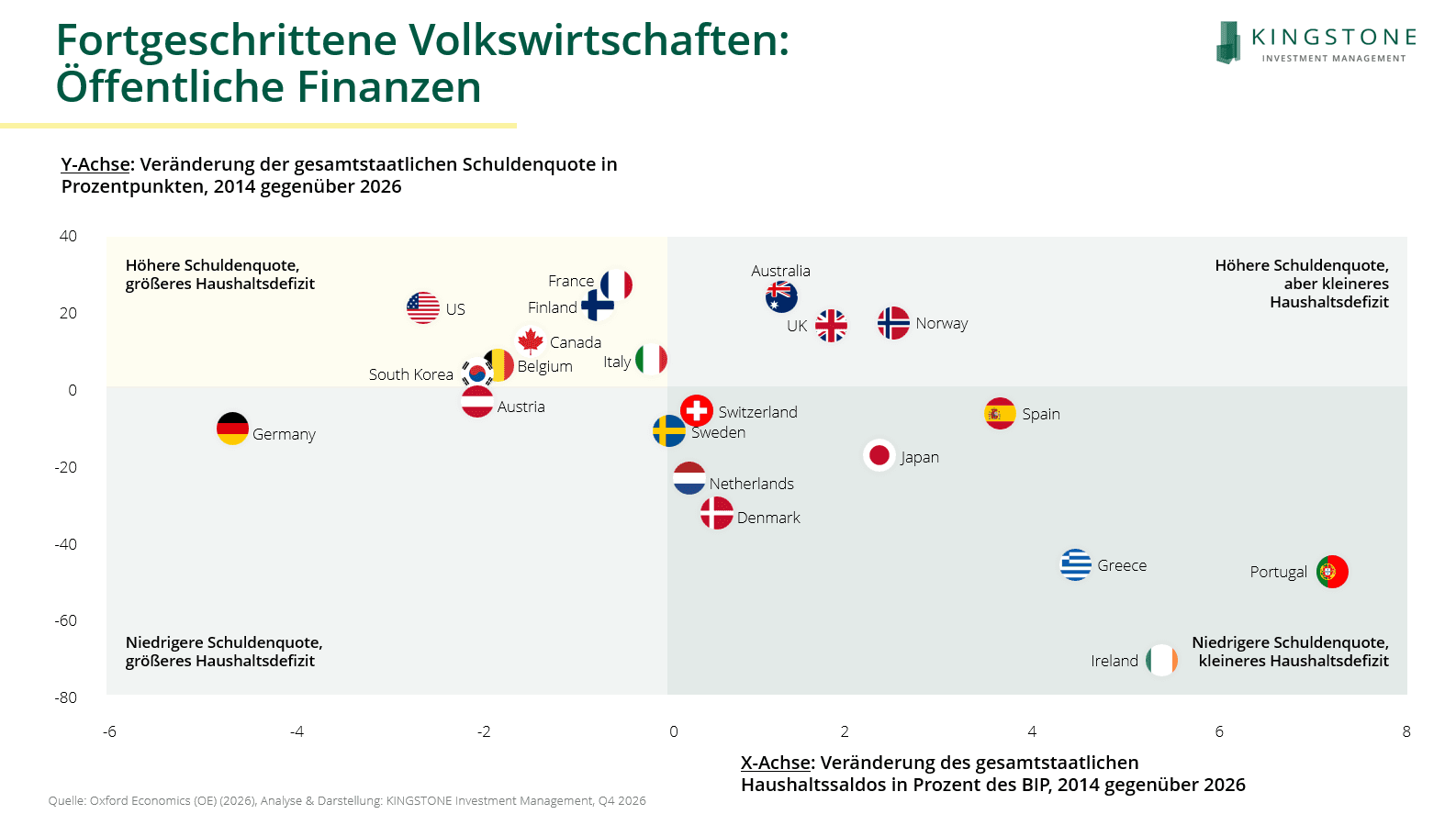
Our chart shows the trend in debt-to-GDP ratios and budget balances between 2014 and 2026. Whilst France, Italy and Belgium are showing higher debt-to-GDP ratios and larger deficits, Greece, Portugal and Ireland have significantly improved their public finances. Germany managed to reduce its debt-to-GDP ratio despite a worsening budget balance. This was made possible primarily by growth in nominal GDP. Fiscal leeway remains comparatively large – but it is not unlimited.
🇫🇷 Euro crisis 2.0: France instead of Greece?
ifo President Clemens Fuest believes a new euro crisis is possible – this time with France at the centre. Public debt of just under 120 per cent, a deficit of over 5 per cent and rising risk premiums are compounded by political instability. Substantial fiscal consolidation seems hardly realistic ahead of the 2027 presidential election. The real risk is a progressive loss of confidence in the bond markets.
🏦 ECB: Price stability or financial stability?
The French bond markets are still functioning. Intervention is therefore unlikely in the short term. The Transmission Protection Instrument (TPI) is of limited use in tackling fundamental fiscal problems. In the event of a systemic crisis, however, the ECB is likely to intervene – possibly through renewed bond-buying programmes (QE). Christine Lagarde’s announced departure does little to alter the fundamental conflict of objectives: stabilising public finances without further fuelling inflation.
⚖️ What does this mean for investors?
A ‘Euro Crisis 2.0’ does not necessarily mean skyrocketing long-term interest rates. Monetary policy interventions could limit the rise in yields – though possibly at the expense of price stability. The risk thus shifts from rising nominal interest rates to persistent inflation and low real yields. Inflation-protected real assets with resilient long-term cash flows could consequently come back into sharper focus for institutional investors.
It is not just the nominal return that matters, but what remains after inflation.
#KingstoneSpotlight #Eurocrisis #France #PublicDebt #ECB #Inflation #RealAssets #Property #Infrastructure