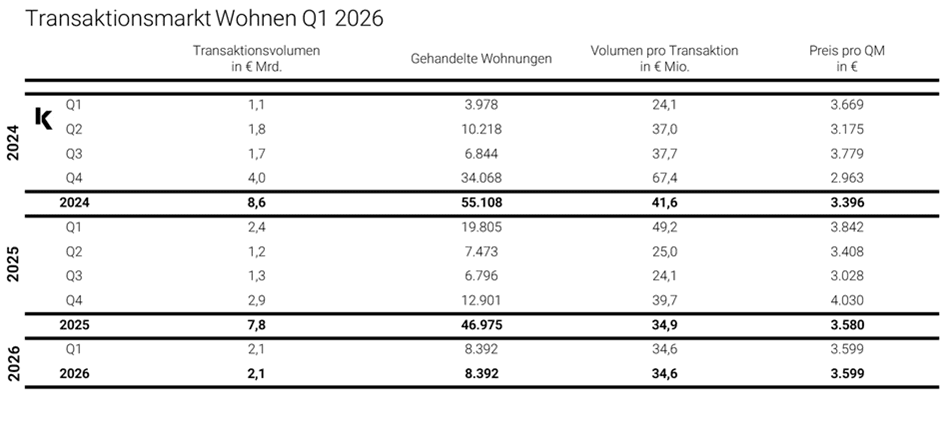
In the first quarter of 2026, around 8,400 apartments in apartment buildings and portfolios were traded in Germany, which corresponds to about a third of the previous year’s volume. At 2.1 billion euros, the transaction volume was about twelve percent below the volume of the first quarter of 2025. This is the result of Lübke Kelber’s analysis of the transaction activity for residential real estate.
The transaction market was very core-heavy in the first quarter. Lübke Kelber attributes about 75 percent of the transaction volume to core and core+ transactions – including a relatively large number of forward deals. “In the first quarter, we also saw a ‘flight to safety’ mentality in the residential real estate sector – especially from institutional investors. At the same time, however, demand for value-add investments remains high – especially from international capital – the only thing missing here were the deals,” says Mark Holz, Head of Strategy and Research, commenting on market developments.
In particular, the major transactions with a volume of more than EUR 100 million were in the core segment and found institutional buyers such as Quantum, HIH and Columbia Threadneedle as well as public sector buyers such as Bayernheim. At the same time, there was a revival on the forward deals, the volume of which totaled more than 600 million euros.
The share of volume generated in A-cities was also very pronounced at 76 percent. Investment demand was particularly high in Hamburg and Berlin, with a total turnover of one billion euros.
Some large portfolios that went on the market at the end of last year, such as 5,500 residential units from DWS or 4,400 residential units from BASF, have not yet been concluded. These are two examples of the current pipeline that indicate the potential and increasing transaction momentum in the current year.
Market fundamentals remain strong – interest rates carry risk
The German housing market will continue to be dominated by the pronounced supply-demand imbalance in 2026. Vacancies are low in many cities and the vast majority of these markets continue to record a decline in vacancy rates. Due to the low project development pipeline, this will continue in the medium term and will lead to rising rents across the board. The large metropolises could see less momentum in rental development this year – rents here are already extremely high. It is more likely that the affordable and at the same time attractive cities in the second and third tiers will experience a more dynamic population development and a more dynamic rent development.
So while the rental market side continues to be positive for investors and portfolio holders, the recent development on the bond and financing markets once again poses a challenge. After the attack on Iran by Israel and the US, oil and gas prices initially rose rapidly, and subsequently bond yields and financing costs. For example, the German 10-year government bond remained above three percent at the end of March and swap rates were also at a two-year high of 3.1 percent at the end of March.
The volatility of the interest rate markets is also likely to cause increasing uncertainty for real estate transactions – at least in the short term. “Nevertheless, we expect investment momentum to pick up in 2026 due to the strong fundamentals in the rental market and demand for housing to continue to rise,” says Marc Sahling, CEO at Lübke Kelber, commenting on market developments.
Methodology
The analysis of the transaction volume includes all residential properties that have at least 20 residential units and in which commercial uses play only a subordinate role. In addition, minority shareholdings as well as pure M&A transactions or entity deals are not taken into account. Special forms of housing, such as student housing or retirement homes, are also not taken into account in the consideration. The A, B and C market typification follows the Lübke Kelber definition.