
INDUSTRIA, the real estate asset manager from Frankfurt, has conducted its survey of institutional investors on future real estate allocation and published it today under the name Wohninvestment Trends 2026 .
The key results: 50 percent of those surveyed want to keep their real estate quota constant over the next twelve months. On the other hand, around 31 percent want to reduce the rate slightly – by less than one percentage point – and another 5.6 percent by more than one percentage point. The rate is expected to grow slightly or strongly at around 14 percent.
Thomas Wirtz FRICS, Managing Director of INDUSTRIA Immobilien, comments: “Many institutional investors have full real estate quotas and are currently investing in real estate only very selectively. The survey confirms what we perceive in practice.”
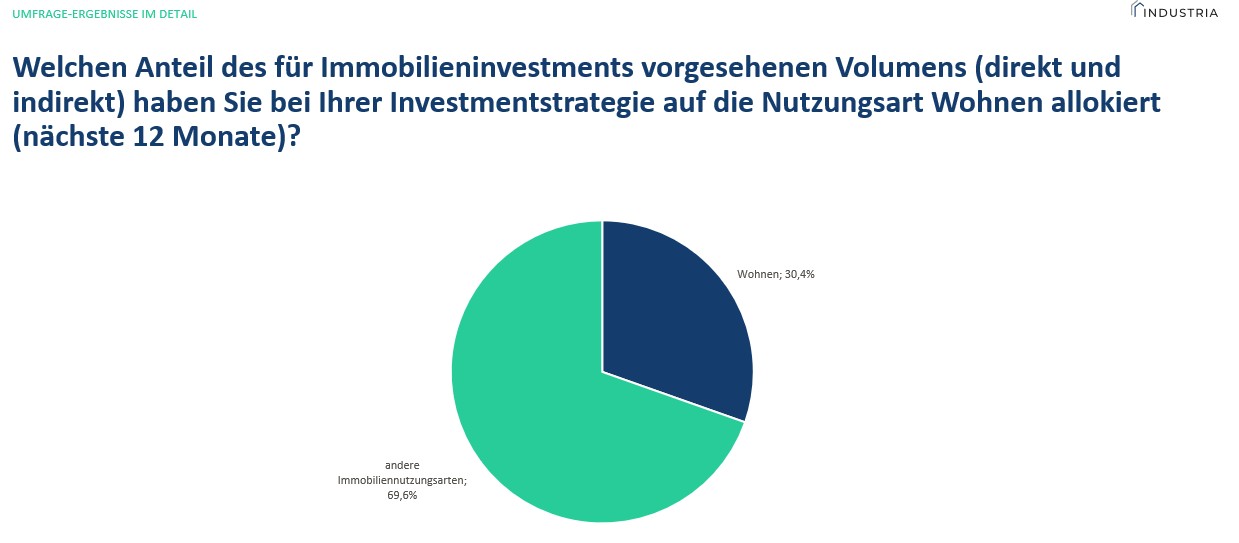
Of the capital to be invested in real estate in the next twelve months, around one third (30.4 percent) is to flow into residential real estate, the rest into commercial uses.
It is interesting to note that investors’ core inclination has increased once again. “This year, 91.3 percent said they wanted to invest in core real estate in the next twelve months. A year ago, it was still 72.1 percent,” Wirtz explains.
At the same time, the requirements for the distribution yield have decreased. For residential real estate nationally, they put more than 53 percent at 3.5 to 4.0 percent p.a. In the category of international residential real estate, more than 55 percent indicated the range of 4.0 to 4.5 percent. Both figures are once again slightly above the values of the previous year (52.2 percent and 52.9 percent).
Residential properties built in modular construction are open to investors, but slightly less than a year ago. This time, 35.3 percent (2025: 44.7 percent) said they would invest in such properties. 61.8 percent (2025: 44.7 percent) observe and wait, while 2.9 percent (2025: 10.5 percent) exclude such residential properties. 64.7 percent (2025: 56.1 percent) said they expected higher yields for residential properties in modular construction.
Another interesting result of the survey: “Investors’ propensity towards Germany has continued to rise. While in 2025 64.2 percent said they wanted to invest in German residential real estate in the next twelve months, in 2026 it was 74.2 percent. In contrast, the share of the rest of Europe fell from 28.8 percent to 20.8 percent. The other markets – the USA and Canada as well as Asia-Pacific – play only a very subordinate role.
INDUSTRIA Immobilien also asked the investors about their strategy. The preference is clearly for a combination of existing and new-build properties, which is stated by 42.4 percent of investors. On the other hand, there is little demand (9.1 percent) for existing properties with development potential.
Residential Investment Trends 2026 – About the Method
The Residential Investment Trends are an annual survey conducted by INDUSTRIA among its existing institutional investors and other investors. The current survey was conducted between March 3 and April 21, 2026. A total of 372 institutional investors were contacted, 36 of whom answered the questionnaire. Some of the investors contacted are existing investors in INDUSTRIA Immobilien’s special funds. This can skew the results, as this group is closer to indirect residential investments. The investors are distributed among the following types as follows: bank/savings bank (25.0 percent), pension fund (19.4 percent), occupational pension fund (19.4 percent), other pension funds (2.8 percent), foundations (5.6 percent), insurance companies (19.4 percent), fund-of-funds/funds of funds (5.6 percent) and corporates (2.8 percent). On average, the assets under management of the 36 investors across all asset classes amounted to EUR 4.7 billion, with a median of EUR 1.1 billion.