Banks’ new lending business increases significantly year-on-year
Sentiment on the real estate financing market has deteriorated again at the beginning of the current year after an interim high in the second half of 2025.
The German Real Estate Financing Index (Difi)* has lost almost ten points compared to the fourth quarter of 2025 and has slipped back into the red at minus 9.1 points. Both the current financing situation and the outlook for the coming months
are assessed more negatively by the experts surveyed.
The Difi is collected and published by JLL and the Hamburg Institute of International Economics (HWWI) and reflects the assessments of financing experts. The situation on the credit market in the past six months and the expected development in the next six months are assessed on a quarterly basis. The difi is calculated as an unweighted average of the balances of the two sub-indicators financing situation and financing expectation of all types of use.
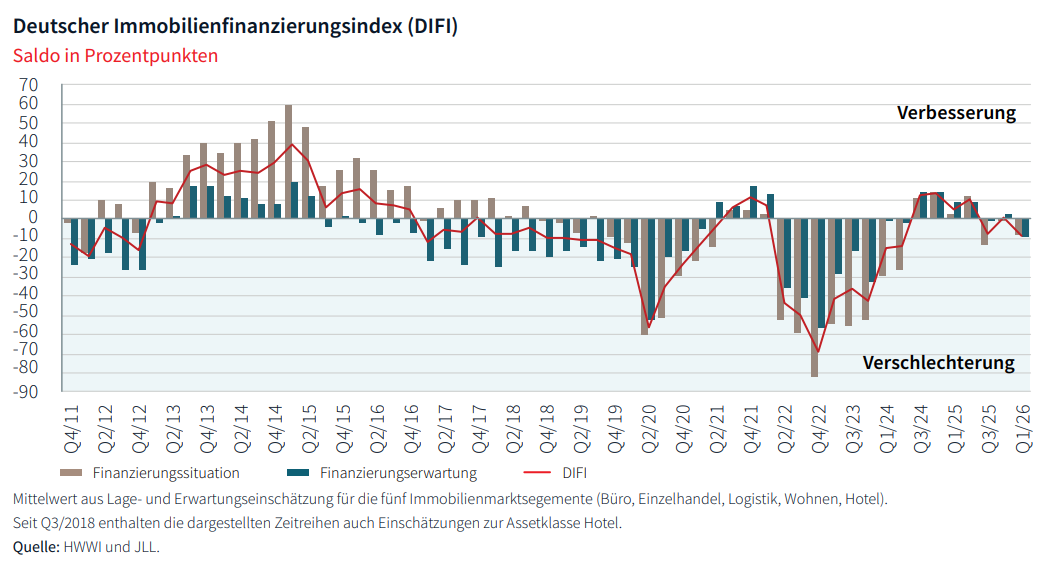
It is striking that the two sub-indicators are quite close to each other at minus 8.2 points (situation) and minus 9.9 points (expectations). This indicates that respondents expect restrictive financing conditions to continue over the next six months. According to Andreas Lagemann, Senior Researcher at the HWWI, it can be assumed that the view into the future will be even weaker. “The current survey was completed before the start of the Iran war at the end of February 2026. Due to the expected consequences of the war, the general interest rate level and thus in particular the swap rates for the financing of real estate have moved significantly upwards. This is likely to lead to a more critical assessment of the financing climate in the upcoming survey.”
Despite significant losses, residential remains the best-rated asset class
In the first quarter of 2026, four of the five segments under consideration show a fairly significant downward movement. The residential use type loses the most points with minus 20 points, but with an index value of 18 points, it remains the best-rated asset class and the only one with a positive sign. This is followed by hotels with minus 7.6 points, logistics with minus 11.6 points, retail with minus 16.1 points and office with minus 27.9 points. Only Logistics was able to gain a few points compared to the previous quarter.
The same picture emerges when looking separately at the assessment of the situation. Here, too, housing fell sharply (minus 33.5 points), but with twelve points it was the only segment to remain in the plus zone. Looking ahead to the next six months, the gap between residential (up 24 points) and the next-placed segments of hotel (down 10 points), logistics (down 13.6 points), retail (down 22.7 points) and office (down 27.3 points) is even more pronounced.
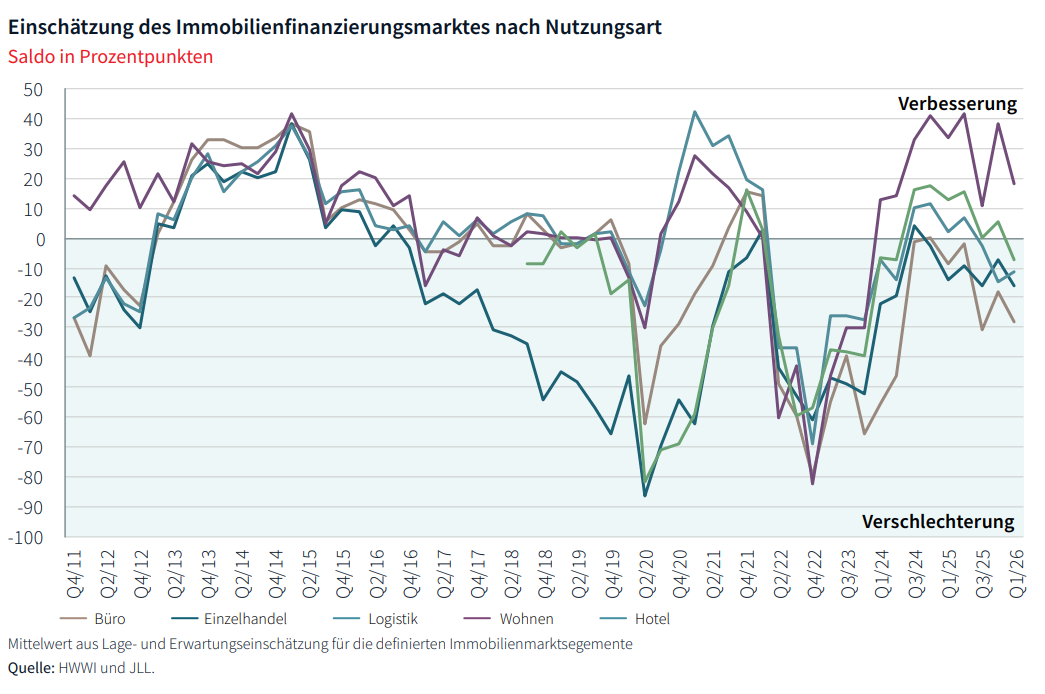
Only for residential and office are the expected values above the current assessment of the situation. In the residential segment, the delta is twelve points, while in office it is significantly lower at 1.3 points. “This leads to the conclusion that the experts for the residential type of use expect a noticeable easing of financing conditions in the next six months, despite the current gloom, while there is at least hope that a bottom will be formed for offices,” Helge Scheunemann, Head of Research at JLL Germany, interprets the survey results.
A contrasting picture can be seen in the retail, logistics and hotel sectors, where the situation indicators achieve higher values than the expectations indicators. This negative difference is particularly pronounced in the retail trade at 13.2 points. This indicates that the experts surveyed in this asset class suspect a significant deterioration in the already difficult current financing conditions in the near future.
Alternative financiers ensure a growing supply of credit
The current Difi survey took a separate look at the current financing offer and analysed the asset classes and lender groups on which the available debt capital is focused.
In general, 40 percent of those surveyed see a higher availability of debt capital in Germany compared to the previous year. In the opinion of 32 percent, this is lower, 28 percent see no change. “These values indicate a stabilization of the financing market, although almost a third of the experts continue to perceive liquidity bottlenecks,” says Scheunemann.
When looking at the various lenders, a clear shift towards players outside the banking sector becomes apparent. For example, almost 60 percent see an increase in the supply of loans from alternative providers such as debt funds. In contrast, less than a quarter see a decline. In the case of traditional providers such as savings banks, cooperative banks and Pfandbrief banks, the proportion of those who see an increase and those who perceive a decline in supply is roughly balanced. In contrast, the activity of insurance companies and pension funds is assessed much more cautiously. Here, only one in eight observes an expansive willingness to finance and one in two a reduced willingness to finance.
Among the various types of use, the residential segment is assessed most positively, in line with the Difi mood. Half of those surveyed see a higher availability of debt capital this year, while only one in five expects a decline. In the other asset classes, on the other hand, scepticism prevails, especially in the case of office properties. Here, half of the participants predict reduced liquidity. Logistics plays a special role, where the experts expect the financing situation to remain almost unchanged.
Berlin Hyp and DZ Hyp remain the most active real estate financiers
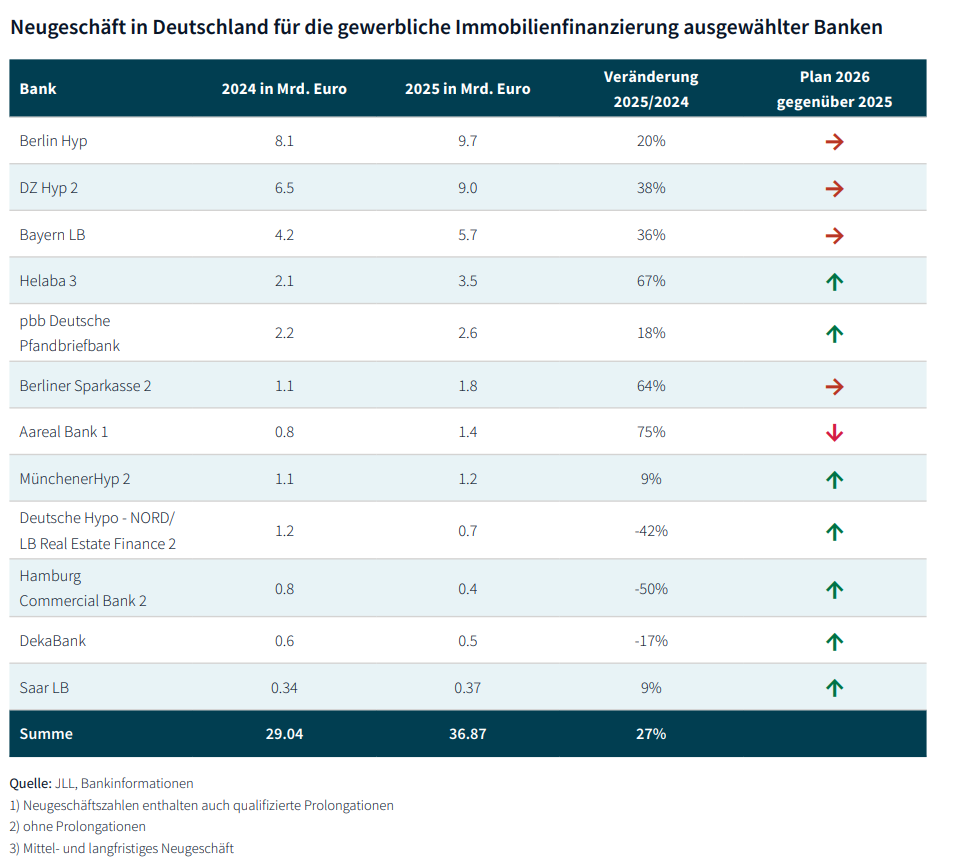
For the quantitative analysis of commercial real estate financing in Germany, JLL looks at the banks’ new business and the development of their loan portfolios every six months. The following are considered: Activities of twelve German banks. Only newly issued financing for German real estate is taken into account. Both commercial and residential properties that are used for capital investment are covered.
In total, these institutions granted new loans worth 36.9 billion euros in 2025, an increase of 27 percent compared to the previous year (29 billion euros). As in the previous year, the strongest lender was Berlin Hyp with a commitment volume of 9.7 billion euros (previous year: 8.1 billion euros). This is followed by DZ Hyp, which achieved the strongest growth in absolute terms with an increase from 6.5 billion euros to nine billion euros. A total of nine banks expanded their new business. Deutsche Hypo (down 42 percent to 0.7 billion euros), Hamburg Commercial Bank (down 50 percent to 0.4 billion euros) and DekaBank (down 17 percent to 0.5 billion euros) reported declines.
The positive trend is likely to continue this year. Only Aareal Bank expects lower new business in 2026 than in the previous year. Four banks expect a similar level and seven institutions expect growth.
The loan portfolios of the banks analyzed have shrunk by three percent to 283.6 billion euros within a year. With a portfolio of 55.1 billion euros, Berlin Hyp is the frontrunner, followed by DZ Hyp (42.8 billion euros). At both banks, the portfolio fell by a single-digit percentage, as did at Deutsche Hypo and Deutsche Pfandbriefbank. In contrast, the decline was more pronounced at DekaBank (minus ten percent), Münchener Hyp (minus eleven percent) and Hamburg Commercial Bank (minus 20 percent). Berliner Sparkasse and Saar LB kept their holdings constant.
Geopolitical uncertainties are slowing down expansion plans
“The German real estate financing market is fundamentally resilient in 2026 despite geopolitical challenges. The majority of financing institutions are sticking to positive growth expectations, even if individual expansion plans are stretched out or implemented more selectively,” says Dominik Rüger, Senior Director Debt Advisory JLL Germany.
The increased competition between traditional banks, alternative lenders, regional institutions and insurance companies is creating a differentiated range of services. “For high-quality properties in prime locations, this competition continues to lead to attractive financing conditions. Geopolitical and macroeconomic developments and their impact on the further course of interest rates ultimately remain the decisive factor for the intensity of the market recovery.”
*Note: 25 experts took part in the survey of the German Real Estate Financing Index from 3 February to 11 February 2026. The assessments of the market situation (past six months) and market expectations (next six months) were queried. The percentage shares of the response categories and the percentage point changes compared with the previous quarter (Δ previous quarter) are shown. The balances result from the difference between the positive and negative response categories (such as “improved” and “deteriorated”). The Difi is calculated as an unweighted average of the balances of the financing situation and the financing expectation of all types of use.