Active hotel asset management is becoming a decisive success factor in a volatile market environment
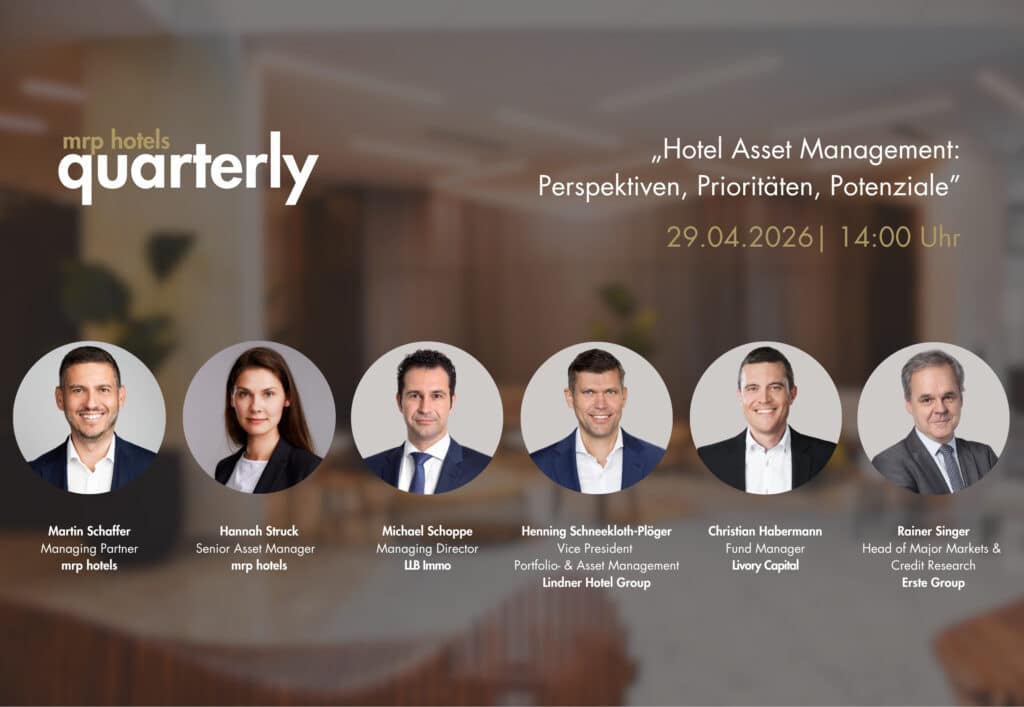
In the current market environment, active asset management is increasingly determining the success or failure of hotel properties – this is the central finding of the current “mrp hotels quarterly”. As part of the webinar, Martin Schaffer, Managing Partner at mrp hotels, and Hannah Struck, Senior Asset Manager & Consultant at mrp hotels, together with Rainer Singer, Head of Major Markets & Credit Research at Erste Group, Michael Schoppe, Managing Director at LLB Immo KAG, Henning Schneekloth-Plöger, Vice President Portfolio & Asset Management at Lindner Hotel Group, and Christian Habermann, Fund Manager at Livory Capital, will discuss the current challenges and strategic fields of action in the industry.
The focus was on the question of how hotel properties can be actively managed under changed market conditions – because it is no longer demand alone that determines performance, but the ability to manage costs, operations and strategy in a targeted manner.
“Today, it is no longer enough to look exclusively at the lease. Asset management means continuously analysing the performance and strategic orientation of a hotel, creating transparency about economic development and, if necessary, providing targeted impetus,” says Martin Schaffer.
Uncertain conditions increase the pressure to act
The economic environment remains challenging. Rising energy prices, geopolitical tensions and slowed consumer behaviour are shaping the market environment.
Rainer Singer describes the situation as follows: “We are operating in a very dynamic environment in which framework conditions change almost daily.” With regard to monetary policy, the development remains open. “The longer the crisis lasts, the more likely interest rate hikes become,” says Singer.
For asset managers, this means that strategies must be reviewed on an ongoing basis and, if necessary, adjusted at short notice.
Key figures show: Growth yes – but at the expense of margins
A look at the portfolio analyzed by mrp hotels (around 20 hotels in the DACH region) illustrates the current development: Demand is stable, but profitability is coming under increasing pressure.
In the first quarter of 2026, occupancy increased by 2.3 percent year-on-year, while the average room rate increased by only 1.0 percent. RevPAR (revenue per available room) grew by 3.4 percent – mainly driven by higher occupancy. “The focus was clearly on volume instead of rate. Guests have become much more price-sensitive,” explains Hannah Struck. At the same time, costs continue to rise. Although the GOPPAR (gross operating profit per available room, +3 percent) is developing positively, energy and personnel costs continue to weigh noticeably on margins.
Struck adds: “The issue of profitability remains central – the cost side in particular is coming back into focus in view of the current geopolitical situation and rising oil prices.”
Demand is shifting – flexibility is becoming crucial
The demand for hotel rooms across all segments is not collapsing, but it is changing significantly. Trips are planned at shorter notice, regional destinations are gaining in importance, while international connections are sometimes under pressure.
“We don’t see a classic decline in demand, but rather a volatility booster,” says Henning Schneekloth-Plöger. “For asset management, this means that markets, target groups and sales channels must be actively managed – and in significantly shorter cycles than before.”
Segment differences intensify
The development of the hotel industry is increasingly segment-dependent. “The budget segment is currently clearly working better than the classic four-star hotel industry,” says Michael Schoppe.
In a market environment characterized by cost and personnel pressure, budget and economy hotels as well as serviced apartments with lean service structures are the main beneficiaries. “The classic full-service hotel industry, on the other hand, is under much more pressure than it was a few years ago,” adds Schneekloth-Plöger.
Asset management becomes more operational and central
The demands on asset management are increasing significantly. In addition to strategic tasks, operational issues are coming more into focus. “Hotels that are willing to adapt their concepts and become more operationally flexible will come through the current environment much better,” says Struck.
At the same time, cooperation between owners and operators is becoming increasingly important. Transparency and regular exchange are becoming the decisive success factor, Schoppe knows. He emphasizes: “A structured and open dialogue between owner and operator is essential today.”
Investments necessary – implementation remains challenging
Despite clear fields of action, investments are often postponed, especially in the area of energy efficiency. Christian Habermann sees this as a structural problem: “Especially in the current market phase, we often see that economically sensible investments are not implemented because owners and operators pursue different interests. This makes it all the more important to think about measures together and to develop solutions based on partnership. Only if both sides pull together can the economic potential of an asset be leveraged in the long term.”
At the same time, the industry remains in a permanent mode of adaptation. “We have been in crisis mode for years – this forces us to be much more agile,” says Schneekloth-Plöger.
Conclusion: Asset management as an active value driver
“In an increasingly volatile market environment, active asset management is becoming the decisive value driver of hotel real estate. Rising costs, uncertain demand and structural shifts can no longer be passively cushioned. They require clear strategic decisions, operational interventions and a close interlocking of owner and operator interests. Today, asset management is the central lever for making hotels economically stable and fit for the future. It is not the market development alone that determines success, but the quality of the management,” concludes Martin Schaffer.